So is she really in pain or is she faking. After the car wreck, she complains of pain. Her doctor says she is hurt. The insurance company's doctor says, no, the wreck wasn't bad enough and she is only pretending to be hurt.
There are sometimes objective findings like muscle spasms or herniated discs or even broken bones, but a lot of the claim depends on whether or not the complaints of the patient are true.
Then there is the other side of the story. The employee who fell at home in the bathroom, but won't admit to being hurt for fear of losing the job. The athlete who denies an injury.
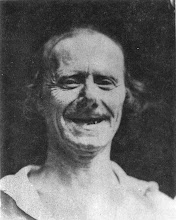
So, once we develop these face reading skills, can we tell who is in pain and who isn't? I think I can see pain in a client's face. (Yes, yes, Kathy, I know I think I can do anything, but I am really just full of......) I look at their eyes and if the muscle around the eyes are contracted (These as we will discover are the orbicularis oculi.) and there is extra moisture in the eyes, they are really in pain. Of course, I have no ideas whether this scientific approach produces false positives or false negatives, but I do think if I see it, a jury sees it also and will agree with me the person is hurt. For a long time, this is how I have picked the cases I want to try, regardless of what the medical records say.
My main sources on reading faces deal mainly with acute pain and so they describe a stronger reaction.
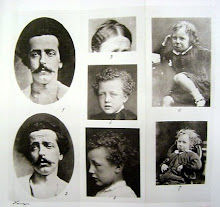
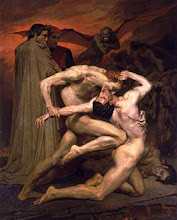
Darwin starts with animals and notes the writhing around "with frightful contortions" and "piercing cries or groans." Almost every muscle is brought into action and "with man the mouth may be closely compressed" or with lips retracted and teeth clenched or ground together. Like the "gnashing of teeth" in hell.
The eyes stare wildly, the brows are heavily contracted, perspiration bathes the body and drops trickle down the face, the nostrils are dilated and often quiver, and the breath is held until the blood stagnates in the purple face. Pain starts as stimulate and excites to action, but if severe, soon induces extreme depression or prostration. So says Darwin.
My face artist, Faigin, breaks the face down into parts.
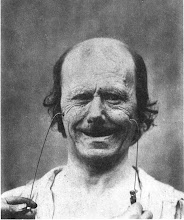
Eyebrows: The entire brow is lowered, especially the inner corner which is sharply downward. There is a roll of skin piles up above the eyebrows (The action of the corrugator muscle).
Eyes: The eyes are reduced to a single line by the compression of the orbicularis oculi. The stronger the action, the straighter the line Faigin draws to show the eye.
Mouth: Either opened in a clenched-teeth grimace or opened in a shout. The upper lip is stretched upward and outward. (Action of the risorius/platysma and levator labii superioris).
Signature Wrinkles: Crowsfeet with the lower lid folded, star-wrinkles from the inner eye, vertical lines between the brows and a joined crease from nose to chin.
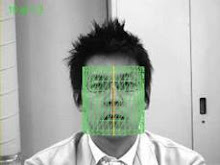
The face scientists with their FACS testing say the bulk of the information about pain conveyed by facial expr4ession is represented by 4 actions: brow lowering, orbit tightening, levator contraction and eye closure. (The levators are on the sides of the nose in three different branches under the eye orbits).
Facial expressions can be used to measure pain in infants and senile patients who cannot express themselves.
The scientists also find different face muscles involved with different types of pain: electric shock, cold, pressure and pain resulting from cutting off of the blood to a nerve.
The scientists took a bunch of back patients and then manipulated the leg to make them hurt so they could observe pain. They also told them to fake a facial display of pain. The patients could mask or hide pain and they could voluntarily make painful expressions that "tended not to differ qualitatively from the genuine display but was more vivid or intense."
Faked pain expressions were much like genuine pain, but they were more extreme and had the added factor of AU12, the lower lip pull, in which the lower lip corners are pulled back and upward. Genuine pain tended to blink more than faked pain. When trying to mask pain, the patients could disguise all of the symptoms except AU7, the tightening of the eyelids, narrowing the eye opening.
The hardest part to fake the pain or hide the pain is, then, in the eyes.
Showing posts with label pain. Show all posts
Showing posts with label pain. Show all posts
Wednesday, April 23, 2008


Subscribe to:
Posts (Atom)







_-_Dante_And_Virgil_In_Hell_(1850).jpg)