Showing posts with label Bierce. Show all posts

Monday, March 24, 2008

Kathy: "Keep it short. You just like to hear yourself talk. I seriously think you are your biggest fan."

I had an idea for a story once. I thought of it again yesterday when I pulled down Volume VII of the Collected Works of Ambrose Bierce to quote the Devil's Dictionary on the meaning of "politics." I ordered this set more than 30 years ago and it is one of the few things I have been able to hang onto as the book shelf space has shrunk with serial downsizing of houses.

I intended to read it beginning to the end, Volumes I through XII.

(Then the Regional Commander for the Holy Spirit Association for the Unification of World Christianity (the Moonies, followers of Sun Myung Moon) got beat up by the Chief of Police while begging for alms in the City of Aubrey, Texas. As is often the case when someone is beaten by a policeman, the Regional Commander was charged with assault on a police officer.

At the time I was considering whether to leave my nearly still-born career as a lawyer to spend the rest of my life shooting free-throws in the back yard. I had sued the sheriff over the jail conditions in Denton County. (This being during my second Babylonian Captivity). He started locking me in the jail for several hours when I tried to visit clients. Also, the sheriff controlled the bonds. This was a county that did not allow bondsmen, but only lawyer-bonds, and the sheriff wouldn't let me make any more bonds. My law practice, already at risk of being declared a hobby by the IRS, went from sparse to nothing.

The Regional Commander found me in the back yard and hired me. The District Attorney dismissed the case against him, we sued Aubrey for violating the Free Exercise Clause of the 1st Amendment, got a consent judgment declaring the Solicitation Ordinance in Aubrey unconstitutional, and the Regional Commander brought me two hundred files of other cities in Texas and Oklahoma he wanted to sue. I bought the first word processor in the county and was suddenly fully employed again.

So my free-throw shooting career came to an end and my plans for this book were put on hold. ) Yes, Uncle Toby, a digression.

Back to Bierce:

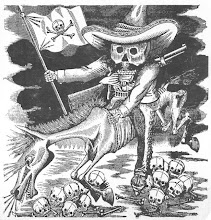
Ambrose Bierce disappeared into the Mexican Revolution. He is known to have been with Pancho Villa's army during his last discovered letter. There was some speculation he had committed suicide. He was in his 70's. He had written a letter to his niece Lori including this:

"Good-bye — if you hear of my being stood up against a Mexican stone wall and shot to rags please know that I think that a pretty good way to depart this life. It beats old age, disease, or falling down the cellar stairs. To be a Gringo in Mexico — ah, that is euthanasia!"


Then there was B. Traven, who wrote Treasure of the Sierra Madres. Traven would have been in Mexico about the time Bierce was there, if Bierce had survived long enough. Bierce was in Mexico in late 1913. Traven was there probably by 1924.

Traven is a puzzle. No one has figured out who he was. He would go by the nickname, El Gringo, and changed his name often. He had some American and some German connections. One anecdote I have heard is that when Treasure of the Sierra Madres was being made into a movie he surfaced for a while to give technical suggestions and then disappeared.

So we have two great personalities and writers. One disappeared in Mexico without a trace and one appeared in Mexico without a history.

My story was that they were the same person. Pretty cool, right?

I planned to read everything either writer published so I could steep myself in both their personalities. I then planned to write the great American novel and in the process explain in fiction both Bierce's disappearance and Traven's appearance.

There were a few problems with this theory. First, Bierce should have been born about 50 years before Traven. If the guy who died in 1969 was really Bierce (or Traven for that matter), Bierce would have died at age 155.

Second, Traven's work may have been originally written in German and translated.

Third, Traven most likely was in Germany or Chicago when Bierce was in San Francisco.

Fourth, writing styles are not very similar. It has been so long since I've read either, I hate to characterize them, but I think it is fair to say they are not similar.

Bierce was known as "Bitter Bierce" and besides his caustic humor he wrote eery short stories: One for instance about an officer directing artillary at his own family's house out of a sense of duty. Another, about a man being hanged from a bridge and the thoughts that went through his mind just before the rope snapped his neck.

Traven was spare in his style and wrote in defense of Mexican Indian rights and Wobbly politics.

All right, I admit, there were a few problems with the idea.

Then Carlos Fuentes wrote El Gringo Viejo and gave his version of Bierce's disappearance. Thus ended my project; I had little enough confidence that I could produce anything worthwhile even without having to be compared with the likes of Carlos Fuentes. The big upside, though, was that I had an excuse to spend a lot of time reading Bierce and Traven.

Politics, noun. A strife of interests masquerading as a contest of principles. The conduct of public affairs for private advantage." —Ambrose Bierce

I am thinking this blog should adopt the policy of Homeland Security of posting warning colors, red, orange, whatever, to give a generally heightened sense of anxiety with no means of remedy. Red could be, "I am about to grind out another half-baked idea that struck me in the wee hours of the morning, so I'll probably change my mind about this later." Orange is, "This is going to be an insufferable load of bombastic drivel (my mind inexplicably moves into that mode sometimes) and in the unlikely event that I ever read it again myself, I'll be embarrassed." That sort of thing.

Anyway, this should be sort of a blend of red and orange, (is that where we get burnt orange?) which should be its own category that is even worse: I am going to talk about local politics....again.

This is in essence a guide to responding to local candidates. They should also be ranked with warning colors:

1. Judges and prosecutors are red and the higher the office, the more alarming the shade of red should be. Sheriffs are usually red, depending on the nature of your work.

2. Legislative offices such as State Rep, Senate, school board, TSC board, Port Authority are orange and the higher the office the scarier the orange.

3. Risible candidate posts. These are the ones either with no power or no responsibility. My old job of County Chairman comes to mind. I am not that great at describing colors. I hear words of color that do not conjure up any image at all--mauve, taupe. This warning color would be sort of like the flesh of a cadaver.

The orange offices can move to red if you actually want something such as a contract to tow cars or collect taxes.

The red offices can move to orange if you never commit any crimes and do not practice law.

The cadaver-colored offices move to red if you want to run for something, yourself.

Here are some of my problems with participating in local races at all:

1. Most of the time it doesn't matter who gets elected because no individual is stronger than the institutional structure of the office he holds. People ask, "Is he a good sheriff?" "Is he a good DA?" Even if the candidate is far more honest and less vindictive than the norm, this is hard to answer. It is like asking, "Is he a good flood victim?" "Is he a good junk yard dog?" Even though the office holder may face the job with integrity and courage, the nature of the job always ultimately beats the good person into a bloody stub of compromises and ugly deeds.

2. It is dangerous to oppose red zone incumbents. Only if they are really horrible can this even be considered. (I know the firebrands among you will view this as gutless). Even if you are certain an incumbent will lose, you usually must still support him, because even after he has been defeated he sits on the bench or in the DA's office or in the sheriff's office for another nine months.

3. I am not sure it is moral. I quit voting entirely during my Tolstoy period. (This period lingers with me, but in a weaker form). Matthew VII, 1, again.

When I spend a lot of energy in electoral politics I begin to get the type of foreboding described by Poe's Masque of the Red Death. As you may recall, the prince (or lord or king, some high muckety-muck) brought a thousand of the beautiful people into a great ballroom to hide from the plague that was killing off the poor in his regime. The plague comes in disguised in a fancy mask and everyone dies.

The striking thing to me about this story is not the morality play of mistreating the poor. It is the jarring, teeth-grinding contrast between the gaiety of the party and the dread engendered from the nasty future we know is inevitable. It is not that I don't enjoy the party of electoral politics (at least as a spectator sport), it is that there is a plague going on among the poor and it won't leave the privileged alone for long:

And now was acknowledged the presence of the Red Death. He had come like a thief in the night. And one by one dropped the revellers in the blood-bedewed halls of their revel, and died each in the despairing posture of his fall. And the life of the ebony clock went out with that of the last of the gay. And the flames of the tripods expired. And Darkness and Decay and the Red Death held illimitable dominion over all.