So is she really in pain or is she faking. After the car wreck, she complains of pain. Her doctor says she is hurt. The insurance company's doctor says, no, the wreck wasn't bad enough and she is only pretending to be hurt.
There are sometimes objective findings like muscle spasms or herniated discs or even broken bones, but a lot of the claim depends on whether or not the complaints of the patient are true.
Then there is the other side of the story. The employee who fell at home in the bathroom, but won't admit to being hurt for fear of losing the job. The athlete who denies an injury.
So, once we develop these face reading skills, can we tell who is in pain and who isn't? I think I can see pain in a client's face. (Yes, yes, Kathy, I know I think I can do anything, but I am really just full of......) I look at their eyes and if the muscle around the eyes are contracted (These as we will discover are the orbicularis oculi.) and there is extra moisture in the eyes, they are really in pain. Of course, I have no ideas whether this scientific approach produces false positives or false negatives, but I do think if I see it, a jury sees it also and will agree with me the person is hurt. For a long time, this is how I have picked the cases I want to try, regardless of what the medical records say.
My main sources on reading faces deal mainly with acute pain and so they describe a stronger reaction.
Darwin starts with animals and notes the writhing around "with frightful contortions" and "piercing cries or groans." Almost every muscle is brought into action and "with man the mouth may be closely compressed" or with lips retracted and teeth clenched or ground together. Like the "gnashing of teeth" in hell.
The eyes stare wildly, the brows are heavily contracted, perspiration bathes the body and drops trickle down the face, the nostrils are dilated and often quiver, and the breath is held until the blood stagnates in the purple face. Pain starts as stimulate and excites to action, but if severe, soon induces extreme depression or prostration. So says Darwin.
My face artist, Faigin, breaks the face down into parts.
Eyebrows: The entire brow is lowered, especially the inner corner which is sharply downward. There is a roll of skin piles up above the eyebrows (The action of the corrugator muscle).
Eyes: The eyes are reduced to a single line by the compression of the orbicularis oculi. The stronger the action, the straighter the line Faigin draws to show the eye.
Mouth: Either opened in a clenched-teeth grimace or opened in a shout. The upper lip is stretched upward and outward. (Action of the risorius/platysma and levator labii superioris).
Signature Wrinkles: Crowsfeet with the lower lid folded, star-wrinkles from the inner eye, vertical lines between the brows and a joined crease from nose to chin.
The face scientists with their FACS testing say the bulk of the information about pain conveyed by facial expr4ession is represented by 4 actions: brow lowering, orbit tightening, levator contraction and eye closure. (The levators are on the sides of the nose in three different branches under the eye orbits).
Facial expressions can be used to measure pain in infants and senile patients who cannot express themselves.
The scientists also find different face muscles involved with different types of pain: electric shock, cold, pressure and pain resulting from cutting off of the blood to a nerve.
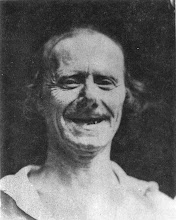
The scientists took a bunch of back patients and then manipulated the leg to make them hurt so they could observe pain. They also told them to fake a facial display of pain. The patients could mask or hide pain and they could voluntarily make painful expressions that "tended not to differ qualitatively from the genuine display but was more vivid or intense."
Faked pain expressions were much like genuine pain, but they were more extreme and had the added factor of AU12, the lower lip pull, in which the lower lip corners are pulled back and upward. Genuine pain tended to blink more than faked pain. When trying to mask pain, the patients could disguise all of the symptoms except AU7, the tightening of the eyelids, narrowing the eye opening.
The hardest part to fake the pain or hide the pain is, then, in the eyes.
Showing posts with label Darwin. Show all posts
Showing posts with label Darwin. Show all posts
Wednesday, April 23, 2008


Monday, April 14, 2008
Smile and the World Smiles With You
Artists, including cartoonists, know about face muscles. Leonardo da Vinci and Michelangelo both did autopsies. Leonardo did thirty; thirty faces cut up to see how the muscles work.
The Artist's Complete Guide to Facial Expression by Gary Faigin lists eleven muscles of the face that are responsible for facial expression. Faigin gives six basic facial expressions: sadness, anger, joy, fear, disgust and surprise and then teaches how to draw them based on the actions of the underlying muscles.
The simplest, the smile muscle, the zygomatic major has a fixed end attached to the zygomatic arch and a free end attached to the corner of the mouth. Tightening a muscle and pulling the free end toward the fixed end creates a smile.
It becomes more complicated when combined with different brow positions: smile + lowered brow=sly; smile+raised brow=eager; smile + fearful brow=ingratiating; smile + sad brow= happy/sad. Each different brow position has different muscle movements.
Paul Ekman, the scientist who developed the Facial Action Coding Systems (FACS) identifies basically the same six emotions as Faigin, but adds contempt.
Ekman describes the zygomatic major as the Lip Corner Puller and labels it AU12. "Felt smiles" are those that involve the outer portion of the muscle orbicularis oculi, AU6, the Cheek Raiser.
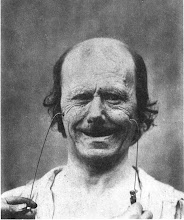
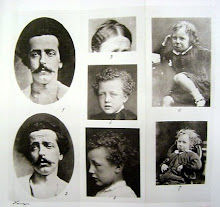
This "felt smile" or "genuine smile" is also called the "Duchenne smile" after a French Neurologist who put electric shocks into people's faces and photographed them to find out how the muscles effect the face. Some muscles are voluntarily exercised (the Lip Corner Puller), some are not (the Cheek Raiser).
Neonates have a Duchenne smile.
We can fake a smiling mouth, but not smiling eyes:
Now do we get to figure out who the liars are? Ekman concludes, "Some people can indeed detect the differences between different kinds of smiles. We still do not know if training can improve accuracy in distinguishing liars from truth-tellers." So, if we get good enough, I guess, at spotting false smiles from true smiles, we will become human lie detectors?
Wait. Wait. Wait, Dr. Ekman.
Two big problems come immediately to mind. I'm sure there are more. One: the Halley smiling for the camera problem, and Two: the Josh Karton doing Stanislavski problem.
When she was about eight, Halley went on a trip with me. As part of our trip celebration we had a black and white photograph taken. Halley smiled for the camera: zygomatic smile. She didn't show "frank joy," but she wasn't trying to fool anyone. She was just a little girl posing for her picture.
Sometimes we want to smile as a greeting or because others are happy and we don't want to ruin the party. Sometimes we smile to put on a good face for a sad or sick friend. In fact, we are told smiling is a good thing. See, http://www.quotegarden.com/smiles.html.
It can even be tactical: "The robbed that smiles, steals something from the thief."
But the zygomatic smile does not always mean a lie. It can be a false positive for lying.
Problem two is the Josh Karton problem. My acting teacher for about twenty years. (I'm not an actor, so this is a whole different story). Josh uses the "system" of Constantin Sergeyevich Stanislavski. When he expresses joy, he feels joy. He uses his own memories to naturally express emotions.
I have not noticed Josh's orbicularis oculi when he smiles, but I'll bet he can feel joy no matter what he is saying.
The Duchenne smile does not always mean the truth. It can be a false negative for lying.
The Artist's Complete Guide to Facial Expression by Gary Faigin lists eleven muscles of the face that are responsible for facial expression. Faigin gives six basic facial expressions: sadness, anger, joy, fear, disgust and surprise and then teaches how to draw them based on the actions of the underlying muscles.
The simplest, the smile muscle, the zygomatic major has a fixed end attached to the zygomatic arch and a free end attached to the corner of the mouth. Tightening a muscle and pulling the free end toward the fixed end creates a smile.
It becomes more complicated when combined with different brow positions: smile + lowered brow=sly; smile+raised brow=eager; smile + fearful brow=ingratiating; smile + sad brow= happy/sad. Each different brow position has different muscle movements.
Paul Ekman, the scientist who developed the Facial Action Coding Systems (FACS) identifies basically the same six emotions as Faigin, but adds contempt.
Ekman describes the zygomatic major as the Lip Corner Puller and labels it AU12. "Felt smiles" are those that involve the outer portion of the muscle orbicularis oculi, AU6, the Cheek Raiser.
This "felt smile" or "genuine smile" is also called the "Duchenne smile" after a French Neurologist who put electric shocks into people's faces and photographed them to find out how the muscles effect the face. Some muscles are voluntarily exercised (the Lip Corner Puller), some are not (the Cheek Raiser).
Neonates have a Duchenne smile.
We can fake a smiling mouth, but not smiling eyes:
The emotion of frank joy is expressed on the face by the combinedDarwin used Duchenne's photographs in the development of his arguments about how emotions are expressed in the face.
contraction of the zygomaticus major muscle and the orbicularis
oculi. The first obeys the will but the second is only put in play by
the sweet emotions of the soul; t h e . . , fake joy, the deceitful laugh,
cannot provoke the contraction of this latter muscle . . . . The muscle
around the eye does not obey the will; it is only brought into
play by a true feeling, by an agreeable emotion. Its inertia, in smiling, unmasks a false friend.
Now do we get to figure out who the liars are? Ekman concludes, "Some people can indeed detect the differences between different kinds of smiles. We still do not know if training can improve accuracy in distinguishing liars from truth-tellers." So, if we get good enough, I guess, at spotting false smiles from true smiles, we will become human lie detectors?
Wait. Wait. Wait, Dr. Ekman.
Two big problems come immediately to mind. I'm sure there are more. One: the Halley smiling for the camera problem, and Two: the Josh Karton doing Stanislavski problem.
When she was about eight, Halley went on a trip with me. As part of our trip celebration we had a black and white photograph taken. Halley smiled for the camera: zygomatic smile. She didn't show "frank joy," but she wasn't trying to fool anyone. She was just a little girl posing for her picture.
Sometimes we want to smile as a greeting or because others are happy and we don't want to ruin the party. Sometimes we smile to put on a good face for a sad or sick friend. In fact, we are told smiling is a good thing. See, http://www.quotegarden.com/smiles.html.
It can even be tactical: "The robbed that smiles, steals something from the thief."
But the zygomatic smile does not always mean a lie. It can be a false positive for lying.
Problem two is the Josh Karton problem. My acting teacher for about twenty years. (I'm not an actor, so this is a whole different story). Josh uses the "system" of Constantin Sergeyevich Stanislavski. When he expresses joy, he feels joy. He uses his own memories to naturally express emotions.
I have not noticed Josh's orbicularis oculi when he smiles, but I'll bet he can feel joy no matter what he is saying.
The Duchenne smile does not always mean the truth. It can be a false negative for lying.
Friday, April 11, 2008
What is this quintessence of dust?
Now to jump in the deep end without my floaties. The question here is whether we can look in the eyes and see the soul? Or more generally, can we look at a face and read the emotions?
This is the bigger view than the "human lie detector" issue. And it uses only one of the tools the interrogators use to get results. But it is where I want to start. And to paraphrase Old Joe Durham, "My soap. My blog. I'll wash it as long as I want."
Now for my reservations, and they are completely in opposition to each other.
First, maybe I am not smart enough or in possession of the right special skills or hard working enough to learn this stuff. It reminds me of a hundred other projects I have begun that fizzled out. Like the times I tried to teach myself Ancient Greek. Or calculus. Or oil painting. Or sculpting. Or Arabic. Or hypnotism. Or astronomy. Or quantum mechanics. The list goes on.
Second, I am afraid that it is a completely phony area of study. Jay Stephen Gould describes these types of errors in The Mismeasure of Man. Scientists measured a bunch of skulls to find out what a criminal's skull looked like. Then they tried to predict who would be a criminal by measuring different parts of the head. The whole field proved to be both stupid and pernicious.
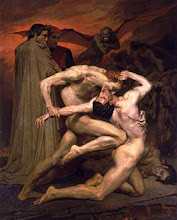
One other gnawing doubt. What if I do learn it and it proves not to be phony? I get this special vision of the human soul. Then do I end up dieing like Kurtz:
If you can't count them, how do you know what they are? I pulled out my old Anatomy and Physiology Book from my class with Dr. Peña. It lists about 20 muscles, not counting the ones that move the eyeball. Some of those are in pairs.
Darwin says, "Some writers consider that these muscles consist of nine pairs, with one unpaired; but others make the number much larger amounting even to fifty-five...."
Some internet sources list 52. (And a lot of discussion of whether it really takes more muscles to frown than to smile).
To complicate the issue further, Darwin, explains the structures of the muscles differ from person to person. When we are trying to figure out what the face is telling us we run into this problem: "Thus the power of uncovering the canine tooth on one side differs much in different persons. the power of raising the wings of the nostrils is also...variable in a remarkable degree; and other such cases could be given."
Nonetheless, Darwin gives us twelve muscles that he uses to describe the expression of emotion. For instance, this is how the muscles react when a human being weeps:
Now fast forward an hundred years and see what this science looks like with modern measurement tools. It has largely been developed by a guy named Paul Ekman.
Subjects were made to to stare into a camera lens to be recorded on videotape. A starter pistol was used for some experiments, but there was a fear the subjects' hearing was endangered. Also, the directional properties of the shots could not be controlled. So startle sounds of white noise were produced electronically, amplified and run into speakers or headphones. Several variations of these themes were developed to distinguish between spontaneous and deliberate facial movements and between emotional and non-emotional facial movements.
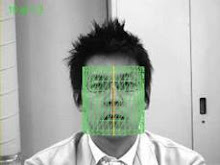
Then they had to decide what to measure. Action Units were numbered that described different movements of the muscles. It is a system called Facial Action Coding System (FACS). For instance Action Unit (AU) 1 involves the inner frontalis muscle and the action is "Raises inner corner of brow." These AU's describe things like AU12, Zygomatic major, Common smile and AU45, Orbicularis oculi, Blink or Wink.
Once they decided what to measure, there was the question of how? Two choices presented themselves: 1. "coders" who graded the movements, or 2. Electromyograph testing of the muscles.
Even judging the slow motion videotapes, there was a risk of bias in the measurements. The coders were tested against each other to find out how reliable they were.
The EMG gave a much finer scale of measurement, but apparently it was difficult to measure "spontaneous happy expressions" on the part of a subject who had a bunch of needles stuck in his face.
After enough review of videotapes carefully measuring many different muscle combinations by enough carefully tested coders, finally the payoff: spontaneous happy expressions were more symmetrical than requested actions expressing happiness.
In other words, there may be some sadness in that lopsided grin.
This is the bigger view than the "human lie detector" issue. And it uses only one of the tools the interrogators use to get results. But it is where I want to start. And to paraphrase Old Joe Durham, "My soap. My blog. I'll wash it as long as I want."
Now for my reservations, and they are completely in opposition to each other.
First, maybe I am not smart enough or in possession of the right special skills or hard working enough to learn this stuff. It reminds me of a hundred other projects I have begun that fizzled out. Like the times I tried to teach myself Ancient Greek. Or calculus. Or oil painting. Or sculpting. Or Arabic. Or hypnotism. Or astronomy. Or quantum mechanics. The list goes on.
Second, I am afraid that it is a completely phony area of study. Jay Stephen Gould describes these types of errors in The Mismeasure of Man. Scientists measured a bunch of skulls to find out what a criminal's skull looked like. Then they tried to predict who would be a criminal by measuring different parts of the head. The whole field proved to be both stupid and pernicious.
One other gnawing doubt. What if I do learn it and it proves not to be phony? I get this special vision of the human soul. Then do I end up dieing like Kurtz:
"He cried in a whisper at some image, at some vision,—he cried out twice, a cry that was no more than a breath—'The horror! The horror!'All right, enough procrastination. We begin as Darwin does, with the muscles of the face. Here the problems begin.
If you can't count them, how do you know what they are? I pulled out my old Anatomy and Physiology Book from my class with Dr. Peña. It lists about 20 muscles, not counting the ones that move the eyeball. Some of those are in pairs.
Darwin says, "Some writers consider that these muscles consist of nine pairs, with one unpaired; but others make the number much larger amounting even to fifty-five...."
Some internet sources list 52. (And a lot of discussion of whether it really takes more muscles to frown than to smile).
To complicate the issue further, Darwin, explains the structures of the muscles differ from person to person. When we are trying to figure out what the face is telling us we run into this problem: "Thus the power of uncovering the canine tooth on one side differs much in different persons. the power of raising the wings of the nostrils is also...variable in a remarkable degree; and other such cases could be given."
Nonetheless, Darwin gives us twelve muscles that he uses to describe the expression of emotion. For instance, this is how the muscles react when a human being weeps:
The corrugators of the brow (corrugator supercilii) seem to be the first muscles to contract and these draw the eyebrows downward and inwards towards the base of the nose.... (This goes on for three pages discussing the malaris muscles, orbicular muscles, pyramidal muscles, and on and on).If you see all of this, you know a person is weeping and therefore probably, "suffering of the body and mind."
Now fast forward an hundred years and see what this science looks like with modern measurement tools. It has largely been developed by a guy named Paul Ekman.
Subjects were made to to stare into a camera lens to be recorded on videotape. A starter pistol was used for some experiments, but there was a fear the subjects' hearing was endangered. Also, the directional properties of the shots could not be controlled. So startle sounds of white noise were produced electronically, amplified and run into speakers or headphones. Several variations of these themes were developed to distinguish between spontaneous and deliberate facial movements and between emotional and non-emotional facial movements.
Then they had to decide what to measure. Action Units were numbered that described different movements of the muscles. It is a system called Facial Action Coding System (FACS). For instance Action Unit (AU) 1 involves the inner frontalis muscle and the action is "Raises inner corner of brow." These AU's describe things like AU12, Zygomatic major, Common smile and AU45, Orbicularis oculi, Blink or Wink.
Once they decided what to measure, there was the question of how? Two choices presented themselves: 1. "coders" who graded the movements, or 2. Electromyograph testing of the muscles.
Even judging the slow motion videotapes, there was a risk of bias in the measurements. The coders were tested against each other to find out how reliable they were.
The EMG gave a much finer scale of measurement, but apparently it was difficult to measure "spontaneous happy expressions" on the part of a subject who had a bunch of needles stuck in his face.
After enough review of videotapes carefully measuring many different muscle combinations by enough carefully tested coders, finally the payoff: spontaneous happy expressions were more symmetrical than requested actions expressing happiness.
In other words, there may be some sadness in that lopsided grin.
Thursday, April 10, 2008
The Holy Grail. The Fountain of Youth.
Yesterday's post brought a serious comment from Mr. Kurgan:
In truth, I hope this is true, as long as we have a way to find out who has those skills. The fact that I now lack the skills, does not mean I do not aspire to learn them if they indeed can be learned. If I think I have learned the skill, I will likely credit it can be done. Even if I can't learn the skill, if someone else can demonstrate it in a controlled experiment, well, I am much comforted by that type of certainty.
My thought is that this inquiry is not anti-law enforcement, but rather a desire to have a more nearly accurate law enforcement.
DNA and fingerprints are good examples. Both of these tools are misused and misread by unskilled practitioners (remember the guy that got shipped to Spain to answer to blowing up the train based on a bad FBI reading), but, well-done, they have impressive results.
Perhaps twice in the last year, I have believed the system had grabbed the wrong guy. I wanted fingerprints. If we have the wrong one, we want a reliable way to test that. One young man was freed of his charges on the spot when the fingerprint guru (I think from Harlingen PD) showed up and said our man was not who the arresting officers thought he was. There was also about twenty tattoo differences, but we did not need to reach that.
The Innocence Project has shown that more nearly accurate law enforcement can help acquit the innocent. DNA has produced 215 post conviction exonerations. The average length of time served by exonerees is 12 years. The total number of years served is approximately 2,640. Sixteen served time on death row. And to me the most disturbing fact: False confessions and incriminating statements lead to wrongful convictions in 25 percent of the DNA exonerations. (How false confessions come about will be a later discussion).
Differently put, if either a machine or a person can accurately tell truth from lie, that would be helpful. We may produce another 215 exonerations.
Where do we begin? Stan B. Walters in his Principles of Kinesic Interview and Interrogation begins with the following:
Before getting there, though, with a compulsive rejection of secondary sources, we should find out what Darwin really said.
The ability to ascertain deception can not only be learned, but it can almost be near perfected, as a couple of your noted text will reveal. Your inability to do so, based on your personal frame of reference, will not allow you to believe that this is possible. To you, this is not reasonable.I accept the challenge, Sr. Kurgan. I shall open my mind to the possibility that the ability to ascertain deception can be near perfected.
In truth, I hope this is true, as long as we have a way to find out who has those skills. The fact that I now lack the skills, does not mean I do not aspire to learn them if they indeed can be learned. If I think I have learned the skill, I will likely credit it can be done. Even if I can't learn the skill, if someone else can demonstrate it in a controlled experiment, well, I am much comforted by that type of certainty.
My thought is that this inquiry is not anti-law enforcement, but rather a desire to have a more nearly accurate law enforcement.
DNA and fingerprints are good examples. Both of these tools are misused and misread by unskilled practitioners (remember the guy that got shipped to Spain to answer to blowing up the train based on a bad FBI reading), but, well-done, they have impressive results.
Perhaps twice in the last year, I have believed the system had grabbed the wrong guy. I wanted fingerprints. If we have the wrong one, we want a reliable way to test that. One young man was freed of his charges on the spot when the fingerprint guru (I think from Harlingen PD) showed up and said our man was not who the arresting officers thought he was. There was also about twenty tattoo differences, but we did not need to reach that.
The Innocence Project has shown that more nearly accurate law enforcement can help acquit the innocent. DNA has produced 215 post conviction exonerations. The average length of time served by exonerees is 12 years. The total number of years served is approximately 2,640. Sixteen served time on death row. And to me the most disturbing fact: False confessions and incriminating statements lead to wrongful convictions in 25 percent of the DNA exonerations. (How false confessions come about will be a later discussion).
Differently put, if either a machine or a person can accurately tell truth from lie, that would be helpful. We may produce another 215 exonerations.
Where do we begin? Stan B. Walters in his Principles of Kinesic Interview and Interrogation begins with the following:
1. Darwin says, "Repressed emotion almost always comes to the surface in the form of body motion."Walters then give three reasons for the failure of people to accurately identify deception:
2. In general, human beings, including investigative interviewers, do a poor job at spotting deception, with the results being little better than chance. Walters cites (Ekman, O'Sullivan 1991).
In other words, Walters thinks most everyone gets it wrong now, but with the proper training, the problem can be fixed. This is the premise I want to explore.
1. Judging on verbal and non-verbal behaviors that are not reliable cues to deception.
2. Being unaware of the cues that do have a higher incidence during deception.
3. Making bad judgments because of the interviewer's preconceptions about the subject's likely credibility.
Before getting there, though, with a compulsive rejection of secondary sources, we should find out what Darwin really said.
Thursday, April 3, 2008
Remembering Rudyard
When I was a child, Rudyard Kipling was my favorite poet. I remember listening to a 78 rpm record of a recitation of Gunga Din in Grandma Stapleton's brownstone house on State Street in Albany, New York. The house is now long gone. "Rockefeller stole our house so his friends could build office buildings."
I listened to it so many times, I committed it to memory. I must have been only five or six years of age, because we did not visit as much after that. When I was in Junior High School, I entered poetry reading contests and used this poem, long since memorized.
In college, I killed a couple of otherwise pleasant evening by deciding someone might enjoy hearing me recite the poem.
It was an odd thing this love my grandmother had for Kipling. She, the hater of the English and all things English and he, the poet of English Empire. Or at least that was how we generally viewed him.
He had written Ulster 1912, anti-Irish home rule, anti-Catholic.
But I doubt that he was always the imperialist. Maybe it is reading through eyes that want to see the world rose colored, but those Empire poems seemed anti-imperialistic to me.
In one of the odd turns in my life I took a graduate course in Portuguese studying the epic poem of Portugal, Os Lusiados, by Luis Camoes. This was the great imperialist poem of Portugal that sounded to me to be anti-imperialist. And then, I think the Iliad is anti-war. I thought Patton was an anti-war movie. I saw Natural Born Killers as a comedy. So I know my judgment on these things is hardly to be trusted.
The White Man's Burden is supposed to be an appeal to the United States to colonize the Philippines. I have never been able to view as "an appeal" the following lines:
Nor have I ever been able to read the Recessional as favoring Empire, but more as a caution against it:
His background, to me, would more likely produce a critic of Empire than an imperialist. He was born in Bombay, India and during his happy early days was raised by the Portuguese Nanny and the Hindu Meeta who taught him the stories that became the basis for his later Jungle Books. When he was later shipped off to English boarding, he was miserable.
In general, people who are exposed to foreign peoples, tend to have their sense of white superiority tempered by a dose of experience. Luis Camoes was one. I think, also, of the contrast between Charles Darwin and Alfred Russel Wallace.
Kipling was awarded and accepted the Nobel Prize. He refused both knighthood and offers to be Poet Laureate of England. Not, to me, a sign of an ambitious imperialist.
It seems to me the death of his son at war in 1915 would have made him anti-war (which means anti-empire) if he were not so before. Teddy Roosevelt had a similar shift when his son died at war. I would imagine that it is hard to stay jingo when the big sacrifice is made. Of course, modern imperialists do not seem to make the foolish mistake of sending their own children (first twins Jenna and Barbara, for instance) to risk death.
Does this sound like an imperialist to you?
I listened to it so many times, I committed it to memory. I must have been only five or six years of age, because we did not visit as much after that. When I was in Junior High School, I entered poetry reading contests and used this poem, long since memorized.
In college, I killed a couple of otherwise pleasant evening by deciding someone might enjoy hearing me recite the poem.
It was an odd thing this love my grandmother had for Kipling. She, the hater of the English and all things English and he, the poet of English Empire. Or at least that was how we generally viewed him.
He had written Ulster 1912, anti-Irish home rule, anti-Catholic.
But I doubt that he was always the imperialist. Maybe it is reading through eyes that want to see the world rose colored, but those Empire poems seemed anti-imperialistic to me.
In one of the odd turns in my life I took a graduate course in Portuguese studying the epic poem of Portugal, Os Lusiados, by Luis Camoes. This was the great imperialist poem of Portugal that sounded to me to be anti-imperialist. And then, I think the Iliad is anti-war. I thought Patton was an anti-war movie. I saw Natural Born Killers as a comedy. So I know my judgment on these things is hardly to be trusted.
The White Man's Burden is supposed to be an appeal to the United States to colonize the Philippines. I have never been able to view as "an appeal" the following lines:
Send forth the best ye breed--
Go bind your sons to exile
To serve your captives' need;
To wait in heavy harness....
Go bind your sons to exile
To serve your captives' need;
To wait in heavy harness....
Nor have I ever been able to read the Recessional as favoring Empire, but more as a caution against it:
Far-called, our navies melt away;
On dune and headland sinks the fire:
Lo, all our pomp of yesterday
Is one with Nineveh and Tyre!
Judge of the Nations, spare us yet,
Lest we forget - lest we forget!
On dune and headland sinks the fire:
Lo, all our pomp of yesterday
Is one with Nineveh and Tyre!
Judge of the Nations, spare us yet,
Lest we forget - lest we forget!
His background, to me, would more likely produce a critic of Empire than an imperialist. He was born in Bombay, India and during his happy early days was raised by the Portuguese Nanny and the Hindu Meeta who taught him the stories that became the basis for his later Jungle Books. When he was later shipped off to English boarding, he was miserable.
In general, people who are exposed to foreign peoples, tend to have their sense of white superiority tempered by a dose of experience. Luis Camoes was one. I think, also, of the contrast between Charles Darwin and Alfred Russel Wallace.
Kipling was awarded and accepted the Nobel Prize. He refused both knighthood and offers to be Poet Laureate of England. Not, to me, a sign of an ambitious imperialist.
It seems to me the death of his son at war in 1915 would have made him anti-war (which means anti-empire) if he were not so before. Teddy Roosevelt had a similar shift when his son died at war. I would imagine that it is hard to stay jingo when the big sacrifice is made. Of course, modern imperialists do not seem to make the foolish mistake of sending their own children (first twins Jenna and Barbara, for instance) to risk death.
EPITAPHS OF THE WAR, 1914-1918
An Only Son
I have slain none except my Mother. She
(Blessing her slayer) died of grief for me.
COMMON FORM
If any question why we died,
Tell them, because our fathers lied.
A DEAD STATESMAN
I could not dig: I dared not rob:
Therefore I lied to please the mob.
Now all my lies are proved untrue
And I must face the men I slew.
What tale shall serve me here among
Mine angry and defrauded young?
An Only Son
I have slain none except my Mother. She
(Blessing her slayer) died of grief for me.
COMMON FORM
If any question why we died,
Tell them, because our fathers lied.
A DEAD STATESMAN
I could not dig: I dared not rob:
Therefore I lied to please the mob.
Now all my lies are proved untrue
And I must face the men I slew.
What tale shall serve me here among
Mine angry and defrauded young?
Does this sound like an imperialist to you?
Subscribe to:
Posts (Atom)








_-_Dante_And_Virgil_In_Hell_(1850).jpg)