Now to jump in the deep end without my floaties. The question here is whether we can look in the eyes and see the soul? Or more generally, can we look at a face and read the emotions?
This is the bigger view than the "human lie detector" issue. And it uses only one of the tools the interrogators use to get results. But it is where I want to start. And to paraphrase Old Joe Durham, "My soap. My blog. I'll wash it as long as I want."
Now for my reservations, and they are completely in opposition to each other.
First, maybe I am not smart enough or in possession of the right special skills or hard working enough to learn this stuff. It reminds me of a hundred other projects I have begun that fizzled out. Like the times I tried to teach myself Ancient Greek. Or calculus. Or oil painting. Or sculpting. Or Arabic. Or hypnotism. Or astronomy. Or quantum mechanics. The list goes on.
Second, I am afraid that it is a completely phony area of study. Jay Stephen Gould describes these types of errors in
The Mismeasure of Man. Scientists measured a bunch of skulls to find out what a criminal's skull looked like. Then they tried to predict who would be a criminal by measuring different parts of the head. The whole field proved to be both stupid and pernicious.
One other gnawing doubt. What if I do learn it and it proves not to be phony? I get this special vision of the human soul. Then do I end up dieing like Kurtz:
"He cried in a whisper at some image, at some vision,—he cried out twice, a cry that was no more than a breath—'The horror! The horror!'
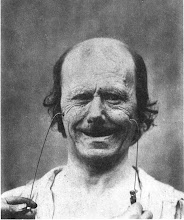
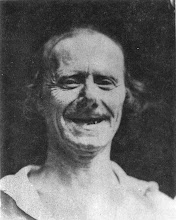
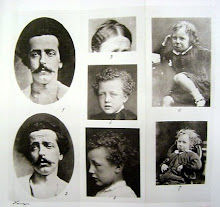
All right, enough procrastination. We begin as Darwin does, with the muscles of the face. Here the problems begin.
If you can't count them, how do you know what they are? I pulled out my old Anatomy and Physiology Book from my class with Dr. Peña. It lists about 20 muscles, not counting the ones that move the eyeball. Some of those are in pairs.
Darwin says, "Some writers consider that these muscles consist of nine pairs, with one unpaired; but others make the number much larger amounting even to fifty-five...."
Some internet sources list 52. (And a lot of discussion of whether it really takes more muscles to frown than to smile).
To complicate the issue further, Darwin, explains the structures of the muscles differ from person to person. When we are trying to figure out what the face is telling us we run into this problem: "Thus the power of uncovering the canine tooth on one side differs much in different persons. the power of raising the wings of the nostrils is also...variable in a remarkable degree; and other such cases could be given."
Nonetheless, Darwin gives us twelve muscles that he uses to describe the expression of emotion. For instance, this is how the muscles react when a human being weeps:
The corrugators of the brow (corrugator supercilii) seem to be the first muscles to contract and these draw the eyebrows downward and inwards towards the base of the nose.... (This goes on for three pages discussing the malaris muscles, orbicular muscles, pyramidal muscles, and on and on).
If you see all of this, you know a person is weeping and therefore probably, "suffering of the body and mind."
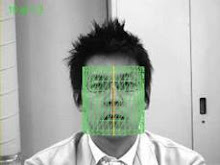
Now fast forward an hundred years and see what this science looks like with modern measurement tools. It has largely been developed by a guy named Paul Ekman.
Subjects were made to to stare into a camera lens to be recorded on videotape. A starter pistol was used for some experiments, but there was a fear the subjects' hearing was endangered. Also, the directional properties of the shots could not be controlled. So startle sounds of white noise were produced electronically, amplified and run into speakers or headphones. Several variations of these themes were developed to distinguish between spontaneous and deliberate facial movements and between emotional and non-emotional facial movements.
Then they had to decide what to measure. Action Units were numbered that described different movements of the muscles. It is a system called
Facial Action Coding System (FACS). For instance Action Unit (AU) 1 involves the inner frontalis muscle and the action is "Raises inner corner of brow." These AU's describe things like AU12, Zygomatic major, Common smile and AU45, Orbicularis oculi, Blink or Wink.
Once they decided what to measure, there was the question of how? Two choices presented themselves: 1. "coders" who graded the movements, or 2. Electromyograph testing of the muscles.
Even judging the slow motion videotapes, there was a risk of bias in the measurements. The coders were tested against each other to find out how reliable they were.
The EMG gave a much finer scale of measurement, but apparently it was difficult to measure "spontaneous happy expressions" on the part of a subject who had a bunch of needles stuck in his face.
After enough review of videotapes carefully measuring many different muscle combinations by enough carefully tested coders, finally the payoff: spontaneous happy expressions were more symmetrical than requested actions expressing happiness.
In other words, there may be some sadness in that lopsided grin.












_-_Dante_And_Virgil_In_Hell_(1850).jpg)