Showing posts with label mimetic desire. Show all posts

Saturday, April 12, 2008

On Sumptuary Laws, with apologies to GOAB

And now for the Sumptuary Laws.

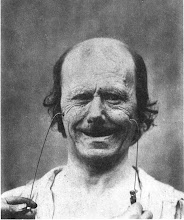
I was on a steady course of examining the secrets told by the face about the emotions, when I was diverted by a glancing blow. One commenter, carrying the moniker of "Anonymous," suggested that GOAB would not have wasted his time with such trivialities as the particularities of some disapproved French Law. I replied, "But he did. See his essay On the sumptuary laws."

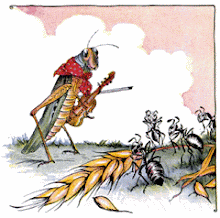
To make sure I was right about that, I reread the essay. Now, of course, I want to write about the sumptuary laws. (Yes, ML, again, mimetic theory). (No, Raulito, I am not yet advising you bring these to Cuba; right now we are only exploring the idea). (Yes, Grasshopper, I will return to the task at hand soon, very soon).

Sumptuary Laws restrict certain types of people from buying certain kinds of things, like clothes or food.

In Ancient Rome Tyrian Purple dye is said to have been first restricted to victorious generals. Later even beardless child Emporers took up the habit, but it was not supposed to be worn by mere wealthy merchants.

The dye was expensive because it was made from the mucus of certain marine mollusks and thousands of the little creatures were smashed to make a gram of the stuff. A Phoenician is said to have figured it out when his dog was out cracking the shells and eating mariscos when the dog's mouth turned purple. The Phoenician Kings grabbed it as their royal symbol and kept the secret of how to make it as long as they could.

Once the Phoenician Kings had it, the Roman hot shots had coveted it as well. (Yes, again, ML). Part of the reason was to make sure the right people enjoyed their fair share of toadying. Because sycophants were much more readily available than mollusks, laws were needed to make sure the merely wealthy did not cut in on the action.

I have to think that an ulterior motive was to keep all the good Roman hard cash from being shipped to the Phoenicians for such a frivolous purpose.

The French had their own restrictions saying, according to GOAB, that none but princes, "shall eat turbot, or shall be allowed to wear velvet and gold braid." Turbot, it seems, is a flat fish related to a flounder. (Cap'n Bob, Cap'n Bill, this would be your arena).

Although GOAB did not mind having ways to distinguish between the classes, but he did not like these laws:

The way in which our laws try to regulate vain and insane expenditures for the table and for clothes seems to be opposed to their purpose. The real way would be to engender in men contempt for gold and silk, as vain and useless things; whereas we increase their honor and value, which is a very inept way to make men lose their taste for them.

GOAB saw it as a simple matter. Kings and princes could abandon these expenses and within a month everyone else would imitate them.

He suggested that the law should restrict these expenditures to "mountebanks and courtesans." GOAB was following the lead of a Greek lawyer named Zaleucus who drafted an ordinance saying that, a free woman may not be attended by more than one chambermaid unless she is drunk. Nor may she wear gold jewels about her person or an embroidered dress unless she is a public whore. And no man, unless he is a pimp, is allowed to wear a gold ring on his finger.

(If there are any Wesleyans out there, remember the similar theme by John Wesley: "I have one word more to say to parents; to mothers in particular. If, in spite of all the Apostle can say, you encourage your children by your example to "adorn" themselves "with gold, or pearls, or costly apparel," you and they must drop into the pit together." I'm not a Methodist, but if John Wesley feels this strongly about the issue, gold, pearls and costly apparel are off my shopping list). (Pardon me, Uncle Toby).

What if we brought a Zaleucus ordinance to our own conspicuous consumers? Only drug dealers, prostitutes and procurers will be allowed to purchase or drive expensive vehicles. Private yachts and jets are also restricted to drug dealers, prostitutes and procurers. At the airplane or yacht dealership (is there such a thing?) the purchaser would be required to sign a statement, "I affirm that I am a drug dealer, prostitute or procurer and will use this expensive means of transportation to entertain customers."

If you see a monster luxury Lexus SUV, it would be polite to tap on the window and say, "Excuse me kind sir, but I suffer from the vice of drug addiction. I see from your car, you are a dealer. Would I be able to purchase an eight ball, please?" Or, "Yes, kind lady, I see from your car that you are a prostitute. I only have $50, but do you suppose....?"

Not everyone would follow the law of course. There would be certain sheep in wolves clothing who would pretend to be drug dealers or prostitutes or procurers so they could drive the expensive car. Then the gossip would change when they dropped their kids off at elementary school. "Those phonies. Look at the car. He's not really a drug dealer, but secretly owns an automobile dealership. And she's not really a prostitute, but owns a boutique on the Island." That sort of thing.

I know my libertarian friends will argue this is a poor way to address the problem of "vain and insane expenditures." Raulito and I are open to other suggestions.

Saturday, March 29, 2008

Violence Unveiled--What is this mimetic desire and why does it make me want to kill?

A standing joke Kathy and I have is based on our different tastes in movies. I expect a murder in the first five minutes and then ongoing murders throughout the movie.

Kathy likes movies about a long lingering death of a loved one. My movies involve, Charles Bronson or Clint Eastwood or someone like that who is badly wronged in the beginning of the movies and then he kills people all through the rest of the movie to get even. The children's version of this would be Mighty Mouse.

Why do I find this kind of movie so satisfying? I began to get some insight into this question about ten years ago. Near the time it first came out, I read a book called Violence Unveiled: Humanity at the Crossroads by Gil Bailie. It is one of a dozen books I have read that immediately altered my view of the world. Since I read that book, I see many social relationships, including my own, in a different way.

This book is actually a popularization of a philosopher, Rene Gerard. Since reading Bailie's book, I have read books by Girard himself, but I find them heavy lifting, so I mention Bailie's book first. This is a theory about why people act like they do.

Bailie, following Girard, supports the theory by giving examples from anthropology and literature. Let me describe my simplification of Bailie's simplification: People, from the time we are little babies, must imitate other people. We see someone else and we want to act the way he acts, look the way he looks, have the things he has. We must do this because this is the way we learn and become older human beings--it is part of the essence of being human. So every healthy, whole human being begins with this desire. Bailie calls it "mimetic desire."

What is "mimetic?" It just means someone is apt to imitate. A snake that looks like a poisonous snake, but is harmless, but survives because it looks like the poisonous snake is a mimetic animal. It comes from a Greek word that means "imitate."

In most ways the mimetic desire is something good for society, especially when it involves copying knowledge or copying values:

The English teacher recites Shakespeare and now all of his students want to recite Shakespeare.

Dad is kind to beggars and now his children are kind to beggars.


When it involves a desire for other people's stuff, it is a little less attractive:

On a simple childhood level, one kid has a toy. Another kid wants to take the toy away from him, but when the first kid loses interest in the toy, they both do and it sits in the middle of the floor where neither plays with it.

One young lawyer drives an expensive sports car, so his buddy wants an expensive car too.


Move on from things to treating people as objects, and it can get really nasty:

The young woman is more attractive to her husband's friend when she is married than after she is divorced. "If he wants her, I want her too, but if he doesn't want her, there must be something wrong with her and I'm not interested."

John Lennon is rich and famous and I'm not so I guess I'll kill him.


Mimetic desire can also be more generalized, between people who identify themselves with groups and with a risk of a bigger level of violence:

The Dutch own all of the property and we want some property.

Mexican immigrants are taking jobs and we want those jobs.

The Jews own all of the banks and newspapers and we want the banks and newspapers.


So, we have mimetic desire both among each other within a group and generalized between group.

Bailie says that one way that people within groups work out their own risk for violence arising from mimetic desire is to find a scapegoat to sacrifice. This scapegoat can be literal, in the sense of animal sacrifice, or it can be metaphorical, in the sense of picking out an individual and throwing him out of the group. He then takes the blame for all of the problems the group was having and there is a period of peace.

An example of this in daily life would be a workplace in which everyone is fighting. Someone gets fired and then everyone can blame the scapegoat for all of the problems. A period of peace reigns.

A classic political example is Hitler's use of the Jews as a scapegoat for disputes among the German people. By sacrificing the Jews, we have someone to blame for all of our problems and now we can get along.

Many political efforts at unifying a generally violent community involves finding the scapegoat to blame, so the rest of us can mend our differences: Muslims, homosexuals, communists.

How does the act of violence against one outcast bring the others back together? Bailie illustrates this with a story of a wise man who was asked to heal the community of a generalized plague of violence. The wise man finds a beggar and tells the mob who have been fighting each other that the begger is a demon. At first, individual members of the mob resist, but then someone throws the first stone. Soon, everyone else pitches in and they stone the beggar into an unrecognizeable bloody pulp. The wise man then says, "See, it was not a beggar, but a demon. Now it has transformed into a bloodied Milosian Hound."

Everyone's guilt is assuaged because they know they have not killed a innocent beggar, but a demon, now transformed into a hound. Also, the act of violence against the beggar allows the mob job to join in a common cause rather than fighting among themselves. The plague of violence in the community comes to an end, at least for a while.

Bailie contrasts this solution with Jesus' solution to a plague of violence in which Jesus himself becomes the beggar and the Milosian Hound, but allows the mob to see the violence from His point of view. The myth of sacred violence is then exposed for what it is--injustice.

Back to Clint Eastwood and Mighty Mouse. My generalized anger towards others who either have something I want or want something I have can be calmed for a while watching the movie.

Clint and Mighty Mouse are the good guys. By stoning some Milosian Hounds we can all feel better for a while.

This also explains why prisons and the death penalty can make the rest of us feel better for a while.