So is she really in pain or is she faking. After the car wreck, she complains of pain. Her doctor says she is hurt. The insurance company's doctor says, no, the wreck wasn't bad enough and she is only pretending to be hurt.
There are sometimes objective findings like muscle spasms or herniated discs or even broken bones, but a lot of the claim depends on whether or not the complaints of the patient are true.
Then there is the other side of the story. The employee who fell at home in the bathroom, but won't admit to being hurt for fear of losing the job. The athlete who denies an injury.
So, once we develop these face reading skills, can we tell who is in pain and who isn't? I think I can see pain in a client's face. (Yes, yes, Kathy, I know I think I can do anything, but I am really just full of......) I look at their eyes and if the muscle around the eyes are contracted (These as we will discover are the orbicularis oculi.) and there is extra moisture in the eyes, they are really in pain. Of course, I have no ideas whether this scientific approach produces false positives or false negatives, but I do think if I see it, a jury sees it also and will agree with me the person is hurt. For a long time, this is how I have picked the cases I want to try, regardless of what the medical records say.
My main sources on reading faces deal mainly with acute pain and so they describe a stronger reaction.
Darwin starts with animals and notes the writhing around "with frightful contortions" and "piercing cries or groans." Almost every muscle is brought into action and "with man the mouth may be closely compressed" or with lips retracted and teeth clenched or ground together. Like the "gnashing of teeth" in hell.
The eyes stare wildly, the brows are heavily contracted, perspiration bathes the body and drops trickle down the face, the nostrils are dilated and often quiver, and the breath is held until the blood stagnates in the purple face. Pain starts as stimulate and excites to action, but if severe, soon induces extreme depression or prostration. So says Darwin.
My face artist, Faigin, breaks the face down into parts.
Eyebrows: The entire brow is lowered, especially the inner corner which is sharply downward. There is a roll of skin piles up above the eyebrows (The action of the corrugator muscle).
Eyes: The eyes are reduced to a single line by the compression of the orbicularis oculi. The stronger the action, the straighter the line Faigin draws to show the eye.
Mouth: Either opened in a clenched-teeth grimace or opened in a shout. The upper lip is stretched upward and outward. (Action of the risorius/platysma and levator labii superioris).
Signature Wrinkles: Crowsfeet with the lower lid folded, star-wrinkles from the inner eye, vertical lines between the brows and a joined crease from nose to chin.
The face scientists with their FACS testing say the bulk of the information about pain conveyed by facial expr4ession is represented by 4 actions: brow lowering, orbit tightening, levator contraction and eye closure. (The levators are on the sides of the nose in three different branches under the eye orbits).
Facial expressions can be used to measure pain in infants and senile patients who cannot express themselves.
The scientists also find different face muscles involved with different types of pain: electric shock, cold, pressure and pain resulting from cutting off of the blood to a nerve.
The scientists took a bunch of back patients and then manipulated the leg to make them hurt so they could observe pain. They also told them to fake a facial display of pain. The patients could mask or hide pain and they could voluntarily make painful expressions that "tended not to differ qualitatively from the genuine display but was more vivid or intense."
Faked pain expressions were much like genuine pain, but they were more extreme and had the added factor of AU12, the lower lip pull, in which the lower lip corners are pulled back and upward. Genuine pain tended to blink more than faked pain. When trying to mask pain, the patients could disguise all of the symptoms except AU7, the tightening of the eyelids, narrowing the eye opening.
The hardest part to fake the pain or hide the pain is, then, in the eyes.
Showing posts with label FACS. Show all posts
Showing posts with label FACS. Show all posts
Wednesday, April 23, 2008


Monday, April 14, 2008
Smile and the World Smiles With You
Artists, including cartoonists, know about face muscles. Leonardo da Vinci and Michelangelo both did autopsies. Leonardo did thirty; thirty faces cut up to see how the muscles work.
The Artist's Complete Guide to Facial Expression by Gary Faigin lists eleven muscles of the face that are responsible for facial expression. Faigin gives six basic facial expressions: sadness, anger, joy, fear, disgust and surprise and then teaches how to draw them based on the actions of the underlying muscles.
The simplest, the smile muscle, the zygomatic major has a fixed end attached to the zygomatic arch and a free end attached to the corner of the mouth. Tightening a muscle and pulling the free end toward the fixed end creates a smile.
It becomes more complicated when combined with different brow positions: smile + lowered brow=sly; smile+raised brow=eager; smile + fearful brow=ingratiating; smile + sad brow= happy/sad. Each different brow position has different muscle movements.
Paul Ekman, the scientist who developed the Facial Action Coding Systems (FACS) identifies basically the same six emotions as Faigin, but adds contempt.
Ekman describes the zygomatic major as the Lip Corner Puller and labels it AU12. "Felt smiles" are those that involve the outer portion of the muscle orbicularis oculi, AU6, the Cheek Raiser.
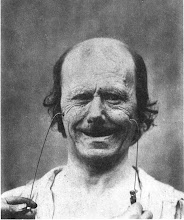
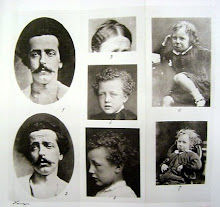
This "felt smile" or "genuine smile" is also called the "Duchenne smile" after a French Neurologist who put electric shocks into people's faces and photographed them to find out how the muscles effect the face. Some muscles are voluntarily exercised (the Lip Corner Puller), some are not (the Cheek Raiser).
Neonates have a Duchenne smile.
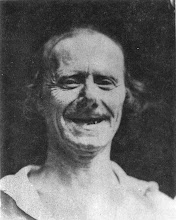
We can fake a smiling mouth, but not smiling eyes:
Now do we get to figure out who the liars are? Ekman concludes, "Some people can indeed detect the differences between different kinds of smiles. We still do not know if training can improve accuracy in distinguishing liars from truth-tellers." So, if we get good enough, I guess, at spotting false smiles from true smiles, we will become human lie detectors?
Wait. Wait. Wait, Dr. Ekman.
Two big problems come immediately to mind. I'm sure there are more. One: the Halley smiling for the camera problem, and Two: the Josh Karton doing Stanislavski problem.
When she was about eight, Halley went on a trip with me. As part of our trip celebration we had a black and white photograph taken. Halley smiled for the camera: zygomatic smile. She didn't show "frank joy," but she wasn't trying to fool anyone. She was just a little girl posing for her picture.
Sometimes we want to smile as a greeting or because others are happy and we don't want to ruin the party. Sometimes we smile to put on a good face for a sad or sick friend. In fact, we are told smiling is a good thing. See, http://www.quotegarden.com/smiles.html.
It can even be tactical: "The robbed that smiles, steals something from the thief."
But the zygomatic smile does not always mean a lie. It can be a false positive for lying.
Problem two is the Josh Karton problem. My acting teacher for about twenty years. (I'm not an actor, so this is a whole different story). Josh uses the "system" of Constantin Sergeyevich Stanislavski. When he expresses joy, he feels joy. He uses his own memories to naturally express emotions.
I have not noticed Josh's orbicularis oculi when he smiles, but I'll bet he can feel joy no matter what he is saying.
The Duchenne smile does not always mean the truth. It can be a false negative for lying.
The Artist's Complete Guide to Facial Expression by Gary Faigin lists eleven muscles of the face that are responsible for facial expression. Faigin gives six basic facial expressions: sadness, anger, joy, fear, disgust and surprise and then teaches how to draw them based on the actions of the underlying muscles.
The simplest, the smile muscle, the zygomatic major has a fixed end attached to the zygomatic arch and a free end attached to the corner of the mouth. Tightening a muscle and pulling the free end toward the fixed end creates a smile.
It becomes more complicated when combined with different brow positions: smile + lowered brow=sly; smile+raised brow=eager; smile + fearful brow=ingratiating; smile + sad brow= happy/sad. Each different brow position has different muscle movements.
Paul Ekman, the scientist who developed the Facial Action Coding Systems (FACS) identifies basically the same six emotions as Faigin, but adds contempt.
Ekman describes the zygomatic major as the Lip Corner Puller and labels it AU12. "Felt smiles" are those that involve the outer portion of the muscle orbicularis oculi, AU6, the Cheek Raiser.
This "felt smile" or "genuine smile" is also called the "Duchenne smile" after a French Neurologist who put electric shocks into people's faces and photographed them to find out how the muscles effect the face. Some muscles are voluntarily exercised (the Lip Corner Puller), some are not (the Cheek Raiser).
Neonates have a Duchenne smile.
We can fake a smiling mouth, but not smiling eyes:
The emotion of frank joy is expressed on the face by the combinedDarwin used Duchenne's photographs in the development of his arguments about how emotions are expressed in the face.
contraction of the zygomaticus major muscle and the orbicularis
oculi. The first obeys the will but the second is only put in play by
the sweet emotions of the soul; t h e . . , fake joy, the deceitful laugh,
cannot provoke the contraction of this latter muscle . . . . The muscle
around the eye does not obey the will; it is only brought into
play by a true feeling, by an agreeable emotion. Its inertia, in smiling, unmasks a false friend.
Now do we get to figure out who the liars are? Ekman concludes, "Some people can indeed detect the differences between different kinds of smiles. We still do not know if training can improve accuracy in distinguishing liars from truth-tellers." So, if we get good enough, I guess, at spotting false smiles from true smiles, we will become human lie detectors?
Wait. Wait. Wait, Dr. Ekman.
Two big problems come immediately to mind. I'm sure there are more. One: the Halley smiling for the camera problem, and Two: the Josh Karton doing Stanislavski problem.
When she was about eight, Halley went on a trip with me. As part of our trip celebration we had a black and white photograph taken. Halley smiled for the camera: zygomatic smile. She didn't show "frank joy," but she wasn't trying to fool anyone. She was just a little girl posing for her picture.
Sometimes we want to smile as a greeting or because others are happy and we don't want to ruin the party. Sometimes we smile to put on a good face for a sad or sick friend. In fact, we are told smiling is a good thing. See, http://www.quotegarden.com/smiles.html.
It can even be tactical: "The robbed that smiles, steals something from the thief."
But the zygomatic smile does not always mean a lie. It can be a false positive for lying.
Problem two is the Josh Karton problem. My acting teacher for about twenty years. (I'm not an actor, so this is a whole different story). Josh uses the "system" of Constantin Sergeyevich Stanislavski. When he expresses joy, he feels joy. He uses his own memories to naturally express emotions.
I have not noticed Josh's orbicularis oculi when he smiles, but I'll bet he can feel joy no matter what he is saying.
The Duchenne smile does not always mean the truth. It can be a false negative for lying.
Sunday, April 13, 2008
Those are pearls that were his eyes: /Nothing of him that doth fade
OK, Readers True, back to the face.
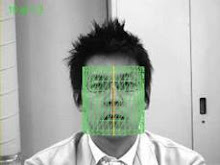
My niece Ana is an engineering student at Carnegie Mellon. The picture you see at the right is an example of work being done there that has the potential to make fine measurements of different parts of the face and face movement from videotapes.
Other attempts have involved maybe a hundred dots on the face that are monitored by software that measures changes.
There are a number of security companies that are hawking products that are intended to allow videotapes of crowds to pick out criminals. These seem to not to have been particularly successful yet, but the technology continues apace.
I was first exposed to the IDENT system for fingerprints about ten years ago when I started representing people accused of illegal entry into the United States. My first reaction was to have my clients refuse to incriminate themselves. How in the world would they ever prove who this guy was and that he was a Mexican national? Well, as a seasoned Assistant US Attorney showed me, they had solved that problem: Automatic Biometric Identification System (IDENT) using automated fingerprint identification systems (AFIS).
Every illegal alien would get each index finger swiped in a machine that recorded it. This then could be compared against a database (actually several databases) of other fingerprints to see if the alien was a recidivist or had a criminal history.
The old INS had been experimenting with this system in 1994 and by the time I was exposed to it in 1998 it was hot stuff.
Decades of success in just lying about your name and age ran head on into this new technology. (Can anyone imagine the plot of Les Miserable today with IDENT? Jean Valjean would never get the chance to reform and Javert would be replaced by a file clerk).
Now I love cool new gadgets and technology. I try to get the latest stuff whether or not I can afford it or figure out how to use it.
But advancing technology certainly changes old ideas about fresh starts and second chances. It also makes possible crimes of previously unimaginable magnitude.
I am still getting my mind around the complicity of New York based IBM in the holocaust. Without specially New York designed machines and punch cards to keep track of and route Polish Jews. They calculated rate of deaths per square kilometer due to progressive starvation and the number of Jews to be transported to the death camps. They kept tabs on trains dispatched to and from Auschwitz and Treblinka.
So my love of the new technology always comes with a queasy feeling. What is the human cost to the IDENT system alone. One anti-immigrant website argues there are more than 366,000 incarcerated illegal immigrants. http://immigrationcounters.com/
That may be high, because the Justice Department numbers look like they are closer to 200,000. In any case, the IDENT system has enabled a new efficiency that allows incarcerating huge numbers who w0uld previously have been sent back, unidentified.
I am no longer able to hear about or meet people incarcerated for immigration offenses without seeing in my minds eye, also, young wives and children who are now left to destitution. (Little Cosette cannot be saved by Jean Valjean because he is in Three Rivers federal prison). I know about them because they call and write and visit me. They wait out in the hall at court. These, Readers True, are real people and it is hard to meet them and not have the flesh crawl every time one the young men they depend upon gets duck-walked away in chains.
Automated Biometric Identification Systems for the face are now here and will soon be highly efficient. For a while, glasses or a new mustache would fool the systems, but now some of the new 3-D systems claim they can make an identification even with a stocking over the face and sun glasses.
The data bases for Illegal Entries have been collecting photographs from the beginning. But this is a sea change. Soon it will be possible to take photographs of crowds and identify everyone.
It will also be possible to sort these based on age, gender and race, prior criminal history, income level, house value, employment history, disease history, book purchases, credit card expenditures.
It will be possible to correlate the face with automobile ownership and travel history as recorded in GPS systems. And cell phone use as shown by tower locations and with searches of key words used in the conversations. And e-mail communications based on key words used and internet search history.
Also, check another dimension noted by Mr. Kurgan in his blog for today: http://andyoubrutus.blogspot.com/
If the FACS develops to its full promise, it will be possible to pick out who is worried or frightened or angry. And all this from a videotape of everyone at a football game or a protest march.
Just think what the Nazis could have done with this neat technology.
My niece Ana is an engineering student at Carnegie Mellon. The picture you see at the right is an example of work being done there that has the potential to make fine measurements of different parts of the face and face movement from videotapes.
Other attempts have involved maybe a hundred dots on the face that are monitored by software that measures changes.
There are a number of security companies that are hawking products that are intended to allow videotapes of crowds to pick out criminals. These seem to not to have been particularly successful yet, but the technology continues apace.
I was first exposed to the IDENT system for fingerprints about ten years ago when I started representing people accused of illegal entry into the United States. My first reaction was to have my clients refuse to incriminate themselves. How in the world would they ever prove who this guy was and that he was a Mexican national? Well, as a seasoned Assistant US Attorney showed me, they had solved that problem: Automatic Biometric Identification System (IDENT) using automated fingerprint identification systems (AFIS).
Every illegal alien would get each index finger swiped in a machine that recorded it. This then could be compared against a database (actually several databases) of other fingerprints to see if the alien was a recidivist or had a criminal history.
The old INS had been experimenting with this system in 1994 and by the time I was exposed to it in 1998 it was hot stuff.
Decades of success in just lying about your name and age ran head on into this new technology. (Can anyone imagine the plot of Les Miserable today with IDENT? Jean Valjean would never get the chance to reform and Javert would be replaced by a file clerk).
Now I love cool new gadgets and technology. I try to get the latest stuff whether or not I can afford it or figure out how to use it.
But advancing technology certainly changes old ideas about fresh starts and second chances. It also makes possible crimes of previously unimaginable magnitude.
I am still getting my mind around the complicity of New York based IBM in the holocaust. Without specially New York designed machines and punch cards to keep track of and route Polish Jews. They calculated rate of deaths per square kilometer due to progressive starvation and the number of Jews to be transported to the death camps. They kept tabs on trains dispatched to and from Auschwitz and Treblinka.
Says Robert Wolfe, the foremost expert on Nazi documentation and formerly chief of captured German records for the National Archives: ``For those who have complained that the proof is not there, this new evidence gives refutation. The juxtaposition of all these sources -- the new German documents, Justice Department records, the IBM files and eyewitness sources -- all together indicate it was not just trading with the enemy, not just IBM and the Third Reich. This is the proof that IBM enabled the Holocaust. The connection to New York is now proven.'' (Click on the title for the citation).IBM ENABLED THE HOLOCAUST! My Sweet Lord. Why isn't this big news and shocking to all? Why isn't this part of the culture of understanding corporate evil? Why hasn't this monster been destroyed by Justice (Department of) or at least by justice? Why has not the wrath of an angry God ripped Big Blue asunder?
So my love of the new technology always comes with a queasy feeling. What is the human cost to the IDENT system alone. One anti-immigrant website argues there are more than 366,000 incarcerated illegal immigrants. http://immigrationcounters.com/
That may be high, because the Justice Department numbers look like they are closer to 200,000. In any case, the IDENT system has enabled a new efficiency that allows incarcerating huge numbers who w0uld previously have been sent back, unidentified.
I am no longer able to hear about or meet people incarcerated for immigration offenses without seeing in my minds eye, also, young wives and children who are now left to destitution. (Little Cosette cannot be saved by Jean Valjean because he is in Three Rivers federal prison). I know about them because they call and write and visit me. They wait out in the hall at court. These, Readers True, are real people and it is hard to meet them and not have the flesh crawl every time one the young men they depend upon gets duck-walked away in chains.
Automated Biometric Identification Systems for the face are now here and will soon be highly efficient. For a while, glasses or a new mustache would fool the systems, but now some of the new 3-D systems claim they can make an identification even with a stocking over the face and sun glasses.
The data bases for Illegal Entries have been collecting photographs from the beginning. But this is a sea change. Soon it will be possible to take photographs of crowds and identify everyone.
It will also be possible to sort these based on age, gender and race, prior criminal history, income level, house value, employment history, disease history, book purchases, credit card expenditures.
It will be possible to correlate the face with automobile ownership and travel history as recorded in GPS systems. And cell phone use as shown by tower locations and with searches of key words used in the conversations. And e-mail communications based on key words used and internet search history.
Also, check another dimension noted by Mr. Kurgan in his blog for today: http://andyoubrutus.blogspot.com/
If the FACS develops to its full promise, it will be possible to pick out who is worried or frightened or angry. And all this from a videotape of everyone at a football game or a protest march.
Just think what the Nazis could have done with this neat technology.
Friday, April 11, 2008
What is this quintessence of dust?
Now to jump in the deep end without my floaties. The question here is whether we can look in the eyes and see the soul? Or more generally, can we look at a face and read the emotions?
This is the bigger view than the "human lie detector" issue. And it uses only one of the tools the interrogators use to get results. But it is where I want to start. And to paraphrase Old Joe Durham, "My soap. My blog. I'll wash it as long as I want."
Now for my reservations, and they are completely in opposition to each other.
First, maybe I am not smart enough or in possession of the right special skills or hard working enough to learn this stuff. It reminds me of a hundred other projects I have begun that fizzled out. Like the times I tried to teach myself Ancient Greek. Or calculus. Or oil painting. Or sculpting. Or Arabic. Or hypnotism. Or astronomy. Or quantum mechanics. The list goes on.
Second, I am afraid that it is a completely phony area of study. Jay Stephen Gould describes these types of errors in The Mismeasure of Man. Scientists measured a bunch of skulls to find out what a criminal's skull looked like. Then they tried to predict who would be a criminal by measuring different parts of the head. The whole field proved to be both stupid and pernicious.
One other gnawing doubt. What if I do learn it and it proves not to be phony? I get this special vision of the human soul. Then do I end up dieing like Kurtz:
If you can't count them, how do you know what they are? I pulled out my old Anatomy and Physiology Book from my class with Dr. Peña. It lists about 20 muscles, not counting the ones that move the eyeball. Some of those are in pairs.
Darwin says, "Some writers consider that these muscles consist of nine pairs, with one unpaired; but others make the number much larger amounting even to fifty-five...."
Some internet sources list 52. (And a lot of discussion of whether it really takes more muscles to frown than to smile).
To complicate the issue further, Darwin, explains the structures of the muscles differ from person to person. When we are trying to figure out what the face is telling us we run into this problem: "Thus the power of uncovering the canine tooth on one side differs much in different persons. the power of raising the wings of the nostrils is also...variable in a remarkable degree; and other such cases could be given."
Nonetheless, Darwin gives us twelve muscles that he uses to describe the expression of emotion. For instance, this is how the muscles react when a human being weeps:
Now fast forward an hundred years and see what this science looks like with modern measurement tools. It has largely been developed by a guy named Paul Ekman.
Subjects were made to to stare into a camera lens to be recorded on videotape. A starter pistol was used for some experiments, but there was a fear the subjects' hearing was endangered. Also, the directional properties of the shots could not be controlled. So startle sounds of white noise were produced electronically, amplified and run into speakers or headphones. Several variations of these themes were developed to distinguish between spontaneous and deliberate facial movements and between emotional and non-emotional facial movements.
Then they had to decide what to measure. Action Units were numbered that described different movements of the muscles. It is a system called Facial Action Coding System (FACS). For instance Action Unit (AU) 1 involves the inner frontalis muscle and the action is "Raises inner corner of brow." These AU's describe things like AU12, Zygomatic major, Common smile and AU45, Orbicularis oculi, Blink or Wink.
Once they decided what to measure, there was the question of how? Two choices presented themselves: 1. "coders" who graded the movements, or 2. Electromyograph testing of the muscles.
Even judging the slow motion videotapes, there was a risk of bias in the measurements. The coders were tested against each other to find out how reliable they were.
The EMG gave a much finer scale of measurement, but apparently it was difficult to measure "spontaneous happy expressions" on the part of a subject who had a bunch of needles stuck in his face.
After enough review of videotapes carefully measuring many different muscle combinations by enough carefully tested coders, finally the payoff: spontaneous happy expressions were more symmetrical than requested actions expressing happiness.
In other words, there may be some sadness in that lopsided grin.
This is the bigger view than the "human lie detector" issue. And it uses only one of the tools the interrogators use to get results. But it is where I want to start. And to paraphrase Old Joe Durham, "My soap. My blog. I'll wash it as long as I want."
Now for my reservations, and they are completely in opposition to each other.
First, maybe I am not smart enough or in possession of the right special skills or hard working enough to learn this stuff. It reminds me of a hundred other projects I have begun that fizzled out. Like the times I tried to teach myself Ancient Greek. Or calculus. Or oil painting. Or sculpting. Or Arabic. Or hypnotism. Or astronomy. Or quantum mechanics. The list goes on.
Second, I am afraid that it is a completely phony area of study. Jay Stephen Gould describes these types of errors in The Mismeasure of Man. Scientists measured a bunch of skulls to find out what a criminal's skull looked like. Then they tried to predict who would be a criminal by measuring different parts of the head. The whole field proved to be both stupid and pernicious.
One other gnawing doubt. What if I do learn it and it proves not to be phony? I get this special vision of the human soul. Then do I end up dieing like Kurtz:
"He cried in a whisper at some image, at some vision,—he cried out twice, a cry that was no more than a breath—'The horror! The horror!'All right, enough procrastination. We begin as Darwin does, with the muscles of the face. Here the problems begin.
If you can't count them, how do you know what they are? I pulled out my old Anatomy and Physiology Book from my class with Dr. Peña. It lists about 20 muscles, not counting the ones that move the eyeball. Some of those are in pairs.
Darwin says, "Some writers consider that these muscles consist of nine pairs, with one unpaired; but others make the number much larger amounting even to fifty-five...."
Some internet sources list 52. (And a lot of discussion of whether it really takes more muscles to frown than to smile).
To complicate the issue further, Darwin, explains the structures of the muscles differ from person to person. When we are trying to figure out what the face is telling us we run into this problem: "Thus the power of uncovering the canine tooth on one side differs much in different persons. the power of raising the wings of the nostrils is also...variable in a remarkable degree; and other such cases could be given."
Nonetheless, Darwin gives us twelve muscles that he uses to describe the expression of emotion. For instance, this is how the muscles react when a human being weeps:
The corrugators of the brow (corrugator supercilii) seem to be the first muscles to contract and these draw the eyebrows downward and inwards towards the base of the nose.... (This goes on for three pages discussing the malaris muscles, orbicular muscles, pyramidal muscles, and on and on).If you see all of this, you know a person is weeping and therefore probably, "suffering of the body and mind."
Now fast forward an hundred years and see what this science looks like with modern measurement tools. It has largely been developed by a guy named Paul Ekman.
Subjects were made to to stare into a camera lens to be recorded on videotape. A starter pistol was used for some experiments, but there was a fear the subjects' hearing was endangered. Also, the directional properties of the shots could not be controlled. So startle sounds of white noise were produced electronically, amplified and run into speakers or headphones. Several variations of these themes were developed to distinguish between spontaneous and deliberate facial movements and between emotional and non-emotional facial movements.
Then they had to decide what to measure. Action Units were numbered that described different movements of the muscles. It is a system called Facial Action Coding System (FACS). For instance Action Unit (AU) 1 involves the inner frontalis muscle and the action is "Raises inner corner of brow." These AU's describe things like AU12, Zygomatic major, Common smile and AU45, Orbicularis oculi, Blink or Wink.
Once they decided what to measure, there was the question of how? Two choices presented themselves: 1. "coders" who graded the movements, or 2. Electromyograph testing of the muscles.
Even judging the slow motion videotapes, there was a risk of bias in the measurements. The coders were tested against each other to find out how reliable they were.
The EMG gave a much finer scale of measurement, but apparently it was difficult to measure "spontaneous happy expressions" on the part of a subject who had a bunch of needles stuck in his face.
After enough review of videotapes carefully measuring many different muscle combinations by enough carefully tested coders, finally the payoff: spontaneous happy expressions were more symmetrical than requested actions expressing happiness.
In other words, there may be some sadness in that lopsided grin.
Subscribe to:
Posts (Atom)







_-_Dante_And_Virgil_In_Hell_(1850).jpg)