Mr. Dupin observes: Perhaps its the translation,but I find it difficult to take any real meaning from XVIII other than what seems apparent on its face: "That Men Are Not to Judge Of Our Happiness Till After Death" because Fortune plays a role.
This is my reading as well. An aside, Uncle Toby: The translation I read is by Donald M. Frame. It is a 20th Century Translation first published in 1957. Mr. Dupin uses Charles Cotton's translation from the late 17th Century. John Florio's translation from the early 17th Century is the one to which I linked yesterday's post. Both Cotton's and Florio's translations are pleasing to the ear. Frame's is easier for me to understand.
Austin, though, tells me I am missing the whole point of the essay. He gives three clues to support his argument: 1. When referring to the Latin, pre-Christian writers, "fortune" is not capitalized, but when referring to the present day, "Fortune" is capitalized. 2. When reaching his conclusion, he notes, "God has willed it as he pleased...." 3. Montaigne notes three (not two or four) execrable and infamous persons whose deaths were ordered and "in every sense composed to perfection." 4. The "by his fall" language echoes the descent into hell of Jesus and other Christian references.
Austin says, we may dismiss one or two of these clues, but at three,we have to pay attention because Montaigne fills his essays with hints of his true intentions. And however much he may love the classics, Montaigne is still very much the Christian.
This, then, is the the argument Austin gives from the hints: "That our happiness must not be judged until after our death" is a rejection of the pagan virtues and an embrace of salvation through Christ. Upon death, the "power and fame" to which we aspire by a career is surpassed by something more grand and glorious than we have desired or hoped.
The pagans before Jesus recognized that "however fortune (small 'f') may smile on them, men cannot be called happy until they have been seen to spend the last day of their lives. The pre-Christian standard is the "state" of the person. If a king is captured and ends up a carpenter or clerk to Rome, his station in life has changed and he cannot be happy.
Today (Montaigne's time) we have Jesus and the present time is indicated when saying, "For it seems that, as storms and tempests are provoked to humble the pride and loftiness of our buildings," so are there "spirits up above" who are envious of grandeurs here below and will wreak havoc on human things and trample all that speaks of human eminence and laugh them all to scorn.
It further seems (again in Montaigne's Christian present tense) that "Fortune (big 'f') sometimes lies in wait precisely for the last day of our life, to show her power to overturn in a moment what she has built up over many years...."
The three execrable and infamous persons are meant to remind us of Jesus and the two thieves on the cross. And the holy trinity. Who but Jesus had a death that was "ordered and in every circumstance composed to perfection?"
By embracing Christian Grace and rejecting the ambitions and designs of man, we can gain a gallant and fortunate death. Through Christ, we may arrive where we "aspired to without going there, more grandly and gloriously" than we had desired or hoped. By our fall we may go beyond the power and the fame to which we had aspired in by our careers.
According to Austin, in this essay, Montaigne answers the question, "Does it matter, this success or failure in life?" with, "No. Success and failure are replaced by something more grand and glorious--the Peace of Christ. This is what allows us when we die to "go well, that is to say quietly and insensibly."
Mr. Dupin also notes that as with the Bible, "improper translation and interpretation can lead to unintended results." This has long concerned me. If Jesus spoke Aramaic, and then His words were written down in Greek and much later translated to English, how am I to rely on what Jesus supposedly said, not speaking or reading Aramaic or Greek?
Neither do I read French. Oh, to be an exegete.
Showing posts with label GOAB. Show all posts
Showing posts with label GOAB. Show all posts
Tuesday, May 20, 2008


Monday, May 19, 2008
Interpreting Montaigne: Ed's superficial reading of the Essay of judging happiness only after death
I was pleased with the comments yesterday's blog elicited. As Mr. Dupin observed, Montaigne (the granddaddy of all bloggers, GOAB) does say it best, in his essay, (aptly named for our subject) "That our happiness must not be judged until after our death." He begins by quoting Ovid:
No man should be called happy till his death;
Always we must await his final day
Reserving judgment till he's laid away.
Here I have the aid of my son, Austin, back from his studies for a few days, in interpreting: Ovid's stories involve metamorphosis. The man with the grief in his old age was Cadmus. "Actaeon, one of your grandsons, was your first reason for grief, in all your happiness, Cadmus." The grandson grew horns on his forehead and his hunting dogs ate him. As long and happy as Cadmus' life had been when his grandchildren began to suffer, his joy ended.
Mr. Hugo 2006 adds the alliterative "lawyers' lament" verdict to the concerns about success and failure. But we lawyers cannot take comfort from the fact we are largely too selfish to find ourselves working in a hospice; we very well may end up the recipient of the care.
Montaigne makes the point, "God has willed it as he pleased; but in my time three of the most execrable and most infamous persons I have known in very abomination of life have had deaths that were ordered and in every circumstance composed to perfection."
And it feels like to me, good people often have nasty, ugly deaths. When the wrong organs begin to fail before the rest of the body, long periods a pain result.
Montaigne also tells us, "In judging the life of another, I always observe how it ended; and one of my principal concerns about my own end is that it shall go well, that is to say quietly and insensibly."
Montaigne is concerned that we may live just a day too long. He quotes someone named Laberius: "Truly this day I have lived one day longer than I should have." When I first read that I tried to figure out who Laberius was and why he thought he should have avoided a certain day.
One guy named Laberius was ridiculed by Julius Caesar but he won the day by being quicker witted. This is all I can find out about him, but it doesn't seem like his last day disgraced his historical legacy, in any case.
Another guy name Laberius died in Britain with a spear through his lung.
Lingering on seems to give the chance to repair a reputation. It is rather like refusing to pass the examination of a harmful witness until something good comes of the testimony. A line in Chinatown made this point: "Course I'm respectable. I'm old. Politicians, ugly buildings, and whores all get respectable if they last long enough."
Presidents are said to worry about what history will say. And I have friends who worry about a legacy. "Will I be known as a greater lawyer than Clarence Darrow?" That sort of thing.
Now my task is to decide whether or not it matters.
That all having been said, Austin tells me I have missed the whole point of the essay. On the next post, I'll describe what he says it really means.
Sunday, May 4, 2008
Thoughts about dying and death
When I told Kathy I was going to write about dying and death today, she gave one of her caustic comments about me opining on another subject about which I know nothing. On the contrary, Kathy, this is the only subject to which I have the same access as all other mortals.
Montaigne (the Granddaddy of All Bloggers, GOAB) makes this point in his Of Practice. We can gain a proficiency through practice in all other human tasks, "But for dying, which is the greatest task we have to perform, practice cannot help us. A man can, by habit and experience, fortify himself against pain, shame, indigence, and such other accidents; but as for death, we can try it only once: we are all apprentices when we come to it."
Montaigne then describes an incident in which he was knocked off his horse by a bigger horse and rider. "It is the only swoon I have experienced to this day," he relates. He didn't think the experience of being close to death, at first, was that bad: "It seemed to me that my life was hanging only by the tip of my lips; I closed my eyes in order, it seemed to me, to help push it out, and took pleasure in growing languid and letting myself go. It was an idea that was only floating on the surface of my soul, as delicate and feeble as all the rest, but in truth not only free from distress but mingled with that sweet feeling that people have who let themselves slide into sleep."
Later he started throwing up clots of blood. And then after two or three hours he began to feel himself caught up in the pains, he says, "...my limbs being all battered and bruised by my fall; and I felt so bad two or three nights after that I thought I was going to die all over again, but by a more painful death; and I still feel the effect of the shock of that collision."
Montaigne in another essay, Judging the death of others, says being dead is not what troubles us, but dying. He quotes (someone completely unknown to me) Epicharmus: "It is not death, but dying, that I fear.
When Caesar was asked what death he found most desirable, he answered (again according to GOAB), "The least premeditated and the quickest." And Pliny, "A quick death is the supreme good fortune of human life."
I have thought that an easy death for me would be by drowning. I once suggested to Kathy that if I fall into senility, she take me to the beach, point out to sea, and tell me to swim to an island paradise. (She wanted to know if it would work right then.)
When I described this plan as an easy death to Brownsville Blogger Stan Raines, he gave me a book of poems he had written, There's More to Blues Than Meets the Eye. One of his poems, The Sea, begins:
It might be a far worse death than Stan or I imagine, but I had an experience when I was in college that makes me think it might not be the worst of all. I, then, fancied myself the greatest of under-water swimmers. I could take several deep breaths and swim from a lakeside restaurant in Lake Travis to a ski ramp near the other side of the lake. Though, we never did, there was some discussion of taking bets on the matter.
Once, in a pool, with my friends Dan Boyd and Stephen McNally present, I was going to put on a demonstration. I was going to swim laps in the pool far beyond anyone's expectations and to universal amazement and admiration. I did. However, at some point I stopped swimming and began to sink. The only thing I remember was Stephen pulling me out and telling me that my competitive spirit was in conflict with the likelihood I would enjoy a long life.
That wasn't so bad. I lost consciousness and it may have been I would have been unaware of the dying part and gone straight to the death. I'm glad it didn't happen then, and I don't want it to happen any time soon, but, Lord, may I be blessed with an easy way out.
Sherwin B. Nuland is a favorite writer of mine on death. One way to judge a book is to look at the index. If it quotes Montaigne, it's a keeper. Nuland, a surgeon from Yale, in his book How we Die, quotes Montaigne twice. (He also quotes Tolstoy, Shakespeare and Laurence Sterne. What a guy.)
Lawyers don't have to see much death, but some of us must hear many very good descriptions of death. Nuland, on the other hand wrote about death after seeing it at close hand over a long career. He says he would like to have a death without suffering, but the overwhelming odds are against it: "Like most people, I will probably suffer with the physical and emotional distress that accompany many mortal illnesses, and like most people I will probably compound the the pained uncertainty of my last months by the further agony of indecision--to continue or to give in, to be treated aggressively or to be comforted, to struggle for the possibility of more time or to call it a day and a life--these are the two sides of the mirror into which we look when afflicted by those illnesses that have the power to kill."
So I will be most likely trapped as well. Stretching out the agony with the hope of recovery or at least a little more time.
Nuland reminds us of the words Shakespeare gives to Julius Caesar:
Montaigne (the Granddaddy of All Bloggers, GOAB) makes this point in his Of Practice. We can gain a proficiency through practice in all other human tasks, "But for dying, which is the greatest task we have to perform, practice cannot help us. A man can, by habit and experience, fortify himself against pain, shame, indigence, and such other accidents; but as for death, we can try it only once: we are all apprentices when we come to it."
Montaigne then describes an incident in which he was knocked off his horse by a bigger horse and rider. "It is the only swoon I have experienced to this day," he relates. He didn't think the experience of being close to death, at first, was that bad: "It seemed to me that my life was hanging only by the tip of my lips; I closed my eyes in order, it seemed to me, to help push it out, and took pleasure in growing languid and letting myself go. It was an idea that was only floating on the surface of my soul, as delicate and feeble as all the rest, but in truth not only free from distress but mingled with that sweet feeling that people have who let themselves slide into sleep."
Later he started throwing up clots of blood. And then after two or three hours he began to feel himself caught up in the pains, he says, "...my limbs being all battered and bruised by my fall; and I felt so bad two or three nights after that I thought I was going to die all over again, but by a more painful death; and I still feel the effect of the shock of that collision."
Montaigne in another essay, Judging the death of others, says being dead is not what troubles us, but dying. He quotes (someone completely unknown to me) Epicharmus: "It is not death, but dying, that I fear.
When Caesar was asked what death he found most desirable, he answered (again according to GOAB), "The least premeditated and the quickest." And Pliny, "A quick death is the supreme good fortune of human life."
I have thought that an easy death for me would be by drowning. I once suggested to Kathy that if I fall into senility, she take me to the beach, point out to sea, and tell me to swim to an island paradise. (She wanted to know if it would work right then.)
When I described this plan as an easy death to Brownsville Blogger Stan Raines, he gave me a book of poems he had written, There's More to Blues Than Meets the Eye. One of his poems, The Sea, begins:
When I have reached sufficient age
And experience has filled me up
And the world has drained me dry
I will heed god's call and take me to the sea.
It might be a far worse death than Stan or I imagine, but I had an experience when I was in college that makes me think it might not be the worst of all. I, then, fancied myself the greatest of under-water swimmers. I could take several deep breaths and swim from a lakeside restaurant in Lake Travis to a ski ramp near the other side of the lake. Though, we never did, there was some discussion of taking bets on the matter.
Once, in a pool, with my friends Dan Boyd and Stephen McNally present, I was going to put on a demonstration. I was going to swim laps in the pool far beyond anyone's expectations and to universal amazement and admiration. I did. However, at some point I stopped swimming and began to sink. The only thing I remember was Stephen pulling me out and telling me that my competitive spirit was in conflict with the likelihood I would enjoy a long life.
That wasn't so bad. I lost consciousness and it may have been I would have been unaware of the dying part and gone straight to the death. I'm glad it didn't happen then, and I don't want it to happen any time soon, but, Lord, may I be blessed with an easy way out.
Sherwin B. Nuland is a favorite writer of mine on death. One way to judge a book is to look at the index. If it quotes Montaigne, it's a keeper. Nuland, a surgeon from Yale, in his book How we Die, quotes Montaigne twice. (He also quotes Tolstoy, Shakespeare and Laurence Sterne. What a guy.)
Lawyers don't have to see much death, but some of us must hear many very good descriptions of death. Nuland, on the other hand wrote about death after seeing it at close hand over a long career. He says he would like to have a death without suffering, but the overwhelming odds are against it: "Like most people, I will probably suffer with the physical and emotional distress that accompany many mortal illnesses, and like most people I will probably compound the the pained uncertainty of my last months by the further agony of indecision--to continue or to give in, to be treated aggressively or to be comforted, to struggle for the possibility of more time or to call it a day and a life--these are the two sides of the mirror into which we look when afflicted by those illnesses that have the power to kill."
So I will be most likely trapped as well. Stretching out the agony with the hope of recovery or at least a little more time.
Nuland reminds us of the words Shakespeare gives to Julius Caesar:
Of all the wonders that I have yet heard,
It seems to most strange that men should fear;
Seeing that death, a necessary end,
Will come when it will come.
Saturday, April 12, 2008
On Sumptuary Laws, with apologies to GOAB
And now for the Sumptuary Laws.
I was on a steady course of examining the secrets told by the face about the emotions, when I was diverted by a glancing blow. One commenter, carrying the moniker of "Anonymous," suggested that GOAB would not have wasted his time with such trivialities as the particularities of some disapproved French Law. I replied, "But he did. See his essay On the sumptuary laws."
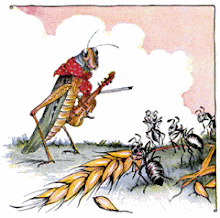
To make sure I was right about that, I reread the essay. Now, of course, I want to write about the sumptuary laws. (Yes, ML, again, mimetic theory). (No, Raulito, I am not yet advising you bring these to Cuba; right now we are only exploring the idea). (Yes, Grasshopper, I will return to the task at hand soon, very soon).
Sumptuary Laws restrict certain types of people from buying certain kinds of things, like clothes or food.
In Ancient Rome Tyrian Purple dye is said to have been first restricted to victorious generals. Later even beardless child Emporers took up the habit, but it was not supposed to be worn by mere wealthy merchants.
The dye was expensive because it was made from the mucus of certain marine mollusks and thousands of the little creatures were smashed to make a gram of the stuff. A Phoenician is said to have figured it out when his dog was out cracking the shells and eating mariscos when the dog's mouth turned purple. The Phoenician Kings grabbed it as their royal symbol and kept the secret of how to make it as long as they could.
Once the Phoenician Kings had it, the Roman hot shots had coveted it as well. (Yes, again, ML). Part of the reason was to make sure the right people enjoyed their fair share of toadying. Because sycophants were much more readily available than mollusks, laws were needed to make sure the merely wealthy did not cut in on the action.
I have to think that an ulterior motive was to keep all the good Roman hard cash from being shipped to the Phoenicians for such a frivolous purpose.
The French had their own restrictions saying, according to GOAB, that none but princes, "shall eat turbot, or shall be allowed to wear velvet and gold braid." Turbot, it seems, is a flat fish related to a flounder. (Cap'n Bob, Cap'n Bill, this would be your arena).
Although GOAB did not mind having ways to distinguish between the classes, but he did not like these laws:
GOAB saw it as a simple matter. Kings and princes could abandon these expenses and within a month everyone else would imitate them.
He suggested that the law should restrict these expenditures to "mountebanks and courtesans." GOAB was following the lead of a Greek lawyer named Zaleucus who drafted an ordinance saying that, a free woman may not be attended by more than one chambermaid unless she is drunk. Nor may she wear gold jewels about her person or an embroidered dress unless she is a public whore. And no man, unless he is a pimp, is allowed to wear a gold ring on his finger.
(If there are any Wesleyans out there, remember the similar theme by John Wesley: "I have one word more to say to parents; to mothers in particular. If, in spite of all the Apostle can say, you encourage your children by your example to "adorn" themselves "with gold, or pearls, or costly apparel," you and they must drop into the pit together." I'm not a Methodist, but if John Wesley feels this strongly about the issue, gold, pearls and costly apparel are off my shopping list). (Pardon me, Uncle Toby).
What if we brought a Zaleucus ordinance to our own conspicuous consumers? Only drug dealers, prostitutes and procurers will be allowed to purchase or drive expensive vehicles. Private yachts and jets are also restricted to drug dealers, prostitutes and procurers. At the airplane or yacht dealership (is there such a thing?) the purchaser would be required to sign a statement, "I affirm that I am a drug dealer, prostitute or procurer and will use this expensive means of transportation to entertain customers."
If you see a monster luxury Lexus SUV, it would be polite to tap on the window and say, "Excuse me kind sir, but I suffer from the vice of drug addiction. I see from your car, you are a dealer. Would I be able to purchase an eight ball, please?" Or, "Yes, kind lady, I see from your car that you are a prostitute. I only have $50, but do you suppose....?"
Not everyone would follow the law of course. There would be certain sheep in wolves clothing who would pretend to be drug dealers or prostitutes or procurers so they could drive the expensive car. Then the gossip would change when they dropped their kids off at elementary school. "Those phonies. Look at the car. He's not really a drug dealer, but secretly owns an automobile dealership. And she's not really a prostitute, but owns a boutique on the Island." That sort of thing.
I know my libertarian friends will argue this is a poor way to address the problem of "vain and insane expenditures." Raulito and I are open to other suggestions.
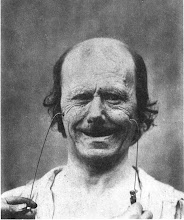
I was on a steady course of examining the secrets told by the face about the emotions, when I was diverted by a glancing blow. One commenter, carrying the moniker of "Anonymous," suggested that GOAB would not have wasted his time with such trivialities as the particularities of some disapproved French Law. I replied, "But he did. See his essay On the sumptuary laws."
To make sure I was right about that, I reread the essay. Now, of course, I want to write about the sumptuary laws. (Yes, ML, again, mimetic theory). (No, Raulito, I am not yet advising you bring these to Cuba; right now we are only exploring the idea). (Yes, Grasshopper, I will return to the task at hand soon, very soon).
Sumptuary Laws restrict certain types of people from buying certain kinds of things, like clothes or food.
In Ancient Rome Tyrian Purple dye is said to have been first restricted to victorious generals. Later even beardless child Emporers took up the habit, but it was not supposed to be worn by mere wealthy merchants.
The dye was expensive because it was made from the mucus of certain marine mollusks and thousands of the little creatures were smashed to make a gram of the stuff. A Phoenician is said to have figured it out when his dog was out cracking the shells and eating mariscos when the dog's mouth turned purple. The Phoenician Kings grabbed it as their royal symbol and kept the secret of how to make it as long as they could.
Once the Phoenician Kings had it, the Roman hot shots had coveted it as well. (Yes, again, ML). Part of the reason was to make sure the right people enjoyed their fair share of toadying. Because sycophants were much more readily available than mollusks, laws were needed to make sure the merely wealthy did not cut in on the action.
I have to think that an ulterior motive was to keep all the good Roman hard cash from being shipped to the Phoenicians for such a frivolous purpose.
The French had their own restrictions saying, according to GOAB, that none but princes, "shall eat turbot, or shall be allowed to wear velvet and gold braid." Turbot, it seems, is a flat fish related to a flounder. (Cap'n Bob, Cap'n Bill, this would be your arena).
Although GOAB did not mind having ways to distinguish between the classes, but he did not like these laws:
The way in which our laws try to regulate vain and insane expenditures for the table and for clothes seems to be opposed to their purpose. The real way would be to engender in men contempt for gold and silk, as vain and useless things; whereas we increase their honor and value, which is a very inept way to make men lose their taste for them.
GOAB saw it as a simple matter. Kings and princes could abandon these expenses and within a month everyone else would imitate them.
He suggested that the law should restrict these expenditures to "mountebanks and courtesans." GOAB was following the lead of a Greek lawyer named Zaleucus who drafted an ordinance saying that, a free woman may not be attended by more than one chambermaid unless she is drunk. Nor may she wear gold jewels about her person or an embroidered dress unless she is a public whore. And no man, unless he is a pimp, is allowed to wear a gold ring on his finger.
(If there are any Wesleyans out there, remember the similar theme by John Wesley: "I have one word more to say to parents; to mothers in particular. If, in spite of all the Apostle can say, you encourage your children by your example to "adorn" themselves "with gold, or pearls, or costly apparel," you and they must drop into the pit together." I'm not a Methodist, but if John Wesley feels this strongly about the issue, gold, pearls and costly apparel are off my shopping list). (Pardon me, Uncle Toby).
What if we brought a Zaleucus ordinance to our own conspicuous consumers? Only drug dealers, prostitutes and procurers will be allowed to purchase or drive expensive vehicles. Private yachts and jets are also restricted to drug dealers, prostitutes and procurers. At the airplane or yacht dealership (is there such a thing?) the purchaser would be required to sign a statement, "I affirm that I am a drug dealer, prostitute or procurer and will use this expensive means of transportation to entertain customers."
If you see a monster luxury Lexus SUV, it would be polite to tap on the window and say, "Excuse me kind sir, but I suffer from the vice of drug addiction. I see from your car, you are a dealer. Would I be able to purchase an eight ball, please?" Or, "Yes, kind lady, I see from your car that you are a prostitute. I only have $50, but do you suppose....?"
Not everyone would follow the law of course. There would be certain sheep in wolves clothing who would pretend to be drug dealers or prostitutes or procurers so they could drive the expensive car. Then the gossip would change when they dropped their kids off at elementary school. "Those phonies. Look at the car. He's not really a drug dealer, but secretly owns an automobile dealership. And she's not really a prostitute, but owns a boutique on the Island." That sort of thing.
I know my libertarian friends will argue this is a poor way to address the problem of "vain and insane expenditures." Raulito and I are open to other suggestions.
Monday, April 7, 2008
Of the Disadvantage of Greatness.
Why not aspire to greatness? Especially when young, why not decide to be CEO or President of Something or Congressman from Somewhere or Lord Mayor of London?
Why can't I sleep on silk sheets, eat salmon roe and wear diamonds the size of horse-dung? Why can't I have a trophy car, long and sleek and maybe a horse or dog bought from the very cover of the Horse and Dog Lovers Gazette?
Or a jet. "No, damn it, I don't want the King Air today. Get the Hawker ready."
At my age, rejecting greatness has a faint odor of sour grapes and laziness. But looking back, I feel blessed to have failed in all of my periodic spasms of ambition.
As always for me, GOAB leads the discussion on this issue (his essay is hidden under the title). By the way, for all of you Montaigne lovers, although the link provides a reference to a different translator, my favorite is one Donald M. Frame. This version of The Complete Essays will be available at the Brownsville Public Library just as soon as I return it.
GOAB immediately acknowledges that he is ill-suited for the pursuit of greatness: "To eschew greatness is a virtue, its seems to me, which I, who am only a gosling, could attain without great striving." Yes, the laziness factor. This then, in moderation, is virtue in itself. If a little Sloth can curb a great deal of Pride, Avarice and Lust, how can it be all bad?
He then gives the proper means of growth: "When I think of growing, it is in a lowly way, with a contsrained and cowardly growth, strictly for myself: in resolution, wisdom, health, beauty, and even riches."
And then to the jugular: "But that prestige, all that powerful authority, oppresses my imagination."
GOAB then goes forward with the many disadvantages of greatness: Your jokes are always funny and your advice is always wise. And the only skill you can develop is managing horses, because they, at least, will not let you win.
He shows that greatness in itself it to be avoided, and gives the reasons why.
Shakespeare also makes the point in Henry IV, Part 2. King Henry says:
Why isn't there more advantage to wealth and power in life? It is the problem with death. As G.K. Chesterton describes in one of his Father Brown stories:
Why can't I sleep on silk sheets, eat salmon roe and wear diamonds the size of horse-dung? Why can't I have a trophy car, long and sleek and maybe a horse or dog bought from the very cover of the Horse and Dog Lovers Gazette?
Or a jet. "No, damn it, I don't want the King Air today. Get the Hawker ready."
At my age, rejecting greatness has a faint odor of sour grapes and laziness. But looking back, I feel blessed to have failed in all of my periodic spasms of ambition.
As always for me, GOAB leads the discussion on this issue (his essay is hidden under the title). By the way, for all of you Montaigne lovers, although the link provides a reference to a different translator, my favorite is one Donald M. Frame. This version of The Complete Essays will be available at the Brownsville Public Library just as soon as I return it.
GOAB immediately acknowledges that he is ill-suited for the pursuit of greatness: "To eschew greatness is a virtue, its seems to me, which I, who am only a gosling, could attain without great striving." Yes, the laziness factor. This then, in moderation, is virtue in itself. If a little Sloth can curb a great deal of Pride, Avarice and Lust, how can it be all bad?
He then gives the proper means of growth: "When I think of growing, it is in a lowly way, with a contsrained and cowardly growth, strictly for myself: in resolution, wisdom, health, beauty, and even riches."
And then to the jugular: "But that prestige, all that powerful authority, oppresses my imagination."
GOAB then goes forward with the many disadvantages of greatness: Your jokes are always funny and your advice is always wise. And the only skill you can develop is managing horses, because they, at least, will not let you win.
He shows that greatness in itself it to be avoided, and gives the reasons why.
Shakespeare also makes the point in Henry IV, Part 2. King Henry says:
How many thousand of my poorest subjectsAnd then,
Are at this hour asleep! O sleep, O gentle sleep,
Nature's soft nurse, how have I frighted thee,
That thou no more wilt weigh my eyelids down
And steep my senses in forgetfulness?
Even if we cannot accept wholesale the argument of GOAB and King Henry that greatness in itself is not worthwhile. Certainly, the easier argument is that life is just too short to bother.
Canst thou, O partial sleep, give thy repose
To the wet sea-boy in an hour so rude,
And in the calmest and most stillest night,
With all appliances and means to boot,
Deny it to a king? Then happy low, lie down!
Uneasy lies the head that wears a crown.
Why isn't there more advantage to wealth and power in life? It is the problem with death. As G.K. Chesterton describes in one of his Father Brown stories:
"There is in the world a very aged rioter and demagogue who breaks into the most refined retreats with the dreadful information that all men are brothers, and wherever this leveller went on his pale horse it was Father Brown's trade to follow."
Sunday, April 6, 2008
Communist Cuba Dabbling in Distributism
Bloggers (the few I have met and as best I can tell from reading) seem endlessly fascinated by whether and if so, how much, their blog is being read. I confess this fault. I put one of the free counters on the blog and it is something of a utilometer of my personal happiness. Each little tick of the counter is another little squirt of dopamine.
More sophisticated bloggers apparently have more sophisticated counters and get additional squirts from learning how widely read they are, based on area codes I guess.
I know this all runs counter to my blogging goal as taken from the Granddaddy of All Bloggers:
It is obvious to me: Raul Castro has been reading my blog. Not only that, I have converted him to distributism. Let me say it again: RAUL CASTRO IS ONE OF MY READERS!!!!
Now it is important I carefully cultivate this first new convert to distributism. First, how to address him? We distributists are anti-hierarchical and I hardly think either Mr. President or General Castro are appropriate.
Nor can I bring myself to say, "Comrade." First, I don't know if this will be part of the distributist tradition. I have not seen the word yet in Chesterton or Hilloc. Also, since we have not met, this may overly familiar. On the other hand, "Raul" or even "Raulito" feels OK, for some reason. Maybe because of that guy who sells the eye surgery on TV.
I am so happy to have you on board, Raulito, that I will happily serve as consultant. To that end, I will be reading medieval Church history and economic and legal forms. More to the point, though, Raulito, I would suggest we approach an appropriate order to come in and help run things. I suggest we avoid the more warlike groups like the Hospitallers of Jerusalem in favor of say, Franciscans or Cistercians.
Now that I know you (Raulito) are a reader, I'll give little hints along the way.
This transition from Cuban Communism to distributism should in some ways be quite smooth, because there are not big landowners with whom we must deal. On the other hand the human rights issues have been a problem in Cuba since they were reported by Bartolome de las Casas, but, hey, human rights is the whole idea behind distributism.
Now if only George W. will start reading.
More sophisticated bloggers apparently have more sophisticated counters and get additional squirts from learning how widely read they are, based on area codes I guess.
I know this all runs counter to my blogging goal as taken from the Granddaddy of All Bloggers:
"I have no thought of serving either you or my own glory. My powers are inadequate for such a purpose. I have dedicated it to the private convenience of my relatives and friends, so that when they have lost me (as soon they must), they may recover here some features of my habits and temperament. Thus reader...you would be unreasonable to spend your leisure on so frivoulous and vain pursuit."Indulge my pride, though as a tell you based on certain empirical evidence I have a celebrity reader. It was only Friday past when I urged an economic system based on medieval Catholicism, distributism. Two days later, I see the headlines, "Cuba to Lend Land--In a bid to boost agricultural production, Raul Castro's government is lending Cuba's unused land to private farmers and cooperatives."
It is obvious to me: Raul Castro has been reading my blog. Not only that, I have converted him to distributism. Let me say it again: RAUL CASTRO IS ONE OF MY READERS!!!!
Now it is important I carefully cultivate this first new convert to distributism. First, how to address him? We distributists are anti-hierarchical and I hardly think either Mr. President or General Castro are appropriate.
Nor can I bring myself to say, "Comrade." First, I don't know if this will be part of the distributist tradition. I have not seen the word yet in Chesterton or Hilloc. Also, since we have not met, this may overly familiar. On the other hand, "Raul" or even "Raulito" feels OK, for some reason. Maybe because of that guy who sells the eye surgery on TV.
I am so happy to have you on board, Raulito, that I will happily serve as consultant. To that end, I will be reading medieval Church history and economic and legal forms. More to the point, though, Raulito, I would suggest we approach an appropriate order to come in and help run things. I suggest we avoid the more warlike groups like the Hospitallers of Jerusalem in favor of say, Franciscans or Cistercians.
Now that I know you (Raulito) are a reader, I'll give little hints along the way.
This transition from Cuban Communism to distributism should in some ways be quite smooth, because there are not big landowners with whom we must deal. On the other hand the human rights issues have been a problem in Cuba since they were reported by Bartolome de las Casas, but, hey, human rights is the whole idea behind distributism.
Now if only George W. will start reading.
Sunday, March 23, 2008
More Blake; the Abomination of the Law
Kathy says my posts are too long and boring. I will only say I take my model from GOAB; he went on and on and on, but when I read him, I always stay with him. But then, I'm not GOAB (no one since, readers true, has been GOAB) and I in the reading of an essay, I have been called "Relentless." (Not just in reading an essay, but I fear it is something of a character defect, something like that of our fat English Bulldog, Daisy, who will sit and bark at a dead bug for hours). So this could well have been part of yesterday's post, because I was not yet ready to turn loose of William Blake, but out of a sense of mercy, I have divided it in two or three...or four.
Who among us can read those words without thinking of the United States Sentencing Commission Guidelines Manual (affectionately called the Federal Sentencing Guidelines by those of us the trade). Or Kafka's little story, In the Penal Colony. Somehow, to think of it, those two pieces of modern literature seem to whirl and blend together. Do you remember the image in 1984 in which the fingers being held out swirled between two and three (or was it three and four), but the pain caused Winston's mind to blur the image to get the result the interrogator desired? This whirling and blending and swirling from pain comes to me with the Federal Sentencing Guidelines, and if me, how much more my clients who are on the bloody end of the stick.
To be fair, the Federal Sentencing Guidelines are not all bad, if we must regulate society using executions, prison camps, fear, chains, threats and violence as motivators.
For instance, by contrast, sentencing by the State of Texas, allows little predictability that can be offered to a client preparing for trial. The accused may be looking at anywhere between five years probation to life imprisonment, depending on the makeup of the jury. My friend Phillip argues the uncertainty in the state system that he would be more willing to brave the harsh sentences of the guidelines than subject a client to the whim of a jury or judge in state court.
In the State of Texas, there is little certainty to come from a trial. The accused may be looking at anywhere between five years probation to life imprisonment, depending on the makeup of the jury. My friend Phillip Cowen argues the uncertainty there is so great that the predictability that comes with a guideline are worth the generally higher sentences.
Maybe, but the Texas Sentencing is a topic for another day.
Today, I want to entertain and amaze you by simply describing the Federal Sentencing Guidelines with its breathtakingly weird values.
At some point I will brave the subject of how cruel these guidelines can been. For today, I can only face the issue of how odd they are. Also, for those of you who are breathlessly awaiting the day, I want at some point to describe how all of this strangeness was adopted.
(Here's a hint: It was cosponsored by Ted Kennedy and Strom Thurmond. It is as if Dr. Moreau and Dr. Mengele got together to recreate Dr. Frankinstein's manufactured human being. Kennedy wanted the newly created invention to do social work and Thurmond wanted him to be a jailer. Instead, the monster had a mind of his own and has decided to plant colonies all over the country, but particularly in Willacy County.)
Anyway, the good doctors forgot to give the monster a frontal lobe, so the poor creature cannot feel emotions. This, then, is how he responds to your suggestions on how to punish the newly convicted felon.
"This kid is 18 years old, so maybe we should give him a break."
"Well, OK, but now I have a Nobel Prize winning cancer researcher with a Phd. Wouldn't it be a shame to see all of that education go to waste?"
Beginning to see a pattern?
"OK,then, this young woman is suffering severe post-partum depression and psychotic episodes, that should be considered shouldn't it?"
"This guy is dying of AIDS and will only be on this earth a few more months."
"This one has held a steady job for thirty years and is near getting his pension."
"No one raised him, he grew up in the streets all alone after both parents were murdered."
"She is taking care of her five kids and five more from her sisters who have gone into hiding."
"She's a war hero just back from Iraq."
"She is set up a foundation for crippled children."
"She has worked full-time as a candy striper since she retired ten years ago."
In other words, most everything people (and yes, this includes judges and prosecutors) think is important is ruled out by this being cobbled together by Ted Kennedy and Strom Thurmond.
I understand, readers true, you are not facing federal charges, so who cares. Permit me a couple of hints of the magnitude of this problem. How about this quote:
Blake brings us back to the first issue we should look at. Do we have a right to be punishing people at all?
All Penal Laws court Transgression & therefore are cruelty & Murder.
The laws...were what Christ pronounced them, The Abomination that maketh desolate, i.e. State Religion, which is the source of all Cruelty.
Who among us can read those words without thinking of the United States Sentencing Commission Guidelines Manual (affectionately called the Federal Sentencing Guidelines by those of us the trade). Or Kafka's little story, In the Penal Colony. Somehow, to think of it, those two pieces of modern literature seem to whirl and blend together. Do you remember the image in 1984 in which the fingers being held out swirled between two and three (or was it three and four), but the pain caused Winston's mind to blur the image to get the result the interrogator desired? This whirling and blending and swirling from pain comes to me with the Federal Sentencing Guidelines, and if me, how much more my clients who are on the bloody end of the stick.
To be fair, the Federal Sentencing Guidelines are not all bad, if we must regulate society using executions, prison camps, fear, chains, threats and violence as motivators.
For instance, by contrast, sentencing by the State of Texas, allows little predictability that can be offered to a client preparing for trial. The accused may be looking at anywhere between five years probation to life imprisonment, depending on the makeup of the jury. My friend Phillip argues the uncertainty in the state system that he would be more willing to brave the harsh sentences of the guidelines than subject a client to the whim of a jury or judge in state court.
In the State of Texas, there is little certainty to come from a trial. The accused may be looking at anywhere between five years probation to life imprisonment, depending on the makeup of the jury. My friend Phillip Cowen argues the uncertainty there is so great that the predictability that comes with a guideline are worth the generally higher sentences.
Maybe, but the Texas Sentencing is a topic for another day.
Today, I want to entertain and amaze you by simply describing the Federal Sentencing Guidelines with its breathtakingly weird values.
At some point I will brave the subject of how cruel these guidelines can been. For today, I can only face the issue of how odd they are. Also, for those of you who are breathlessly awaiting the day, I want at some point to describe how all of this strangeness was adopted.
(Here's a hint: It was cosponsored by Ted Kennedy and Strom Thurmond. It is as if Dr. Moreau and Dr. Mengele got together to recreate Dr. Frankinstein's manufactured human being. Kennedy wanted the newly created invention to do social work and Thurmond wanted him to be a jailer. Instead, the monster had a mind of his own and has decided to plant colonies all over the country, but particularly in Willacy County.)
Anyway, the good doctors forgot to give the monster a frontal lobe, so the poor creature cannot feel emotions. This, then, is how he responds to your suggestions on how to punish the newly convicted felon.
"This kid is 18 years old, so maybe we should give him a break."
Sorry. The guideline says age (including youth) "is not ordinarily relevant in determining whether a departure is warranted."
"Well, OK, but now I have a Nobel Prize winning cancer researcher with a Phd. Wouldn't it be a shame to see all of that education go to waste?"
Sorry, again. Education is "not ordinarily relevant in determining whether a departure is warranted."
Beginning to see a pattern?
"OK,then, this young woman is suffering severe post-partum depression and psychotic episodes, that should be considered shouldn't it?"
Are you not paying attention? "Mental and emotional conditions are not ordinarily relevant in determining whether a departure is warranted."
"This guy is dying of AIDS and will only be on this earth a few more months."
Well, no, physical condition is "not ordinarily relevant in determining whether a departure is warranted."
"This one has held a steady job for thirty years and is near getting his pension."
No, employment record is "not ordinarily relevant in determining whether a departure is warranted."
"No one raised him, he grew up in the streets all alone after both parents were murdered."
Sorry.
"She is taking care of her five kids and five more from her sisters who have gone into hiding."
No, family ties and responsibilities, are "not ordinarily relevant in determining whether a departure is warranted."
"She's a war hero just back from Iraq."
Nope.
"She is set up a foundation for crippled children."
Naw.
"She has worked full-time as a candy striper since she retired ten years ago."
Sorry, again.
In other words, most everything people (and yes, this includes judges and prosecutors) think is important is ruled out by this being cobbled together by Ted Kennedy and Strom Thurmond.
I understand, readers true, you are not facing federal charges, so who cares. Permit me a couple of hints of the magnitude of this problem. How about this quote:
The number of people behind bars in the "land of the free" is grown as large as the combined populations of Atlanta, Miami, Minneapolis, Cincinnati, Kansas City and Pittsburgh.
That's the shocking fact in a Pew Center on the States report showing that one in 100 adults in the U.S. are in prison or jail--more than 2.3 million people. -- For a link to this quote, click on the title.
Blake brings us back to the first issue we should look at. Do we have a right to be punishing people at all?
Jesus was sitting in Moses' Chair;
They Brought the trembling Woman There
Moses commands she be stoned to death;
What was the sound of Jesus' breath?
"Good & Evil are no more!
Sinai's trumpets cease to roar!
Cease, finger of God, to write!
The Heavens are not clean in thy Sight!
Thou art Good & thou Alone,
Nor may the sinner cast one stone."
Sunday, March 16, 2008
Freedom of Speech and Freedom From Quartered Troops, Illegal Searches, Hopes for Penumbras and Emanations and other Mournfully Expectant Desires
Granddaddy of all Bloggers

WWMD
"I speak truth, not so much as I would, but as much as I dare; and I dare a little the more, as I grow older; for, methinks, custom allows to age more liberty of prating, and more indiscretion of talking of a man's self." The granddaddy of all bloggers (hereinafter GOAB) tells us.
What greater security in freedom of speech GOAB offers from "custom;" far more constant, than that whippersnapper, the First Amendment.
This brings me to further discussion of the Bill of Rights, in particular the 1st, 3rd, 4th, 9th and 10th.
First, to my Primo (that is, both directly descended from the McGroarty family of County Donegal, by way of Wilkes-Barre, Penn.--everyone is Irish on St. Patrick's day) and his concern for the 1st Amendment. Also, to offer to him the sincerest form of flattery.
The First Amendment is gone. Justice Holmes burned it in the burning theater. Adams and Woodrow Wilson jailed it during time of war. And then most deadly of all, the corporations bought it: Time Warner, Disney, Murdoch's News Corporation, Bertelsmann of Germany, and Viacom (formerly CBS) -- now control most of the media industry in the U.S. General Electric's NBC is a close sixth.
You and I, Primo, can say most anything we want because we have no power. No one cares because no one listens. But imagine if either one of us owned one of the big five. Only then would we find out if First Amendment provides any protection. My hunch is that just as free speech disappears in time of war, a clear and present danger would exist if either of us were in a position of power.
Now back to the antinomianism. Neither your hero Voltaire, nor my hero GOAB had the benefit of the Bill of Rights. The salvation of society, in the unlikely event it occurs, will not be by law, but by grace. The Bill of Rights, however graceful, is still law.
Now the 3rd Amendment, alone, seems still to be around and strong. I search the house each day and find no troops quartered.
The 4th Amendment appears to have been repealed with the war on drugs. I did not read about the repeal in the advance sheets, but try to keep someone out of the slam on the flimsy grounds that he has not been secure in his person, house, papers, and effects, against unreasonable searches and seizures.
Fellow blogger, BobbyWC describes his hope for the 9th Amendment. The 9th and 10th Amendments describe the rights and powers being retained by the people. These amendments had a brief flowering with the Right of Privacy being found in the "penumbras and emanations" of the Amendments. Outside of this pleasing phrase, not much satisfaction has come from 9 and 10.
Charles L. Black in his slim book, A New Birth of Freedom, argues the Declaration of Independence, in particular the "right to the pursuit of happiness" be carried down into and through the Ninth and Fourteenth Amendments. He argues the result "will be a thoroughgoing and never-ending working-over of the regime of law..." leaving folks alone to pursue happiness, which he thinks is not a bad thing.
Subscribe to:
Posts (Atom)












_-_Dante_And_Virgil_In_Hell_(1850).jpg)