Showing posts with label Uncle Toby. Show all posts

Wednesday, June 4, 2008

Pascal's First Three Provincial Letters

"Go West Young Man," is the phrase Horace Greeley famously stole from another editorial. "Read Pascal, Old Man" is what my kid suggests. So I have been trying.

I dutifully hopped on the adult tricycle loaned to me by Jeff (the retired syphilis hunter) and peddled over to the Brownsville Public Library. There, the only Pascal available was volume 30 out of the Great Books publication. So I check it out and I also picked up both volumes of the Syntopicon for browsing.

For the last several days, I have been reading The Provincial Letters.  It seemed reasonable to start at the beginning of the book, because I don't know enough about the writings to skip to the good parts.  Also, the last third is filled with science and math and equations that I will probably never be able to read.  Unfortunately several days of reading and re-reading has taken me only through the first three letters.

Austin sneers at the reading of interpretations, histories, biographies, etc. from the classic writers, but with hard guys, I tend to read around them a while before I can get up the courage to actually read the book. Sometimes I only read around them and never get to the book.

In the case of Pascal, except for the two page "Biographical Note" at the beginning of the Volume 30, I haven't read anything.  Usually, trying to get ready to read something this intimidating, I would first read a biography of Pascal, then I would read a history of 17th Century France, then I would read a history of mathematicians and then I would pick up a "the Best of" type of collection that has summaries and explanations surrounding snippets of original work.  The down side to this approach is that I may never actually read anything by the author I am reading about so I don't get a chance to see if I agree with any of the critiques.  For instance, I once read a good biography of James Joyce.  I still have both Ulysses and Finnegans Wake knocking around in the house, unread.

For what very little it may be worth, this is what I have gleaned from the first three Provincial Letters:  Pascal was attracted to a form of French Catholicism called Jansenism.  A theologian for the Jansenists named M. Arnauld was "brought before the Sorbonne" which seems to mean was tried in a court that decided correct theology.  The Sorbonne must have been large because 71 doctors tried to defend him and "on the other side" eighty secular doctors and some forty mendicant friars condemned him.

Pascal came to the rescue with these Provincial letters.  The orthodox view was promoted by the Jesuits and this was that every person had "sufficient grace" given to him by God to obey the divine commandments.  The Jansenists said, maybe so, every person has sufficient grace, but not every person was given by God the "efficacious grace," so they couldn't actually obey the divine commandments by putting this sufficient grace into action.

The Jesuits accused the Jansenists of believing like Protestants and in particular, Calvinists, that God had given this efficacious grace only to a chosen few.  Then there were fence straddlers who agreed with the Jansenists, but wanted to stay on the right side of the argument politically who said, "Sufficient grace is given to all, but not every one has the type of grace that will suffice."

Pascal notes that the choices given are being censured as a Jansenist, being a heretic or being a blockhead and offending against reason.

Pascal has one of his characters argue that silence is the safest position.  If you cannot remain silent, the next safest position is being a blockhead.

I'm sure there is a moral to this story, a punch-line to this joke, a crisis to be weathered, a lesson to be learned.  If I get to the end and figure it out, I'll let you know.  

Tuesday, May 20, 2008

Austin's interpretation of "That our happiness must not be judged until after our death."

Mr. Dupin observes: Perhaps its the translation,but I find it difficult to take any real meaning from XVIII other than what seems apparent on its face: "That Men Are Not to Judge Of Our Happiness Till After Death" because Fortune plays a role.

This is my reading as well. An aside, Uncle Toby: The translation I read is by Donald M. Frame. It is a 20th Century Translation first published in 1957. Mr. Dupin uses Charles Cotton's translation from the late 17th Century. John Florio's translation from the early 17th Century is the one to which I linked yesterday's post. Both Cotton's and Florio's translations are pleasing to the ear. Frame's is easier for me to understand.

Austin, though, tells me I am missing the whole point of the essay. He gives three clues to support his argument: 1. When referring to the Latin, pre-Christian writers, "fortune" is not capitalized, but when referring to the present day, "Fortune" is capitalized. 2. When reaching his conclusion, he notes, "God has willed it as he pleased...." 3. Montaigne notes three (not two or four) execrable and infamous persons whose deaths were ordered and "in every sense composed to perfection." 4. The "by his fall" language echoes the descent into hell of Jesus and other Christian references.

Austin says, we may dismiss one or two of these clues, but at three,we have to pay attention because Montaigne fills his essays with hints of his true intentions. And however much he may love the classics, Montaigne is still very much the Christian.

This, then, is the the argument Austin gives from the hints: "That our happiness must not be judged until after our death" is a rejection of the pagan virtues and an embrace of salvation through Christ. Upon death, the "power and fame" to which we aspire by a career is surpassed by something more grand and glorious than we have desired or hoped.

The pagans before Jesus recognized that "however fortune (small 'f') may smile on them, men cannot be called happy until they have been seen to spend the last day of their lives. The pre-Christian standard is the "state" of the person. If a king is captured and ends up a carpenter or clerk to Rome, his station in life has changed and he cannot be happy.

Today (Montaigne's time) we have Jesus and the present time is indicated when saying, "For it seems that, as storms and tempests are provoked to humble the pride and loftiness of our buildings," so are there "spirits up above" who are envious of grandeurs here below and will wreak havoc on human things and trample all that speaks of human eminence and laugh them all to scorn.

It further seems (again in Montaigne's Christian present tense) that "Fortune (big 'f') sometimes lies in wait precisely for the last day of our life, to show her power to overturn in a moment what she has built up over many years...."

The three execrable and infamous persons are meant to remind us of Jesus and the two thieves on the cross. And the holy trinity. Who but Jesus had a death that was "ordered and in every circumstance composed to perfection?"

By embracing Christian Grace and rejecting the ambitions and designs of man, we can gain a gallant and fortunate death. Through Christ, we may arrive where we "aspired to without going there, more grandly and gloriously" than we had desired or hoped. By our fall we may go beyond the power and the fame to which we had aspired in by our careers.

According to Austin, in this essay, Montaigne answers the question, "Does it matter, this success or failure in life?" with, "No. Success and failure are replaced by something more grand and glorious--the Peace of Christ. This is what allows us when we die to "go well, that is to say quietly and insensibly."

Mr. Dupin also notes that as with the Bible, "improper translation and interpretation can lead to unintended results." This has long concerned me. If Jesus spoke Aramaic, and then His words were written down in Greek and much later translated to English, how am I to rely on what Jesus supposedly said, not speaking or reading Aramaic or Greek?

Neither do I read French. Oh, to be an exegete.

Saturday, April 12, 2008

On Sumptuary Laws, with apologies to GOAB

And now for the Sumptuary Laws.

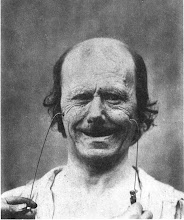
I was on a steady course of examining the secrets told by the face about the emotions, when I was diverted by a glancing blow. One commenter, carrying the moniker of "Anonymous," suggested that GOAB would not have wasted his time with such trivialities as the particularities of some disapproved French Law. I replied, "But he did. See his essay On the sumptuary laws."

To make sure I was right about that, I reread the essay. Now, of course, I want to write about the sumptuary laws. (Yes, ML, again, mimetic theory). (No, Raulito, I am not yet advising you bring these to Cuba; right now we are only exploring the idea). (Yes, Grasshopper, I will return to the task at hand soon, very soon).

Sumptuary Laws restrict certain types of people from buying certain kinds of things, like clothes or food.

In Ancient Rome Tyrian Purple dye is said to have been first restricted to victorious generals. Later even beardless child Emporers took up the habit, but it was not supposed to be worn by mere wealthy merchants.

The dye was expensive because it was made from the mucus of certain marine mollusks and thousands of the little creatures were smashed to make a gram of the stuff. A Phoenician is said to have figured it out when his dog was out cracking the shells and eating mariscos when the dog's mouth turned purple. The Phoenician Kings grabbed it as their royal symbol and kept the secret of how to make it as long as they could.

Once the Phoenician Kings had it, the Roman hot shots had coveted it as well. (Yes, again, ML). Part of the reason was to make sure the right people enjoyed their fair share of toadying. Because sycophants were much more readily available than mollusks, laws were needed to make sure the merely wealthy did not cut in on the action.

I have to think that an ulterior motive was to keep all the good Roman hard cash from being shipped to the Phoenicians for such a frivolous purpose.

The French had their own restrictions saying, according to GOAB, that none but princes, "shall eat turbot, or shall be allowed to wear velvet and gold braid." Turbot, it seems, is a flat fish related to a flounder. (Cap'n Bob, Cap'n Bill, this would be your arena).

Although GOAB did not mind having ways to distinguish between the classes, but he did not like these laws:

The way in which our laws try to regulate vain and insane expenditures for the table and for clothes seems to be opposed to their purpose. The real way would be to engender in men contempt for gold and silk, as vain and useless things; whereas we increase their honor and value, which is a very inept way to make men lose their taste for them.

GOAB saw it as a simple matter. Kings and princes could abandon these expenses and within a month everyone else would imitate them.

He suggested that the law should restrict these expenditures to "mountebanks and courtesans." GOAB was following the lead of a Greek lawyer named Zaleucus who drafted an ordinance saying that, a free woman may not be attended by more than one chambermaid unless she is drunk. Nor may she wear gold jewels about her person or an embroidered dress unless she is a public whore. And no man, unless he is a pimp, is allowed to wear a gold ring on his finger.

(If there are any Wesleyans out there, remember the similar theme by John Wesley: "I have one word more to say to parents; to mothers in particular. If, in spite of all the Apostle can say, you encourage your children by your example to "adorn" themselves "with gold, or pearls, or costly apparel," you and they must drop into the pit together." I'm not a Methodist, but if John Wesley feels this strongly about the issue, gold, pearls and costly apparel are off my shopping list). (Pardon me, Uncle Toby).

What if we brought a Zaleucus ordinance to our own conspicuous consumers? Only drug dealers, prostitutes and procurers will be allowed to purchase or drive expensive vehicles. Private yachts and jets are also restricted to drug dealers, prostitutes and procurers. At the airplane or yacht dealership (is there such a thing?) the purchaser would be required to sign a statement, "I affirm that I am a drug dealer, prostitute or procurer and will use this expensive means of transportation to entertain customers."

If you see a monster luxury Lexus SUV, it would be polite to tap on the window and say, "Excuse me kind sir, but I suffer from the vice of drug addiction. I see from your car, you are a dealer. Would I be able to purchase an eight ball, please?" Or, "Yes, kind lady, I see from your car that you are a prostitute. I only have $50, but do you suppose....?"

Not everyone would follow the law of course. There would be certain sheep in wolves clothing who would pretend to be drug dealers or prostitutes or procurers so they could drive the expensive car. Then the gossip would change when they dropped their kids off at elementary school. "Those phonies. Look at the car. He's not really a drug dealer, but secretly owns an automobile dealership. And she's not really a prostitute, but owns a boutique on the Island." That sort of thing.

I know my libertarian friends will argue this is a poor way to address the problem of "vain and insane expenditures." Raulito and I are open to other suggestions.

Monday, March 24, 2008

Kathy: "Keep it short. You just like to hear yourself talk. I seriously think you are your biggest fan."

I had an idea for a story once. I thought of it again yesterday when I pulled down Volume VII of the Collected Works of Ambrose Bierce to quote the Devil's Dictionary on the meaning of "politics." I ordered this set more than 30 years ago and it is one of the few things I have been able to hang onto as the book shelf space has shrunk with serial downsizing of houses.

I intended to read it beginning to the end, Volumes I through XII.

(Then the Regional Commander for the Holy Spirit Association for the Unification of World Christianity (the Moonies, followers of Sun Myung Moon) got beat up by the Chief of Police while begging for alms in the City of Aubrey, Texas. As is often the case when someone is beaten by a policeman, the Regional Commander was charged with assault on a police officer.

At the time I was considering whether to leave my nearly still-born career as a lawyer to spend the rest of my life shooting free-throws in the back yard. I had sued the sheriff over the jail conditions in Denton County. (This being during my second Babylonian Captivity). He started locking me in the jail for several hours when I tried to visit clients. Also, the sheriff controlled the bonds. This was a county that did not allow bondsmen, but only lawyer-bonds, and the sheriff wouldn't let me make any more bonds. My law practice, already at risk of being declared a hobby by the IRS, went from sparse to nothing.

The Regional Commander found me in the back yard and hired me. The District Attorney dismissed the case against him, we sued Aubrey for violating the Free Exercise Clause of the 1st Amendment, got a consent judgment declaring the Solicitation Ordinance in Aubrey unconstitutional, and the Regional Commander brought me two hundred files of other cities in Texas and Oklahoma he wanted to sue. I bought the first word processor in the county and was suddenly fully employed again.

So my free-throw shooting career came to an end and my plans for this book were put on hold. ) Yes, Uncle Toby, a digression.

Back to Bierce:

Ambrose Bierce disappeared into the Mexican Revolution. He is known to have been with Pancho Villa's army during his last discovered letter. There was some speculation he had committed suicide. He was in his 70's. He had written a letter to his niece Lori including this:

"Good-bye — if you hear of my being stood up against a Mexican stone wall and shot to rags please know that I think that a pretty good way to depart this life. It beats old age, disease, or falling down the cellar stairs. To be a Gringo in Mexico — ah, that is euthanasia!"


Then there was B. Traven, who wrote Treasure of the Sierra Madres. Traven would have been in Mexico about the time Bierce was there, if Bierce had survived long enough. Bierce was in Mexico in late 1913. Traven was there probably by 1924.

Traven is a puzzle. No one has figured out who he was. He would go by the nickname, El Gringo, and changed his name often. He had some American and some German connections. One anecdote I have heard is that when Treasure of the Sierra Madres was being made into a movie he surfaced for a while to give technical suggestions and then disappeared.

So we have two great personalities and writers. One disappeared in Mexico without a trace and one appeared in Mexico without a history.

My story was that they were the same person. Pretty cool, right?

I planned to read everything either writer published so I could steep myself in both their personalities. I then planned to write the great American novel and in the process explain in fiction both Bierce's disappearance and Traven's appearance.

There were a few problems with this theory. First, Bierce should have been born about 50 years before Traven. If the guy who died in 1969 was really Bierce (or Traven for that matter), Bierce would have died at age 155.

Second, Traven's work may have been originally written in German and translated.

Third, Traven most likely was in Germany or Chicago when Bierce was in San Francisco.

Fourth, writing styles are not very similar. It has been so long since I've read either, I hate to characterize them, but I think it is fair to say they are not similar.

Bierce was known as "Bitter Bierce" and besides his caustic humor he wrote eery short stories: One for instance about an officer directing artillary at his own family's house out of a sense of duty. Another, about a man being hanged from a bridge and the thoughts that went through his mind just before the rope snapped his neck.

Traven was spare in his style and wrote in defense of Mexican Indian rights and Wobbly politics.

All right, I admit, there were a few problems with the idea.

Then Carlos Fuentes wrote El Gringo Viejo and gave his version of Bierce's disappearance. Thus ended my project; I had little enough confidence that I could produce anything worthwhile even without having to be compared with the likes of Carlos Fuentes. The big upside, though, was that I had an excuse to spend a lot of time reading Bierce and Traven.

Let the people take heart and hope everywhere, for the cross is bending, the midnight is passing and joy cometh with the morning. Eugene V. Debs

To the tune of Mammy's little baby loves shortnin':

"Rush," says the boss
"Work like as hoss
I'll take the profit
and you take the loss

I've got the brains
I've got the dough
The Lord himself
Decreed it so."


Mammy's little baby loves union union
Mammy's little baby loves union shop,

etc.


Someday, we will look back on employment in the same way we now look back on slavery. In fact, the term "wage slavery" is not a metaphor. It is a form of slavery that should be abolished. It is not usually as cruel as slavery slavery, but it can be.

This is simple statement of the premise: Everyone should get the full value of his labor. To get any less is theft. To get anymore is theft.

Capital is withheld wages. If a company accumulates capital it means wages have been withheld from those who earned them. Unless these wages go to benefit the labor that produced them, then they have been stolen from the rightful owners.

I know this all sounds dry, and preachy and Marxist.

(May I first say, I am not a Marxist. First, I cannot be an "-ist" for anyone I cannot read and rarely have I found a German author whose work I am able to read. I cannot be a Hegelian either. Or a Kantian or a Heideggerian. All these books sit on my shelf and my son has read them and he recommends them, but it is not likely to happen.

Next, to the extent I can understand the issues, in the great battle between Karl Marx and Pierre-Joseph Proudhon, I stand with Proudhon. (Maybe this is just because the French write better.) Proudhon rejected collective ownership in favor of a plan in which the individual worker had ownership and he believed that social revolution could be achieved peacefully.

Also, I have never been the member of any organization that saw the teaching of Marx as an organizing force. I did try to get into the Navy Judge Advocates General Corps once which is publicly owned and operated, but I don't know if they talk about Marx or not, because I didn't get in.

So, unless you are just feeling grumpy, there is no need to call me a Marxist. Also, there is some risk I might begin to imagine that I have read Marx.

Also, it is not really accurate to call me a socialist, either. I am not a fan of collective ownership in most cases, although I would like to see a socialized bank, hospital and insurance company competing with privately owned ones. If we had these things, I would probably use them. However, I think we need privately owned houses to live in. I think everyone should have one. (This is an evolving opinion. I tried going without any property for a while during my Tolstoy period, but it was very inconvenient).

Don't under-estimate the quality of government work. Government prisons are far better than private prisons. The U.S. Army is first rate, I hear, and far better than the private mercenary corporations, at least as far as I can tell from news reports. The best criminal defense law firm in town are the Federal Public Defenders. If I ever get in trouble, I'll admit how broke I am (Kathy wants me to keep this secret), so they will represent me.

I am pretty socialistic in the sense that I would like to see a Year of Jubilee (hit the link in the title)and international equalization of all wealth, but this is more religious than economic. I have read biographies of Eugene V. Debs and if I had been around in 1912 or 1916 or 1920, I would have voted for him. Debs was a socialist, but I don't think I really am. We named our spare bedroom after Debs.

Fighting Bob La Follette was both a Republican and a Progressive and looks to me a lot like a socialist. If he were running this time around, I would vote for him and cast my first Republican vote. This is regardless of the office. Also, I would vote for the Vermont Independent Socialist, Bernie Sanders.

My friend, Dan Boyd, suggests I am an anarcho-syndicalist. I like the title. From the web, it appears anarcho-syndicalists also call themselves libertarian socialists, I guess as opposed to authoritarian socialists or libertarian economic oppressors. Brownsville, though, appears to have not anarcho-syndicalist clubs or political parties. I don't know much about the Rotarians or the Kiwanians or the Knights of Columbus. These may all be anarcho-syndicalists, but I am deterred by the funny hats. I read the Autobiography of Big Bill Haywood one of the founders of the Wobblies. I am a fan. We named our kitchen after Haywood.

I am still a Democrat. You can be these other things and still be a Democrat. In fact as Bill Clinton is now trying to prove again, as George Wallace showed before, you can be a racist and be a Democrat. You can also be these things and be a Republican, or at least once upon a time you could. The racism is easy for a Republican, as David Duke recently demonstrated and Woodrow Wilson earlier established. Teddy Roosevelt was a Republican and by his last race he was at least a progressive. Fighting Bob La Follette was both a Republican and a Progressive and looks to me a lot like a socialist.

My friend and tax man, Bill Fulcher, is both a Democrat and statewide treasure of the socialists. Where but Brownsville can you find a socialist tax man? I also have a socialist barber. God, I love this town.

The problem with me being a Democrat, though, is I am usually angry with most Democrats who grab office and, also, given a chance, I sue them a lot.

Another problem: I have strong doubts that voting matters at all. As my son Austin argues, "If voting made a difference, it would be illegal." That is probably right. I quit voting for a while because I worried about Matthew vii, 1 and thought maybe Jesus was instructing us not to vote in the Sermon on the Mount. It makes sense and that is how the Jehovah's Witnesses and the Mennonites interpret it. Fan, again. I have never met a Witness or a Mennonite I did not like, but no rooms have been named after them.

My greatest concern is that voting in a non-democratic format such as plebiscites for Napoleon or Hitler or in the Electoral College or in the Democratic Super-delegate system uses up energy that could be more effectively directed to something important. Like writing in a blog, for instance.

My two favorite magazines are the Economist and the Socialist Worker. The Economist is an English, capitalist magazine and the Socialist Worker is an American (and obviously socialist) magazine. Both promote a economic interpretation of history and the world. In fact, they are very similar, except for the last paragraphs of the articles. The Economist describes a world in which money governs everything and that's OK. The Socialist Workers describe a world in which money governs everything and that's not OK. Anyway, I think both are more trustworthy for predictions of political races and economic trends than those confused magazines such as Nation, Texas Observer and National Review (yes, I read that one on-line) that think ideas are more important than money in predicting social behavior. (OK, OK, I may also occasionally read People, but it doesn't count here).

Treat all of this as a long digression, Uncle Toby. People often ask me why I don't run for office. The tirade above should put that to rest. I don't expect anyone to care what my politics are. I just throw it in to anticipate questions about where this labor opinion comes from and because I very much enjoy talking about myself.

Now, where does this opinion come from?

1. I have been an employer, and not a very good one.
2. I have been an employee and it was a bad fit.
3. I tried to start a coop and we never got off the ground, because it lost more money than it made--tens of thousands of dollars more.

I have tested the limits of the employer-employee relationships off and on since I got fired from my job as a paperboy for trying to organize a union.

These issues also include some skeletons that I must toss out of the closet. Bear with me, readers true. Sorting all of this out may be as hard as all of that time I have done in therapy.

Friday, March 21, 2008

Three Things No District Attorney Should Do, But That All District Attorneys Will Always Do, For All The Wrong Reasons

Before we begin, and in hopes of establishing some meager credentials, let's drag one of my skeletons out of the closet for all of the paraclete to see.

(Paraclete here is used in the obsolete form, second definition in the OED2, meaning advocate or intercessor. It is not meant so broadly as to mean all lawyers, oh no, readers true, most lawyers are not paraclete, but satans; Satans, not meaning the Devil, but in the etymological sense of 'adversary' with allusion to Matt. xvi 23. Nor is it so narrow as to include only criminal defense lawyers, but would include other "advocates" and "comforters" such as Tolstoy, Gandhi and Jimmy Odabashian, and Gail Hanson, that is those who advocate and comfort without setting foot in the courtroom. It is not capitalized so as not to mistake it with the Holy Spirit on this Good Friday. Nor is the form changed for the plural, because I cannot find a single usage in which it has been changed for the plural. I find reference to "paracletes" as the plural, but I am unwilling to be the first to actually use that ugly form.

Roughly stated, "paraclete," here means defense attorneys and preachers for accused criminals and '"satan," here means prosecutors. This is not intended as an insult, but just an etymological inevitability. Please do not be offended dear, dear friends in the various offices of prosecution; I am not responsible for penning the Gospels.

While I am digressing may I say, on this Good Friday, that Dorothy Day who is, or should be a saint, uses the word "precarity." In 1952 writing for the Catholic Worker Movement:
"True poverty is rare," a saintly priest writes to us from Martinique. "Nowadays communities are good, I am sure, but they are mistaken about poverty. They accept, admit on principle, poverty, but everything must be good and strong, buildings must be fireproof, Precarity is rejected everywhere, and precarity is an essential element of poverty. That has been forgotten. Here we want precarity in everything except the church. (...) Precarity enables us to help very much the poor. When a community is always building, and enlarging, and embellishing, which is good in itself, there is nothing left over for the poor. We have no right to do this as long as there are slums and breadlines somewhere.
No one else seems to use it and OED2 does not describe the word, so much more elegant than the awkward "precariousness."

In summary, "paraclete" should mean , when we do our jobs, defense lawyers, "satans" means prosecutors, and "precarity" is my Good Friday prayer.

I add "precarity" because all good things come in groups of three.

Please pardon me, Uncle Toby.)

Now for the skeleton: I ran for District Attorney in Denton County in 1976. The shame of it. Fortunately, I lost.

Nonetheless, about the things I am about to say, I know of what I speak.

No District Attorney should do the following:

1. Prosecute food stamp fraud.
2. Prosecute hot checks.
3. Prosecute dope cases.

1. Food Stamp Fraud. Food stamp fraud is the worst. It always jails a welfare mom who is struggling to hold things together. It puts her in jail. The kids go hungry. She loses her job at Whataburger. If she happened to have a house at a nickel down and umpteen dollars a month on a contract for deed, she loses that. When she gets out, her life is a shambles, her children are at risk and she can't dig out. Instead of just taking the overpayment out of her future stamps. The Texas Department of Human Racehorses (or whatever euphemism they use these days) sends it over to the DA for prosecution.

Instead of telling TDHR to go back to the hell from whence they came, DA's offices love these cases. Why? a. They are easy to prove because TDHR extorts a confession on the false promise of future food stamps. b. The accused is always too broke to hire a lawyer. c. TDHR gives a kickback of $500 for each case.

2. Hot checks. This is a poverty crime. Merchants should verify the checks before they accept them. Hot check courtrooms are filled with the poor and not criminals. DA offices and the majesty of the law should not be a collection agency for sloppy merchants. Most people who write hot checks are not really guilty of theft, as they are charged, but with not balancing their check books, but they cannot afford the defense and the public defenders don't have the time to defend them.

But DA's love these cases. Why? Merchants like them and they are more likely to contribute to a campaign than poor people are. Also, DA's get to print up those nifty signs so all the merchants can stick them in their windows that say, "We prosecute hot checks!" with the campaign logo on the bottom.

Another skeleton: I printed one of those signs when I ran for DA in 1976. I hope by now they are all clogging up solid waste deposits so no one will ever see one again. The shame of it.

3. Dope cases. They corrupt the police forces (and sheriff's office as we saw a few years back). The feds have more resources and can do it better. If the case is too small for the feds, it's not worth handling. They clog up the courts. Many of the people accused are not criminals or even particularly anti-social.

Why do DAs handle them? Forfeiture money and property is a lot of fun. Anyone want a Escalade with tinted windows? The photo opportunities to claim that a zillion dollars have been taken off the street with pictures, yes, just like Tony Montana, with a mountain of dope, money and guns, is just too exciting.

What should a DA prosecute? Murder. Rape. Robbery. Assault. Burglary. The rest are civil matters.

Think how the backlog of cases, overcrowded jails, beleaguered jailers, overworked prosecutors, harried judges, exhausted probation officers, nervous bailiffs, nearsighted clerks and frazzled public defenders would be helped by this change. Also think about how many poor and harmless people you would let out of jail.