Showing posts with label lie detection. Show all posts

Sunday, April 13, 2008

Those are pearls that were his eyes: /Nothing of him that doth fade

OK, Readers True, back to the face.

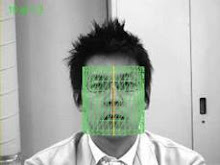
My niece Ana is an engineering student at Carnegie Mellon. The picture you see at the right is an example of work being done there that has the potential to make fine measurements of different parts of the face and face movement from videotapes.

Other attempts have involved maybe a hundred dots on the face that are monitored by software that measures changes.

There are a number of security companies that are hawking products that are intended to allow videotapes of crowds to pick out criminals. These seem to not to have been particularly successful yet, but the technology continues apace.

I was first exposed to the IDENT system for fingerprints about ten years ago when I started representing people accused of illegal entry into the United States. My first reaction was to have my clients refuse to incriminate themselves. How in the world would they ever prove who this guy was and that he was a Mexican national? Well, as a seasoned Assistant US Attorney showed me, they had solved that problem: Automatic Biometric Identification System (IDENT) using automated fingerprint identification systems (AFIS).

Every illegal alien would get each index finger swiped in a machine that recorded it. This then could be compared against a database (actually several databases) of other fingerprints to see if the alien was a recidivist or had a criminal history.

The old INS had been experimenting with this system in 1994 and by the time I was exposed to it in 1998 it was hot stuff.

Decades of success in just lying about your name and age ran head on into this new technology. (Can anyone imagine the plot of Les Miserable today with IDENT? Jean Valjean would never get the chance to reform and Javert would be replaced by a file clerk).

Now I love cool new gadgets and technology. I try to get the latest stuff whether or not I can afford it or figure out how to use it.

But advancing technology certainly changes old ideas about fresh starts and second chances. It also makes possible crimes of previously unimaginable magnitude.

I am still getting my mind around the complicity of New York based IBM in the holocaust. Without specially New York designed machines and punch cards to keep track of and route Polish Jews. They calculated rate of deaths per square kilometer due to progressive starvation and the number of Jews to be transported to the death camps. They kept tabs on trains dispatched to and from Auschwitz and Treblinka.
Says Robert Wolfe, the foremost expert on Nazi documentation and formerly chief of captured German records for the National Archives: ``For those who have complained that the proof is not there, this new evidence gives refutation. The juxtaposition of all these sources -- the new German documents, Justice Department records, the IBM files and eyewitness sources -- all together indicate it was not just trading with the enemy, not just IBM and the Third Reich. This is the proof that IBM enabled the Holocaust. The connection to New York is now proven.'' (Click on the title for the citation).
IBM ENABLED THE HOLOCAUST! My Sweet Lord. Why isn't this big news and shocking to all? Why isn't this part of the culture of understanding corporate evil? Why hasn't this monster been destroyed by Justice (Department of) or at least by justice? Why has not the wrath of an angry God ripped Big Blue asunder?

So my love of the new technology always comes with a queasy feeling. What is the human cost to the IDENT system alone. One anti-immigrant website argues there are more than 366,000 incarcerated illegal immigrants. http://immigrationcounters.com/

That may be high, because the Justice Department numbers look like they are closer to 200,000. In any case, the IDENT system has enabled a new efficiency that allows incarcerating huge numbers who w0uld previously have been sent back, unidentified.

I am no longer able to hear about or meet people incarcerated for immigration offenses without seeing in my minds eye, also, young wives and children who are now left to destitution. (Little Cosette cannot be saved by Jean Valjean because he is in Three Rivers federal prison). I know about them because they call and write and visit me. They wait out in the hall at court. These, Readers True, are real people and it is hard to meet them and not have the flesh crawl every time one the young men they depend upon gets duck-walked away in chains.

Automated Biometric Identification Systems for the face are now here and will soon be highly efficient. For a while, glasses or a new mustache would fool the systems, but now some of the new 3-D systems claim they can make an identification even with a stocking over the face and sun glasses.

The data bases for Illegal Entries have been collecting photographs from the beginning. But this is a sea change. Soon it will be possible to take photographs of crowds and identify everyone.

It will also be possible to sort these based on age, gender and race, prior criminal history, income level, house value, employment history, disease history, book purchases, credit card expenditures.

It will be possible to correlate the face with automobile ownership and travel history as recorded in GPS systems. And cell phone use as shown by tower locations and with searches of key words used in the conversations. And e-mail communications based on key words used and internet search history.

Also, check another dimension noted by Mr. Kurgan in his blog for today: http://andyoubrutus.blogspot.com/

If the FACS develops to its full promise, it will be possible to pick out who is worried or frightened or angry. And all this from a videotape of everyone at a football game or a protest march.

Just think what the Nazis could have done with this neat technology.

Friday, April 11, 2008

What is this quintessence of dust?

Now to jump in the deep end without my floaties. The question here is whether we can look in the eyes and see the soul? Or more generally, can we look at a face and read the emotions?

This is the bigger view than the "human lie detector" issue. And it uses only one of the tools the interrogators use to get results. But it is where I want to start. And to paraphrase Old Joe Durham, "My soap. My blog. I'll wash it as long as I want."

Now for my reservations, and they are completely in opposition to each other.

First, maybe I am not smart enough or in possession of the right special skills or hard working enough to learn this stuff. It reminds me of a hundred other projects I have begun that fizzled out. Like the times I tried to teach myself Ancient Greek. Or calculus. Or oil painting. Or sculpting. Or Arabic. Or hypnotism. Or astronomy. Or quantum mechanics. The list goes on.

Second, I am afraid that it is a completely phony area of study. Jay Stephen Gould describes these types of errors in The Mismeasure of Man. Scientists measured a bunch of skulls to find out what a criminal's skull looked like. Then they tried to predict who would be a criminal by measuring different parts of the head. The whole field proved to be both stupid and pernicious.

One other gnawing doubt. What if I do learn it and it proves not to be phony? I get this special vision of the human soul. Then do I end up dieing like Kurtz:
"He cried in a whisper at some image, at some vision,—he cried out twice, a cry that was no more than a breath—'The horror! The horror!'
All right, enough procrastination. We begin as Darwin does, with the muscles of the face. Here the problems begin.

If you can't count them, how do you know what they are? I pulled out my old Anatomy and Physiology Book from my class with Dr. Peña. It lists about 20 muscles, not counting the ones that move the eyeball. Some of those are in pairs.

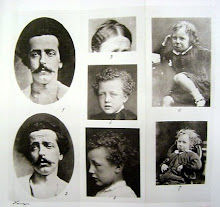
Darwin says, "Some writers consider that these muscles consist of nine pairs, with one unpaired; but others make the number much larger amounting even to fifty-five...."

Some internet sources list 52. (And a lot of discussion of whether it really takes more muscles to frown than to smile).

To complicate the issue further, Darwin, explains the structures of the muscles differ from person to person. When we are trying to figure out what the face is telling us we run into this problem: "Thus the power of uncovering the canine tooth on one side differs much in different persons. the power of raising the wings of the nostrils is also...variable in a remarkable degree; and other such cases could be given."

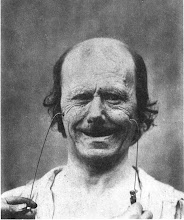
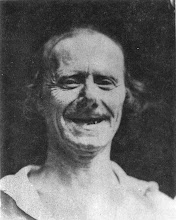
Nonetheless, Darwin gives us twelve muscles that he uses to describe the expression of emotion. For instance, this is how the muscles react when a human being weeps:

The corrugators of the brow (corrugator supercilii) seem to be the first muscles to contract and these draw the eyebrows downward and inwards towards the base of the nose.... (This goes on for three pages discussing the malaris muscles, orbicular muscles, pyramidal muscles, and on and on).
If you see all of this, you know a person is weeping and therefore probably, "suffering of the body and mind."

Now fast forward an hundred years and see what this science looks like with modern measurement tools. It has largely been developed by a guy named Paul Ekman.

Subjects were made to to stare into a camera lens to be recorded on videotape. A starter pistol was used for some experiments, but there was a fear the subjects' hearing was endangered. Also, the directional properties of the shots could not be controlled. So startle sounds of white noise were produced electronically, amplified and run into speakers or headphones. Several variations of these themes were developed to distinguish between spontaneous and deliberate facial movements and between emotional and non-emotional facial movements.

Then they had to decide what to measure. Action Units were numbered that described different movements of the muscles. It is a system called Facial Action Coding System (FACS). For instance Action Unit (AU) 1 involves the inner frontalis muscle and the action is "Raises inner corner of brow." These AU's describe things like AU12, Zygomatic major, Common smile and AU45, Orbicularis oculi, Blink or Wink.

Once they decided what to measure, there was the question of how? Two choices presented themselves: 1. "coders" who graded the movements, or 2. Electromyograph testing of the muscles.

Even judging the slow motion videotapes, there was a risk of bias in the measurements. The coders were tested against each other to find out how reliable they were.

The EMG gave a much finer scale of measurement, but apparently it was difficult to measure "spontaneous happy expressions" on the part of a subject who had a bunch of needles stuck in his face.

After enough review of videotapes carefully measuring many different muscle combinations by enough carefully tested coders, finally the payoff: spontaneous happy expressions were more symmetrical than requested actions expressing happiness.

In other words, there may be some sadness in that lopsided grin.

Thursday, April 10, 2008

The Holy Grail. The Fountain of Youth.

Yesterday's post brought a serious comment from Mr. Kurgan:
The ability to ascertain deception can not only be learned, but it can almost be near perfected, as a couple of your noted text will reveal. Your inability to do so, based on your personal frame of reference, will not allow you to believe that this is possible. To you, this is not reasonable.
I accept the challenge, Sr. Kurgan. I shall open my mind to the possibility that the ability to ascertain deception can be near perfected.

In truth, I hope this is true, as long as we have a way to find out who has those skills. The fact that I now lack the skills, does not mean I do not aspire to learn them if they indeed can be learned. If I think I have learned the skill, I will likely credit it can be done. Even if I can't learn the skill, if someone else can demonstrate it in a controlled experiment, well, I am much comforted by that type of certainty.

My thought is that this inquiry is not anti-law enforcement, but rather a desire to have a more nearly accurate law enforcement.

DNA and fingerprints are good examples. Both of these tools are misused and misread by unskilled practitioners (remember the guy that got shipped to Spain to answer to blowing up the train based on a bad FBI reading), but, well-done, they have impressive results.

Perhaps twice in the last year, I have believed the system had grabbed the wrong guy. I wanted fingerprints. If we have the wrong one, we want a reliable way to test that. One young man was freed of his charges on the spot when the fingerprint guru (I think from Harlingen PD) showed up and said our man was not who the arresting officers thought he was. There was also about twenty tattoo differences, but we did not need to reach that.

The Innocence Project has shown that more nearly accurate law enforcement can help acquit the innocent. DNA has produced 215 post conviction exonerations. The average length of time served by exonerees is 12 years. The total number of years served is approximately 2,640. Sixteen served time on death row. And to me the most disturbing fact: False confessions and incriminating statements lead to wrongful convictions in 25 percent of the DNA exonerations. (How false confessions come about will be a later discussion).

Differently put, if either a machine or a person can accurately tell truth from lie, that would be helpful. We may produce another 215 exonerations.

Where do we begin? Stan B. Walters in his Principles of Kinesic Interview and Interrogation begins with the following:
1. Darwin says, "Repressed emotion almost always comes to the surface in the form of body motion."
2. In general, human beings, including investigative interviewers, do a poor job at spotting deception, with the results being little better than chance. Walters cites (Ekman, O'Sullivan 1991).
Walters then give three reasons for the failure of people to accurately identify deception:

1. Judging on verbal and non-verbal behaviors that are not reliable cues to deception.
2. Being unaware of the cues that do have a higher incidence during deception.
3. Making bad judgments because of the interviewer's preconceptions about the subject's likely credibility.
In other words, Walters thinks most everyone gets it wrong now, but with the proper training, the problem can be fixed. This is the premise I want to explore.

Before getting there, though, with a compulsive rejection of secondary sources, we should find out what Darwin really said.


Wednesday, April 9, 2008

Before We Get To The Waterboarding

A standing joke among criminal defense lawyers is the perspicacity of arresting officers in finding probable cause to search a truck or car for contraband.

"I suspected he was carrying drugs, because he would not look at me and the guilty avert their eyes." Or, "I suspected he was carrying drugs, because he looked right at me and that is what drug dealers do to avoid suspicion."

"He acted nervous." Or, "He acted too calm for someone who had been stopped by the police."

And the one I like: "He only had one key with him, and that is typical of drug dealers." The first time I heard that I was in the courtroom with only one key with me.

Many officers clearly have better noses than bloodhounds:

"I smelled the strong odor of burning marihuana." And, "I smelled the distinctive odor of wet marihuana."

And another favorite. "The car was empty, but I could tell it had been abandoned because of the smell of illegal aliens." I prepared a cross-examination on this to test the officer's nose on distinguishing between an illegal alien or a permanent resident or merely a laser passing card. Also, I thought it would be instructive if his nose could tell whether it was a Mexican illegal alien or a Central American illegal alien who might have a right to sanctuary claims.

At border crossings, a similar phenomena occurs in the claimed ability of the agents to tell a truth teller from a liar.

The typical statement: "No, I didn't know there were ten kilos of cocaine welded into the gas tank of the car I was driving."

The feds do not audiotape or videotape interviews, so there is always a dispute about what was actually said. If two officers are present, their versions will differ slightly. And then the accused will have a different version. And then there will be a dispute about what was written down and when. And how it should have been translated and if the officer actually understood.

The officer at trial will want to testify, "He hesitated and then stammered in his response, and moved his hand in a characteristic evasive manner, so in my experience, I could tell he was lying."

Just like the movie in which the prospective father in law claimed he was a human lie detector machine.

The inquiry to come, si Dios quiere, Readers True, is whether a lie detector machine or a lie detector person can really tell if someone is lying. This is of interest to me, naturally, because if you can tell when someone is lying I want to be able to do it for the purposes of judging a witness If the claim is just hogwash, I want to be able to show that during cross-examination.

In truth, I don't want to know if my friends are trying to protect me from an ugly truth, so I have no desire to apply the skill in personal life.

However, if a Javert or a Flambeau or a Monk can read the liar, it would be nice to find out. On the other hand, how do we distinguish that officer from Barney Fife and Fearless Fosdick when they come to testify?

For those among you who sit on the front row and raise your hand to be recognized, I offer the following texts in preparation for these (occasional and intermittent) sessions:

The Expression of the Emotions in Man and Animals by Charles Darwin.
Interrogations, Confessions, and Entrapment edited by G. Daniel Lassiter.
Never be Lied to Again by David J. Lieberman.
Principles of Kinesic Interview and Interrogation by Stan B. Walters.
What the Face Reveals edited by Paul Ekman and Erika L. Rosenberg.