Showing posts with label Kathy. Show all posts

Sunday, February 15, 2009

The New US Attorney


I don't think we have a new appointment for US for the Southern District. I heard some names floated and had heard that DA Armando Villalobos wants the job.

I doubt Armando would really be happy in the job and if he reconsiders and no one else wants the job (which I can understand)we may be short on candidates. So, I am considering stepping up to the plate.

This is not as completely far-fetched as my friends may think. It is true I've never been a prosecutor for philosophical, even religious, reasons, and that I don't believe in punishment as a goal of the criminal justice system. But my naysaying friends should consider three facts: 1. I could use the salary. 2. I was an early Obama supporter (after it became clear Kucinich would not get on the ballot). 3. I am an old buddy of Congressman Doggett (though I will deny this if it should ever become a campaign issue against him, like with that Chicago college teacher) and Doggett apparently is collecting the names for the selection process.

However, I must throw my hat in the ring with certain reservations. First, the office has to be moved to downtown Brownsville. I suffer from motion sickness when I go north of Ruben Torres Blvd. I think it has to do with the speed at which the earth spins at different latitudes.
Also, I don't think I could get anyone to loan me the money to buy a house in Houston and my credit's not good enough to rent. Although I like the concept of a homeless US Attorney and the empathy that may produce for the poor immigrant being prosecuted, I don't see how I could meet the federal court dress code of "dressing with dignity" while sleeping in a dumpster. Also, Kathy would probably complain.

Second, there are certain types of prosecutions that I can't do and I would have to take the appointment with the understanding we would dump these types of cases. Basically, these are the prosecutions that I believe come out of class warfare of the rich against the poor, North against South, and all those other nasty splits in society. I think immigration prosecutions are immoral, so those would have to go. That, of course, would put an end to immigrant transporting cases.

I think the war on drugs is really a war on poor people, so I would dump those prosecutions as well. If the drug trade goes so will the gun trade, for the most part.

That pretty well limits the prosecutions to Mexican shark fishermen and bad xerox copies of $20.00 bills. As worrisome as those crimes are to the Republic, I think we can probably squeak by with just me and a good secretary. This should save a lot of money.

Of course, I don't have the energy to mount a campaign on my own without risk of cutting into the afternoon naps, but if you think this is a good plan, I await the groundswell.

Monday, July 14, 2008

Hillary for VP

I was at my son's wedding reception in St. Louis this weekend when a rumor swept the hall that Hillary had been chosen as Vice President nominee by Obama. I think Randall (the one whose life, I argue, has not been a failure) got a call from his wife and started the rumor. I told several people myself. Later we all ran to the TV and the internet to confirm the story, but no one else seems to have heard of it.

Dr. K thought Obama would pick Caroline Kennedy or a Republican Chuck Hagel so he was surprised. I thought ultimately Obama would pick Hillary so I felt vindicated. But now it appears my gloating was premature. However, I still think she should be chosen.

I am not a big fan of Hillary's and did not vote for her in the primary, but I think she would be a good choice for several reasons. First, it would be the democratic thing to do. She did after all get the second most votes. The Constitution originally gave the Vice Presidency to the second place winner, regardless of party, so this is not exactly a new concept. Second, she appears to have a base of support different from Obama's. I don't know why this is, really, but if it is so, it would be ticket balancing. I assume Obama will carry New York without Hillary, but I do know my wife, mother and sister all supported Obama and they would be happier with her on the ticket. Third, my wife, sister and mother all supported Hillary and I don't want to have to hear about it if Obama picks someone else and loses.

In the primaries, just 1.3 million Texans voted Republican compared to almost 2.9 million who voted Democrat. The Nation magazine has an article this week that makes the argument that Texas could turn blue. The enthusiasm shown by Hillary supporters, especially on issues like health insurance and mortgage relief, at the county convention make me think a Texas upset might be possible.

Thursday, June 5, 2008

Tricycling Brownsville

So Jeff now daily rides his bicycle to the federal courthouse and parks under the awning while he presides for the Brownsville division over the defense of the huddled masses yearning to breath free. Anyway, with the usual dollop of mimetic desire, I too wanted to ride a bicycle to the courthouse.

Kathy, though, insisted that I could not walk without falling so the risk of a bicycle was too great for the meager amount of life insurance I had purchased. Because I suspected I was unable to qualify for more life insurance, we compromised on the adult tricycle. As it happens, Jeff had purchased the tricycle for his suegro who it seems is even more feeble than I am and he had only been able to ride it once.

Kathy and I headed for the island in Sara's truck, fighting all the way. My daughters thought it was fine if I rode a tricycle, but only if I wore a disguise, so no one would recognize me as their father--Groucho nose, glasses and mustache.

On the way back, somewhere along the way, the flag, you know, orange on a tall fiberglass pole, blew away.

Back on the ground in Brownsville, I raised the seat and tightened things up. Kathy insisted I ride around in the parking lot behind the house some before I ventured out. I also dug up an old bicycle cable with a lock on in that belongs to some long since stolen bicycle. I did fine in the parking lot so I ventured out into the larger world, humming the tune from Indiana Jones.

The first problem is car driving in downtown Brownsville is a blood sport and there are extra points for bicyclists. There was no way I could go on the busy streets. The next problem is that tricycles are wider than bicycles and it takes some calculation to make sure I didn't get stuck on a curb.

I soon discovered 8th Street, low traffic and a nice parking area halfway between the state and federal courthouses: a light pole perfect for locking up an adult tricycle. There wasn't a lot of other traffic.

This particular adult tricycle has a basket of a perfect size for my old beat-up leather briefcase.

However, there is the problem of sunburning the top of my bald pate. My usual straw fedora won't stay on with the blazing speed of an adult tricycle. I dug a gimme cap out of the closet that says "Relax" on the front and it seems to work.

The neighborhood kids are also out on their bikes and when I drive by they come out and join me for a couple of blocks. A half a dozen kids on bikes, one pulling another in a sort of bike trailer filled with yet another kid, cruising the wrong way down 8th street. It may appear to be an odd gathering, but outside of inmates, it has become the larger part of my contact with the world.

Jeff tells me this is a good green thing to do, but then he is much more hopeful about life. I just keep thinking how much money I could save if I could raise enough money to be able to afford to sell the car.

Sunday, May 18, 2008

If At First You Don't Succeed, Failure May Be Your Style. Quentin Crisp

My friend Randall (who hereinafter will be referred to as R. to protect his anonymity) called with a topic. When are we failures in life? His wife tells him he is a failure and he is past 60 with the kid grown and gone, so there is not much time to turn things around at this point.

R. disputes her conclusion. He sees his life as largely a success and his wife sees it as largely (or completely and totally) a failure. A loss. Not really worth having been lived.

I for one would be willing to declare R. a success on the basis of being a successful father alone. This was Jackie O's definition and she was rich and famous. So R. can accept this definition if he wants. His wife won't, but I'll give it to him. For that matter, it would be easy to make an argument for R. He was elected a member of his city counsel and had many successful law suits that mattered at least to his clients. Somehow, though, I don't think these would weigh much in the wifely judgment day.

I have further assured R. that in my experience, all husbands are sooner or later failures, completely and utterly. I further assured him that Kathy is always asking me, "If you're so smart, why aren't we rich." She throws out the decade that has passed without a vacation. She notes my car always looks like a wreck. My clothes are terrible. My dog is fat and has gas. She grumbles about the 32 inch waist I had when we were married that keeps swinging between 40 and 50 inches. Despite my soaring success in life (as I see it), she is sure I have failed and failed her as well. "I'm worried about my future," she cries.

And it is the same with all of our friends. I mentioned our mutual friends, all of whom are now about sixty and failures in the eyes of their wives. Some have actually saved money, have a nice house, annuities and 401 K plans, but their wives are still wrecks about the declining income and the likelihood of destitution. None of this seemed to comfort R.

Anyway, it is now incumbent upon me to redefine success and failure in such a way that R. and I and all of our friends (who have lived so long and have so little to show for it) are not failures.

Oddly, I don't remember much comment about the subject of failure from philosophers or novelists or poets in my decades of aimless and unproductive reading.

However, I do think when we read a translation of Aristotle and his definition of "happiness," this is something we would now call "success." My hope is that Aristotle can bail out R. and me and all others similarly situated. If we can claim to be a success by Aristotelian standards, this would largely negate being a failure when we are weighed in the wifely balance.

The word we translate as happiness is eudaimonia which breaks down, eu, "good" and daimonia, "spirit." By extension, it refers to good fortune or what we might usually call "success."

Happiness for moderns is subjective. You can take a pill or have whiskey and become happy. For Aristotle, a child could never be happy, because not enough life had been lived. Aristotle grappled with the concept of not calling anyone happy until his death and believed that the life of happiness could be negated even after death. If someone based his life on a project that was merely and illusion and false, this may not be learned until later. The happy life would be erased retroactively even if the dead was oblivious to the failure. If the dead man's son turns out to be a murderer, he will not have been happy.

Even for moderns, these things could be said about success. The apparently successful man might be safely in the grave when his children or his life's work goes on to prove he was a terrible failure.

First what I "remember" Aristotle said, but cannot find. Happiness (hereinafter called success) is achieved with good birth, good health, good land, good children and some other things like good horses.

These things are achieved by practicing the virtues. Political virtue is highly ranked. R. served as a counsel member for the poor area of town and worked to help them get the city services of the richer parts of town. Aristotle would give him high marks for this. I'd say a B or maybe an A-.

Aristotle would also judge success on how money is handled. He ranked liberality and magnificence high. Magnificence is something like giving a park to the city. I doubt R. was able to do much of this, but he always ranked high in liberality. He gave political contributions and attended the arts and bought lunches. Aristotle would probably at least give him a C+. Now this is the sticking point and where his wife probably fails him. In fact, a failure here for most wives seems to outweigh all the other grades. It is heavily weighted in the wifely report card.

Aristotle put a lot of stock in honor as well. I think he was talking about war or other sacrifice. R. probably wouldn't get much there.

Aristotle wanted a balance between ambitions and lack of ambition. R. may have fallen a little heavy in the lack of ambition category. OK, only a D, but it isn't failure.

On the anger/good temper grade, after overcoming a childhood inability to lose at ping pong, he would score very high on the good temper grade. Pushing an A, I would say.

Aristotle also graded success on friendliness, truthfulness and good-wit. R. really should get better than average on all of these. Especially on friendliness and good-wit. I don't know if Aristotle graded on a curve or not, but surely R. should get B's or better.

So, on Aristotle's success report card, I think R. would probably be a success.

How then, should he (and I and all others similarly situated) comfort ourselves on having failed on the wife report card? I say we look to true successes in life like Socrates, Tolstoy, Gandhi. If the biographers are correct, their wives would have given them failing grades as well.

Tuesday, May 6, 2008

Some Brief Notes About Hell

What is hell? Yes, Kathy, now I have jumped off the deep end.

I can remember being asked once to draw heaven in a Bible school class. I drew a picture of someone climbing up a hill and then sliding down only to begin again. My thought was that the greatest pleasure in life was achieving something (I suspect the thought was more in Bible school age language) and so heaven must be the continued effort without it really mattering if you got anywhere or not.

Only later did I hear about the the Greek myth of King Sisyphus who for eternity was required to push a boulder up a hill in tartarus, the hellish part of the Greek's underworld, only to see it roll down again.

My childhood drawing of heaven looked a lot like the Greek's conception of hell. Back to the drawing board.

From childhood sermons I had heard of a hell of fire and brimstone. Later I read Jonathan Edward's sermon, "Sinners in the hands of an angry God:"

The God that holds you over the pit of hell, much as one holds a spider, or some loathsome insect over the fire, abhors you, and is dreadfully provoked: his wrath towards you burns like fire; he looks upon you as worthy of nothing else, but to be cast into the fire; he is of purer eyes than to bear to have you in his sight; you are ten thousand times more abominable in his eyes, than the most hateful venomous serpent is in ours.
I wasn't sure I could swallow that idea of God or hell, but the language still holds me spellbound.

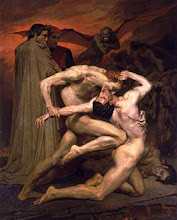
When I read Dante's Inferno in college, my imagination of the sophistication of hell increased. I was particularly struck by the varieties of hell for different types of sinners. Also, I had never thought of Satan in a frozen center, so that was fun. A couple of years ago, I read a murder mystery, The Dante Club, by Mathew Pearl. I enjoyed it and also enjoyed revisiting various types of Dante's punishments. It features Longfellow, who by the way, wrote some of my favorite translations of Spanish literature.

Milton's hell seemed like a great adventure for me. I read Paradise Lost in college. I was of an age when the adventure of being in hell plotting a revenge against heaven was much more appealing to me than Milton's paradise. I agreed with the proposition: To reign is worth ambition though in Hell: Better to reign in Hell, then serve in Heav'n.

I also read about Sartre's hell being other people in "No Exit." It did not hold me spellbound.

For some reason, I have been fascinated by the contemplation of hell. It makes me feel better, but I am not sure why. I know my conception of hell is simple, simple, simple. Maybe, as I approach that seventh decade, I should think more deeply about the subject.

Sunday, May 4, 2008

Thoughts about dying and death

When I told Kathy I was going to write about dying and death today, she gave one of her caustic comments about me opining on another subject about which I know nothing. On the contrary, Kathy, this is the only subject to which I have the same access as all other mortals.

Montaigne (the Granddaddy of All Bloggers, GOAB) makes this point in his Of Practice. We can gain a proficiency through practice in all other human tasks, "But for dying, which is the greatest task we have to perform, practice cannot help us. A man can, by habit and experience, fortify himself against pain, shame, indigence, and such other accidents; but as for death, we can try it only once: we are all apprentices when we come to it."

Montaigne then describes an incident in which he was knocked off his horse by a bigger horse and rider. "It is the only swoon I have experienced to this day," he relates. He didn't think the experience of being close to death, at first, was that bad: "It seemed to me that my life was hanging only by the tip of my lips; I closed my eyes in order, it seemed to me, to help push it out, and took pleasure in growing languid and letting myself go. It was an idea that was only floating on the surface of my soul, as delicate and feeble as all the rest, but in truth not only free from distress but mingled with that sweet feeling that people have who let themselves slide into sleep."

Later he started throwing up clots of blood. And then after two or three hours he began to feel himself caught up in the pains, he says, "...my limbs being all battered and bruised by my fall; and I felt so bad two or three nights after that I thought I was going to die all over again, but by a more painful death; and I still feel the effect of the shock of that collision."

Montaigne in another essay, Judging the death of others, says being dead is not what troubles us, but dying. He quotes (someone completely unknown to me) Epicharmus: "It is not death, but dying, that I fear.

When Caesar was asked what death he found most desirable, he answered (again according to GOAB), "The least premeditated and the quickest." And Pliny, "A quick death is the supreme good fortune of human life."

I have thought that an easy death for me would be by drowning. I once suggested to Kathy that if I fall into senility, she take me to the beach, point out to sea, and tell me to swim to an island paradise. (She wanted to know if it would work right then.)

When I described this plan as an easy death to Brownsville Blogger Stan Raines, he gave me a book of poems he had written, There's More to Blues Than Meets the Eye. One of his poems, The Sea, begins:

When I have reached sufficient age
And experience has filled me up
And the world has drained me dry
I will heed god's call and take me to the sea.


It might be a far worse death than Stan or I imagine, but I had an experience when I was in college that makes me think it might not be the worst of all. I, then, fancied myself the greatest of under-water swimmers. I could take several deep breaths and swim from a lakeside restaurant in Lake Travis to a ski ramp near the other side of the lake. Though, we never did, there was some discussion of taking bets on the matter.

Once, in a pool, with my friends Dan Boyd and Stephen McNally present, I was going to put on a demonstration. I was going to swim laps in the pool far beyond anyone's expectations and to universal amazement and admiration. I did. However, at some point I stopped swimming and began to sink. The only thing I remember was Stephen pulling me out and telling me that my competitive spirit was in conflict with the likelihood I would enjoy a long life.

That wasn't so bad. I lost consciousness and it may have been I would have been unaware of the dying part and gone straight to the death. I'm glad it didn't happen then, and I don't want it to happen any time soon, but, Lord, may I be blessed with an easy way out.

Sherwin B. Nuland is a favorite writer of mine on death. One way to judge a book is to look at the index. If it quotes Montaigne, it's a keeper. Nuland, a surgeon from Yale, in his book How we Die, quotes Montaigne twice. (He also quotes Tolstoy, Shakespeare and Laurence Sterne. What a guy.)

Lawyers don't have to see much death, but some of us must hear many very good descriptions of death. Nuland, on the other hand wrote about death after seeing it at close hand over a long career. He says he would like to have a death without suffering, but the overwhelming odds are against it: "Like most people, I will probably suffer with the physical and emotional distress that accompany many mortal illnesses, and like most people I will probably compound the the pained uncertainty of my last months by the further agony of indecision--to continue or to give in, to be treated aggressively or to be comforted, to struggle for the possibility of more time or to call it a day and a life--these are the two sides of the mirror into which we look when afflicted by those illnesses that have the power to kill."

So I will be most likely trapped as well. Stretching out the agony with the hope of recovery or at least a little more time.

Nuland reminds us of the words Shakespeare gives to Julius Caesar:

Of all the wonders that I have yet heard,
It seems to most strange that men should fear;
Seeing that death, a necessary end,
Will come when it will come.

Saturday, April 26, 2008

The Peace Bishop

So who are these people, the Pax Christi? I first ran into them in the early 80's and they were people completely outside of my experience.

I was a backslid Baptist and had no interest whatsoever in self-sacrifice for any purpose. These people seemed to waltz into prison without a second thought. And not even for some risk that might have brought a shot at some big bucks. Incredible.

There didn't seem to be very many of them. I supposed going to prison for religious reasons tended to winnow those few pieces of weighty grain from all the rest of us light little pieces of chaff the wind could blow away.

For me, Bishop John Fitzpatrick was the center of it all. He was the Bishop in Brownsville from 1971 until 1991 and I bumped into him only rarely, at a restaurant or a meeting. I wish I could report I felt some type of religious awe, but in those days (and maybe now) my religious awe receptors were blunted. I felt a different type of awe. The type of awe I felt around dangerous people: Billy Jack the junior high school bully, biker friends of my brother in Austin, the antiquities smuggler from Mexico, the reputed hit-man from up the Valley.

For one thing, he scared me because he was unafraid of a federal judge.

The Bishop and the Federal Judge were in a head to head dispute. The Federal Judge was a devout Catholic and was standing on THE LAW. The Bishop, GOD'S LAW.

The faithful, including the director of Casa Romero, were helping refugees from El Salvador. They were "transporting" refugees in violation of federal criminal law. So they were being prosecuted.

This is how the Fifth Circuit describes the Bishops position:
Bishop John Fitzpatrick, Bishop of the Roman Catholic Diocese of Brownsville, testified that meeting material human needs represents an essential aspect of Christianity, and that each individual remains free to fulfill this obligation according to the directives of his or her own conscience. Although no law of the Roman Catholic Church specifically requires Roman Catholics to provide sanctuary or rides to Salvadorans, Bishop Fitzpatrick believes that providing such assistance constitutes an appropriate expression of the Christian gospel.
I was, in those days, still trying to be a good lawyer which I thought meant supporting THE LAW. But in this dispute I knew that the Bishop was expressing one of those self-evident truths. You, know, that thing about being created equal and endowed by our Creator with those inalienable rights. So, I knew the Bishop was right and the Judge was wrong. This from a backslid Baptist.

Of course, though when the law and God's law come into conflict, people of conscience go to prison. This was the Pax Christi.

So who are these Pax Christi? They support
"Christian nonviolence on the personal, communal, national and international levels...nuclear, conventional and domestic disarmament, an end to the international arms trade, economic conversion to a non-military economy, conscientious objection, and nonviolent alternatives to war...the struggle against economic injustice, militarism, and environmental destruction which are particularly harmful to those who are poor, minorities, children, and women...and universal human rights, both at home and abroad, through solidarity with oppressed and marginalized people struggling for dignity."

The group was formed just after World War II when German and French Catholics met to discuss the senselessness of having killed each other by the millions in just a few years. It came to the United States in 1972.

OK, how did that fit me? Well, first I wasn't religious and second I hadn't exactly been a pacifist. It is true, I had opposed the Viet Nam war, but this conviction only came after I drew a number 53 in the draft lottery, pretty well assuring if the war didn't end, I'd be draft. (It did. I wasn't.) Before I drew my lottery number I favored stopping the dominoes and I expressed the certainty that, "Some things are worth fighting for." (Yes, even the grammar was bad).

And not being a pacifist, although I had the courage for the occasional fist fight in High School, I certainly didn't have the courage to stand up to a federal judge as a lawyer. So before the Pax Christi Bishop and the Pax Christi members, I stood in dread and wonder.

I haven't gotten much braver as the years have passed, but I have come to the view this fearless, small group are right about most everything. Kathy and I converted to Catholicism. And now, when I have money for dues, I join to get the newsletters and to the extent my faint-heartedness permits, I participate.


Wednesday, April 23, 2008

My Pity Wanting Pain

So is she really in pain or is she faking. After the car wreck, she complains of pain. Her doctor says she is hurt. The insurance company's doctor says, no, the wreck wasn't bad enough and she is only pretending to be hurt.

There are sometimes objective findings like muscle spasms or herniated discs or even broken bones, but a lot of the claim depends on whether or not the complaints of the patient are true.

Then there is the other side of the story. The employee who fell at home in the bathroom, but won't admit to being hurt for fear of losing the job. The athlete who denies an injury.

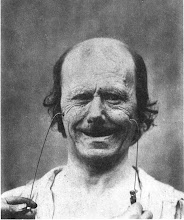
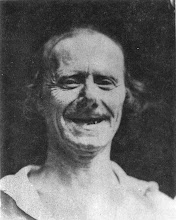
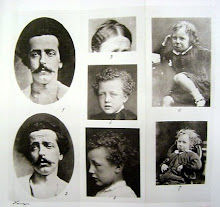
So, once we develop these face reading skills, can we tell who is in pain and who isn't? I think I can see pain in a client's face. (Yes, yes, Kathy, I know I think I can do anything, but I am really just full of......) I look at their eyes and if the muscle around the eyes are contracted (These as we will discover are the orbicularis oculi.) and there is extra moisture in the eyes, they are really in pain. Of course, I have no ideas whether this scientific approach produces false positives or false negatives, but I do think if I see it, a jury sees it also and will agree with me the person is hurt. For a long time, this is how I have picked the cases I want to try, regardless of what the medical records say.

My main sources on reading faces deal mainly with acute pain and so they describe a stronger reaction.

Darwin starts with animals and notes the writhing around "with frightful contortions" and "piercing cries or groans." Almost every muscle is brought into action and "with man the mouth may be closely compressed" or with lips retracted and teeth clenched or ground together. Like the "gnashing of teeth" in hell.

The eyes stare wildly, the brows are heavily contracted, perspiration bathes the body and drops trickle down the face, the nostrils are dilated and often quiver, and the breath is held until the blood stagnates in the purple face. Pain starts as stimulate and excites to action, but if severe, soon induces extreme depression or prostration. So says Darwin.

My face artist, Faigin, breaks the face down into parts.

Eyebrows: The entire brow is lowered, especially the inner corner which is sharply downward. There is a roll of skin piles up above the eyebrows (The action of the corrugator muscle).

Eyes: The eyes are reduced to a single line by the compression of the orbicularis oculi. The stronger the action, the straighter the line Faigin draws to show the eye.

Mouth: Either opened in a clenched-teeth grimace or opened in a shout. The upper lip is stretched upward and outward. (Action of the risorius/platysma and levator labii superioris).

Signature Wrinkles: Crowsfeet with the lower lid folded, star-wrinkles from the inner eye, vertical lines between the brows and a joined crease from nose to chin.

The face scientists with their FACS testing say the bulk of the information about pain conveyed by facial expr4ession is represented by 4 actions: brow lowering, orbit tightening, levator contraction and eye closure. (The levators are on the sides of the nose in three different branches under the eye orbits).

Facial expressions can be used to measure pain in infants and senile patients who cannot express themselves.

The scientists also find different face muscles involved with different types of pain: electric shock, cold, pressure and pain resulting from cutting off of the blood to a nerve.

The scientists took a bunch of back patients and then manipulated the leg to make them hurt so they could observe pain. They also told them to fake a facial display of pain. The patients could mask or hide pain and they could voluntarily make painful expressions that "tended not to differ qualitatively from the genuine display but was more vivid or intense."

Faked pain expressions were much like genuine pain, but they were more extreme and had the added factor of AU12, the lower lip pull, in which the lower lip corners are pulled back and upward. Genuine pain tended to blink more than faked pain. When trying to mask pain, the patients could disguise all of the symptoms except AU7, the tightening of the eyelids, narrowing the eye opening.

The hardest part to fake the pain or hide the pain is, then, in the eyes.

Tuesday, April 15, 2008

What Should We Teach Our Children?

What makes for a good teacher? I was challenged a few days ago to tread on thin ice by an anoynomous commentator. What about the education of children?

I begged Kathy to get in the discussion. After all, curriculum is part of her master's studies, but she was not taking the bait.

How about this for a wild swing at the subject: Through the sixth grade, all of the children will work through Euclid's Propositions, study Greek so they can read Homer, study Spanish so they can read Lope, study French so they can read Voltaire and then read Shakespeare and the Bible. And they should learn to type.

Now, Uncle Toby, a major departure from the subject to warm to the idea of good and bad teachers:

I remember wanting to write my big English paper for the year about Robert Service. It must have been 10th grade or so. I was friends with the "Smart English Student Girls." Not really friends, because they were at a more respectable 10th grade social level, but at least we could talk about poetry. Neither was very good looking by 10th grade standards and I was not even in the game at that age, so there was little to cloud the discussions.

The Daughter of the Banker, Smart English-Student Girl (Please understand, none of us had ever set foot in the British Isles, this was what passed for English language literature in Denton, Texas in the mid-60's. I think they call it language arts now.) told me I could not write about Robert Service. He did not write about nice subjects and besides his poetry was laughable, because it rhymed. The teacher would never allow it.

I can't remember if the teacher allowed the paper or not, but she made it clear that she concurred with the view that Robert Service did not deserve a paper. And I can't remember the teacher's name.

Robert Service was a banker who wanted to be a cowboy or a gold prospector. All of us Walter Mitty's see the world in a similar way. I am a lawyer who wanted to be a prize fighter or a mule skinner. So maybe that was the hold Service had on me.

Our lives overlapped by eight years. He died in 1958. In theory, I could have at the age of seven managed to get over to Lancieaux, France and met the great man before he died.

The things I could have done, if I had just known. I was in Chile in 1972. I could have have gone north and tapped on Pablo Neruda's door. I could have met the great man before he died.

On one occasion I did. C.P. Snow was giving a lecture at the University of Texas in 1969 or 1970. As a freshman student, I had not heard of him, but my English teacher, Maureen McElroy told me to go meet the great man before he died. And I did. (Actually, it was not even a close call because he died in 1980, but it would most assuredly have been my only chance).

Maureen McElroy also taught me about the miracle play. And Marlowe. And Ralph Roister Doister. And Gammer Gurton's Needle

So why was I captured by rhyming poetry? And why was it risible to the Smart English Girls?

Did you know that the Romans did not have rhymes. Latin poetry does not rhyme. This came through the Arabs.

Jorge Green taught me that. And this: "Abenamar, Abenamar moro de la moreria, el dia que tu naciste grandes sinyales abia."

Was it T.S. Eliot who said, "Shakespeare and Dante divide the world between them. There is no third?"

It is like that for me. Maureen McElroy (English Teacher) and Jorge Green (Spanish teacher) divide my little world of teachers between them. There is no third.

Monday, April 7, 2008

If You Love Freedom, Thank a Librarian.

I got a ticket from Harlingen in the mail today for $75.00 for running a stop light on March 26, 2008. Of course, I promptly paid it, as I always do during those occasional periods when I have enough cash to pay them. Otherwise I become self-righteous, innocent and decide to demand my Texas Constitition-guaranteed jury trial.

The technology was really pretty cool. It had a picture of my no-longer-new Hyundai with a nice view of dents on in the rear. (It did not, however, catch the dents on the two sides). A tattered red bumper sticker quoting a former pope was stuck to the rear window. The license plate was mine. And you could almost make out the silhouette of the driver.

I say almost, because you see, I was not in Harlingen March 26th. In fact, I struggle not to go north of 802. I've never known anything good to happen that far north. I know Freddy Fender was from San Benito and that pretty well redeems the city, but Harlingen--I just can't think of anything.

I will go to the airport in Harlingen if I am facing really bad news that will make me actually fly somewhere, but I would rather drive a range of about ten hours than get on an airplane, so I do not exactly rack up the frequent flyer miles. In fact, I don't think I've gotten a free airplane ticket in ten years. I'll also go up to Raymondville for jail visits, but I hardly ever leave the main thoroughfares.

Mere work will not force me to go further than Raymondville. We are talking about death, marriage or birth (not mine for any of the three) and not much else.

So you can imagine my surprise to find I had been ticketed in Harlingen. And this on a perfectly good day when I most likely would not have left the house or driven, much less to some frightening northern city.

As you might guess, it wasn't me. Though I have not yet conducted the cross-examination, that week was Spring Break, Kathy was not teaching, her car was in the shop and believe I have some evidence she went to Harlingen to a stained glass shop in my car. She must have also busted a stop light, but since I was not there, it will be hard to argue against this allegation.

OK. Maybe a small thing. My car commits an offense, maybe, when I'm not there and I am responsible for paying the fine. (Anyone who thinks there is a chance that I might suggest Kathy pay the fine has clearly not been married as long as I have).

But where is my culpable mental state? I mean if I commit a criminal act don't all the various theories of law require I know I've committed a crime?

Unfortunately, committing a crime without knowing it is increasingly common. I represented a high school student who got in his Dad's car and drove it to school. The Dad had been repairing the upholstery in the back seat and left an unopened beer on the floor board. Sniffer dogs, parking lot patrols or other devices somehow turned it up while the student was in school. Zero Tolerance!! So the student, though not a great student, but nevertheless college bound, finds himself sentenced to 30 days in an alternative school penitentiary. We sued and then compromised.

Another case involved the dogs alerting to a girl's trunk at school. It turned out she had a sack of dog food in the trunk.

In theory, a Mexican National could be kidnapped and carried in a trunk into the United States and he might be guilt of illegal entry, because the crime may not require a culpable mental state.

I had a client accused of exporting legal cars, but not following the (brand new) regulations governing the paperwork. Knowledge of the law is not required for the crime and some laws are so obscure, no one knows them.

Maybe it's just that I am a relic of past days that make me think we should have some intent to commit a crime before we become criminals. Thirty five years ago, knowing you were committing a crime before you were prosecuted was a clearly defined right. But that's not the way it is now.

When we let rights slip away, they don't come back without a fight. And we just seem to get used to it. I had a friend once who argued that hell was really impossible because the idea of eternal suffering didn't make sense: after a while, you would get used to it.

I remember being shocked when I first got searched before I got on an airplane. Then I was shocked when I first got searched going into a courthouse. These things don't shock me anymore. But then, going on an airplane or in a courthouse was more or less voluntary for me.

What about all those jurors who are required to go by law, but can only go if they are searched? How are they "secure in their persons?"

We now expect to have our phone records given to the government, videotaping anytime we are outside of home, fingerprint taken to cash a check and blood taken if we drive. I know there is a good argument for each of these, doesn't anybody else feel just a little bit violated? Almost anyone in uniform can walk up and demand to see your ID. School lockers and car trunks at school and your car as far north as Sarita can be searched. And that's for the citizens.

Employers demand polygraphs to get or keep your job. Getting a loan, health insurance, a government job can be even worse. "Mr. Jones, ever committed adultery?" "Ms. Smith, ever had an STD?"

I was at a seminar a couple of weeks back and one of the speakers made this point: who can we think of in the last thirty years who has stood firm rather than give up civil liberties? Only the librarians. God bless them.

Monday, March 31, 2008

There is nothing that fails like success. -- G.K. Chesterton

Another of my big dozen books is Tolstoy's War and Peace. There are several books that have been watershed events that changed my world view. I read War and Peace when I was in my mid-forties. By most measures of success in life, it is fortunate I did not read it earlier. On the other hand, had I read and understood and applied Tolstoy's lessons when I was in my twenties, I could have avoided a couple of decades of hollow pursuits, meaningless losses and empty victories.

The immediate impact of reading the book was wrecking my view of history; Tolstoy destroys the Great Man approach to history. I was not completely sold on Great Man histories, even before Tolstoy. I had read enough economic determinism to figure economics was the real driving force. But I did think the big names must have made some difference.

Tolstoy showed that Napoleon, regardless of what he thought he was leading, was just the guy stuck in the front of the mass movement of people from West to East. If anyone had any control of a battle or political victory, it was some guy in a trench who was deciding whether or not to fight or run. The heroes at the top, regardless of what they thought, were not controlling events.

Reading Tolstoy was a full summer's effort. I had to stop and read a biography of Napoleon and a history of the Napoleonic wars to follow the story. I had trouble following name changes and family relationships and military ranks, so circling back in the book took me a while.

Whether or not it is "The World's Greatest Novel," I don't know. I am still haunted by certain scenes. A death at battle. The burning of Moscow. I also read some of the critic's surveys. Harold Bloom, for instance, in The Western Canon, features the short story Hadji Murad. Bloom basically took the approach, "That Tolstoy is an unmatched writer, but if you read his essays on law, religion and politics, he's just a nut." (I can't find the quote, but this is the impression I got). Many other critics seemed to take a similar view of Tolstoy's later work.

The approach is much like what you see written about Ezra Pound--good poet, but insane and a fascist traitor.

After I finally worked my way through War and Peace, I could not get enough of Tolstoy. I still rank Resurrection by Tolstoy as my favorite novel. It is about the legal system, a murder case, prison and the interaction between classes, so it harmonizes well with experiences in my life. Tolstoy wrote a version of the gospels, The Gospel in Brief, that I preferred to Matthew, Mark, Luke and John. He wrote essays on government, politics, war and religion such as The Kingdom of God is Within You that word for word persuaded me that I should change the way I lived life. I decided not to run for County Chairman (or anything else) again, I quit trying to get rich and began to try to get broke, and within a couple of years I quit filing lawsuits and started representing indigent criminal defendants (this greatly facilitated the prior goal).

Kathy was surprisingly accepting of all of this weirdness.

As the years have past, I have had to back off (at least for now) on some of the Tolstoyan lifestyle to sort of a Tolstoy Light. I found I was too middle class to suffer so much. It was a pain trying to live without a house, so the bank and I have been buying another one. I got tired of the long hours. And I kept getting rid of more money than I had to give, not so much out of generosity, but out of not really knowing how much money I had.

After I became powerless and broke, as you might imagine, I got a whole new set of friends. Not a lot of the old ones stuck around, but the ones who did were keepers. Another change was I was able to quit spending time with people I didn't like. I have to lie a lot less, even to Kathy. A don't take Prozac anymore. I don't have to worry about how to invest the 401K plans or keeping up with a beach house, a Hummer, a Rolex or a swimming pool. That junk is fortunately all gone. I sleep through the night. I am willing to get out of bed in the morning.

Some book!

Saturday, March 29, 2008

Violence Unveiled--What is this mimetic desire and why does it make me want to kill?

A standing joke Kathy and I have is based on our different tastes in movies. I expect a murder in the first five minutes and then ongoing murders throughout the movie.

Kathy likes movies about a long lingering death of a loved one. My movies involve, Charles Bronson or Clint Eastwood or someone like that who is badly wronged in the beginning of the movies and then he kills people all through the rest of the movie to get even. The children's version of this would be Mighty Mouse.

Why do I find this kind of movie so satisfying? I began to get some insight into this question about ten years ago. Near the time it first came out, I read a book called Violence Unveiled: Humanity at the Crossroads by Gil Bailie. It is one of a dozen books I have read that immediately altered my view of the world. Since I read that book, I see many social relationships, including my own, in a different way.

This book is actually a popularization of a philosopher, Rene Gerard. Since reading Bailie's book, I have read books by Girard himself, but I find them heavy lifting, so I mention Bailie's book first. This is a theory about why people act like they do.

Bailie, following Girard, supports the theory by giving examples from anthropology and literature. Let me describe my simplification of Bailie's simplification: People, from the time we are little babies, must imitate other people. We see someone else and we want to act the way he acts, look the way he looks, have the things he has. We must do this because this is the way we learn and become older human beings--it is part of the essence of being human. So every healthy, whole human being begins with this desire. Bailie calls it "mimetic desire."

What is "mimetic?" It just means someone is apt to imitate. A snake that looks like a poisonous snake, but is harmless, but survives because it looks like the poisonous snake is a mimetic animal. It comes from a Greek word that means "imitate."

In most ways the mimetic desire is something good for society, especially when it involves copying knowledge or copying values:

The English teacher recites Shakespeare and now all of his students want to recite Shakespeare.

Dad is kind to beggars and now his children are kind to beggars.


When it involves a desire for other people's stuff, it is a little less attractive:

On a simple childhood level, one kid has a toy. Another kid wants to take the toy away from him, but when the first kid loses interest in the toy, they both do and it sits in the middle of the floor where neither plays with it.

One young lawyer drives an expensive sports car, so his buddy wants an expensive car too.


Move on from things to treating people as objects, and it can get really nasty:

The young woman is more attractive to her husband's friend when she is married than after she is divorced. "If he wants her, I want her too, but if he doesn't want her, there must be something wrong with her and I'm not interested."

John Lennon is rich and famous and I'm not so I guess I'll kill him.


Mimetic desire can also be more generalized, between people who identify themselves with groups and with a risk of a bigger level of violence:

The Dutch own all of the property and we want some property.

Mexican immigrants are taking jobs and we want those jobs.

The Jews own all of the banks and newspapers and we want the banks and newspapers.


So, we have mimetic desire both among each other within a group and generalized between group.

Bailie says that one way that people within groups work out their own risk for violence arising from mimetic desire is to find a scapegoat to sacrifice. This scapegoat can be literal, in the sense of animal sacrifice, or it can be metaphorical, in the sense of picking out an individual and throwing him out of the group. He then takes the blame for all of the problems the group was having and there is a period of peace.

An example of this in daily life would be a workplace in which everyone is fighting. Someone gets fired and then everyone can blame the scapegoat for all of the problems. A period of peace reigns.

A classic political example is Hitler's use of the Jews as a scapegoat for disputes among the German people. By sacrificing the Jews, we have someone to blame for all of our problems and now we can get along.

Many political efforts at unifying a generally violent community involves finding the scapegoat to blame, so the rest of us can mend our differences: Muslims, homosexuals, communists.

How does the act of violence against one outcast bring the others back together? Bailie illustrates this with a story of a wise man who was asked to heal the community of a generalized plague of violence. The wise man finds a beggar and tells the mob who have been fighting each other that the begger is a demon. At first, individual members of the mob resist, but then someone throws the first stone. Soon, everyone else pitches in and they stone the beggar into an unrecognizeable bloody pulp. The wise man then says, "See, it was not a beggar, but a demon. Now it has transformed into a bloodied Milosian Hound."

Everyone's guilt is assuaged because they know they have not killed a innocent beggar, but a demon, now transformed into a hound. Also, the act of violence against the beggar allows the mob job to join in a common cause rather than fighting among themselves. The plague of violence in the community comes to an end, at least for a while.

Bailie contrasts this solution with Jesus' solution to a plague of violence in which Jesus himself becomes the beggar and the Milosian Hound, but allows the mob to see the violence from His point of view. The myth of sacred violence is then exposed for what it is--injustice.

Back to Clint Eastwood and Mighty Mouse. My generalized anger towards others who either have something I want or want something I have can be calmed for a while watching the movie.

Clint and Mighty Mouse are the good guys. By stoning some Milosian Hounds we can all feel better for a while.

This also explains why prisons and the death penalty can make the rest of us feel better for a while.

Monday, March 24, 2008

Kathy: "Keep it short. You just like to hear yourself talk. I seriously think you are your biggest fan."

I had an idea for a story once. I thought of it again yesterday when I pulled down Volume VII of the Collected Works of Ambrose Bierce to quote the Devil's Dictionary on the meaning of "politics." I ordered this set more than 30 years ago and it is one of the few things I have been able to hang onto as the book shelf space has shrunk with serial downsizing of houses.

I intended to read it beginning to the end, Volumes I through XII.

(Then the Regional Commander for the Holy Spirit Association for the Unification of World Christianity (the Moonies, followers of Sun Myung Moon) got beat up by the Chief of Police while begging for alms in the City of Aubrey, Texas. As is often the case when someone is beaten by a policeman, the Regional Commander was charged with assault on a police officer.

At the time I was considering whether to leave my nearly still-born career as a lawyer to spend the rest of my life shooting free-throws in the back yard. I had sued the sheriff over the jail conditions in Denton County. (This being during my second Babylonian Captivity). He started locking me in the jail for several hours when I tried to visit clients. Also, the sheriff controlled the bonds. This was a county that did not allow bondsmen, but only lawyer-bonds, and the sheriff wouldn't let me make any more bonds. My law practice, already at risk of being declared a hobby by the IRS, went from sparse to nothing.

The Regional Commander found me in the back yard and hired me. The District Attorney dismissed the case against him, we sued Aubrey for violating the Free Exercise Clause of the 1st Amendment, got a consent judgment declaring the Solicitation Ordinance in Aubrey unconstitutional, and the Regional Commander brought me two hundred files of other cities in Texas and Oklahoma he wanted to sue. I bought the first word processor in the county and was suddenly fully employed again.

So my free-throw shooting career came to an end and my plans for this book were put on hold. ) Yes, Uncle Toby, a digression.

Back to Bierce:

Ambrose Bierce disappeared into the Mexican Revolution. He is known to have been with Pancho Villa's army during his last discovered letter. There was some speculation he had committed suicide. He was in his 70's. He had written a letter to his niece Lori including this:

"Good-bye — if you hear of my being stood up against a Mexican stone wall and shot to rags please know that I think that a pretty good way to depart this life. It beats old age, disease, or falling down the cellar stairs. To be a Gringo in Mexico — ah, that is euthanasia!"


Then there was B. Traven, who wrote Treasure of the Sierra Madres. Traven would have been in Mexico about the time Bierce was there, if Bierce had survived long enough. Bierce was in Mexico in late 1913. Traven was there probably by 1924.

Traven is a puzzle. No one has figured out who he was. He would go by the nickname, El Gringo, and changed his name often. He had some American and some German connections. One anecdote I have heard is that when Treasure of the Sierra Madres was being made into a movie he surfaced for a while to give technical suggestions and then disappeared.

So we have two great personalities and writers. One disappeared in Mexico without a trace and one appeared in Mexico without a history.

My story was that they were the same person. Pretty cool, right?

I planned to read everything either writer published so I could steep myself in both their personalities. I then planned to write the great American novel and in the process explain in fiction both Bierce's disappearance and Traven's appearance.

There were a few problems with this theory. First, Bierce should have been born about 50 years before Traven. If the guy who died in 1969 was really Bierce (or Traven for that matter), Bierce would have died at age 155.

Second, Traven's work may have been originally written in German and translated.

Third, Traven most likely was in Germany or Chicago when Bierce was in San Francisco.

Fourth, writing styles are not very similar. It has been so long since I've read either, I hate to characterize them, but I think it is fair to say they are not similar.

Bierce was known as "Bitter Bierce" and besides his caustic humor he wrote eery short stories: One for instance about an officer directing artillary at his own family's house out of a sense of duty. Another, about a man being hanged from a bridge and the thoughts that went through his mind just before the rope snapped his neck.

Traven was spare in his style and wrote in defense of Mexican Indian rights and Wobbly politics.

All right, I admit, there were a few problems with the idea.

Then Carlos Fuentes wrote El Gringo Viejo and gave his version of Bierce's disappearance. Thus ended my project; I had little enough confidence that I could produce anything worthwhile even without having to be compared with the likes of Carlos Fuentes. The big upside, though, was that I had an excuse to spend a lot of time reading Bierce and Traven.

Let the people take heart and hope everywhere, for the cross is bending, the midnight is passing and joy cometh with the morning. Eugene V. Debs

To the tune of Mammy's little baby loves shortnin':

"Rush," says the boss
"Work like as hoss
I'll take the profit
and you take the loss

I've got the brains
I've got the dough
The Lord himself
Decreed it so."


Mammy's little baby loves union union
Mammy's little baby loves union shop,

etc.


Someday, we will look back on employment in the same way we now look back on slavery. In fact, the term "wage slavery" is not a metaphor. It is a form of slavery that should be abolished. It is not usually as cruel as slavery slavery, but it can be.

This is simple statement of the premise: Everyone should get the full value of his labor. To get any less is theft. To get anymore is theft.

Capital is withheld wages. If a company accumulates capital it means wages have been withheld from those who earned them. Unless these wages go to benefit the labor that produced them, then they have been stolen from the rightful owners.

I know this all sounds dry, and preachy and Marxist.

(May I first say, I am not a Marxist. First, I cannot be an "-ist" for anyone I cannot read and rarely have I found a German author whose work I am able to read. I cannot be a Hegelian either. Or a Kantian or a Heideggerian. All these books sit on my shelf and my son has read them and he recommends them, but it is not likely to happen.

Next, to the extent I can understand the issues, in the great battle between Karl Marx and Pierre-Joseph Proudhon, I stand with Proudhon. (Maybe this is just because the French write better.) Proudhon rejected collective ownership in favor of a plan in which the individual worker had ownership and he believed that social revolution could be achieved peacefully.

Also, I have never been the member of any organization that saw the teaching of Marx as an organizing force. I did try to get into the Navy Judge Advocates General Corps once which is publicly owned and operated, but I don't know if they talk about Marx or not, because I didn't get in.

So, unless you are just feeling grumpy, there is no need to call me a Marxist. Also, there is some risk I might begin to imagine that I have read Marx.

Also, it is not really accurate to call me a socialist, either. I am not a fan of collective ownership in most cases, although I would like to see a socialized bank, hospital and insurance company competing with privately owned ones. If we had these things, I would probably use them. However, I think we need privately owned houses to live in. I think everyone should have one. (This is an evolving opinion. I tried going without any property for a while during my Tolstoy period, but it was very inconvenient).

Don't under-estimate the quality of government work. Government prisons are far better than private prisons. The U.S. Army is first rate, I hear, and far better than the private mercenary corporations, at least as far as I can tell from news reports. The best criminal defense law firm in town are the Federal Public Defenders. If I ever get in trouble, I'll admit how broke I am (Kathy wants me to keep this secret), so they will represent me.

I am pretty socialistic in the sense that I would like to see a Year of Jubilee (hit the link in the title)and international equalization of all wealth, but this is more religious than economic. I have read biographies of Eugene V. Debs and if I had been around in 1912 or 1916 or 1920, I would have voted for him. Debs was a socialist, but I don't think I really am. We named our spare bedroom after Debs.

Fighting Bob La Follette was both a Republican and a Progressive and looks to me a lot like a socialist. If he were running this time around, I would vote for him and cast my first Republican vote. This is regardless of the office. Also, I would vote for the Vermont Independent Socialist, Bernie Sanders.

My friend, Dan Boyd, suggests I am an anarcho-syndicalist. I like the title. From the web, it appears anarcho-syndicalists also call themselves libertarian socialists, I guess as opposed to authoritarian socialists or libertarian economic oppressors. Brownsville, though, appears to have not anarcho-syndicalist clubs or political parties. I don't know much about the Rotarians or the Kiwanians or the Knights of Columbus. These may all be anarcho-syndicalists, but I am deterred by the funny hats. I read the Autobiography of Big Bill Haywood one of the founders of the Wobblies. I am a fan. We named our kitchen after Haywood.

I am still a Democrat. You can be these other things and still be a Democrat. In fact as Bill Clinton is now trying to prove again, as George Wallace showed before, you can be a racist and be a Democrat. You can also be these things and be a Republican, or at least once upon a time you could. The racism is easy for a Republican, as David Duke recently demonstrated and Woodrow Wilson earlier established. Teddy Roosevelt was a Republican and by his last race he was at least a progressive. Fighting Bob La Follette was both a Republican and a Progressive and looks to me a lot like a socialist.

My friend and tax man, Bill Fulcher, is both a Democrat and statewide treasure of the socialists. Where but Brownsville can you find a socialist tax man? I also have a socialist barber. God, I love this town.

The problem with me being a Democrat, though, is I am usually angry with most Democrats who grab office and, also, given a chance, I sue them a lot.

Another problem: I have strong doubts that voting matters at all. As my son Austin argues, "If voting made a difference, it would be illegal." That is probably right. I quit voting for a while because I worried about Matthew vii, 1 and thought maybe Jesus was instructing us not to vote in the Sermon on the Mount. It makes sense and that is how the Jehovah's Witnesses and the Mennonites interpret it. Fan, again. I have never met a Witness or a Mennonite I did not like, but no rooms have been named after them.

My greatest concern is that voting in a non-democratic format such as plebiscites for Napoleon or Hitler or in the Electoral College or in the Democratic Super-delegate system uses up energy that could be more effectively directed to something important. Like writing in a blog, for instance.

My two favorite magazines are the Economist and the Socialist Worker. The Economist is an English, capitalist magazine and the Socialist Worker is an American (and obviously socialist) magazine. Both promote a economic interpretation of history and the world. In fact, they are very similar, except for the last paragraphs of the articles. The Economist describes a world in which money governs everything and that's OK. The Socialist Workers describe a world in which money governs everything and that's not OK. Anyway, I think both are more trustworthy for predictions of political races and economic trends than those confused magazines such as Nation, Texas Observer and National Review (yes, I read that one on-line) that think ideas are more important than money in predicting social behavior. (OK, OK, I may also occasionally read People, but it doesn't count here).

Treat all of this as a long digression, Uncle Toby. People often ask me why I don't run for office. The tirade above should put that to rest. I don't expect anyone to care what my politics are. I just throw it in to anticipate questions about where this labor opinion comes from and because I very much enjoy talking about myself.

Now, where does this opinion come from?

1. I have been an employer, and not a very good one.
2. I have been an employee and it was a bad fit.
3. I tried to start a coop and we never got off the ground, because it lost more money than it made--tens of thousands of dollars more.

I have tested the limits of the employer-employee relationships off and on since I got fired from my job as a paperboy for trying to organize a union.

These issues also include some skeletons that I must toss out of the closet. Bear with me, readers true. Sorting all of this out may be as hard as all of that time I have done in therapy.

Sunday, March 23, 2008

More Blake; the Abomination of the Law

Kathy says my posts are too long and boring. I will only say I take my model from GOAB; he went on and on and on, but when I read him, I always stay with him. But then, I'm not GOAB (no one since, readers true, has been GOAB) and I in the reading of an essay, I have been called "Relentless." (Not just in reading an essay, but I fear it is something of a character defect, something like that of our fat English Bulldog, Daisy, who will sit and bark at a dead bug for hours). So this could well have been part of yesterday's post, because I was not yet ready to turn loose of William Blake, but out of a sense of mercy, I have divided it in two or three...or four.

All Penal Laws court Transgression & therefore are cruelty & Murder.

The laws...were what Christ pronounced them, The Abomination that maketh desolate, i.e. State Religion, which is the source of all Cruelty.


Who among us can read those words without thinking of the United States Sentencing Commission Guidelines Manual (affectionately called the Federal Sentencing Guidelines by those of us the trade). Or Kafka's little story, In the Penal Colony. Somehow, to think of it, those two pieces of modern literature seem to whirl and blend together. Do you remember the image in 1984 in which the fingers being held out swirled between two and three (or was it three and four), but the pain caused Winston's mind to blur the image to get the result the interrogator desired? This whirling and blending and swirling from pain comes to me with the Federal Sentencing Guidelines, and if me, how much more my clients who are on the bloody end of the stick.

To be fair, the Federal Sentencing Guidelines are not all bad, if we must regulate society using executions, prison camps, fear, chains, threats and violence as motivators.

For instance, by contrast, sentencing by the State of Texas, allows little predictability that can be offered to a client preparing for trial. The accused may be looking at anywhere between five years probation to life imprisonment, depending on the makeup of the jury. My friend Phillip argues the uncertainty in the state system that he would be more willing to brave the harsh sentences of the guidelines than subject a client to the whim of a jury or judge in state court.

In the State of Texas, there is little certainty to come from a trial. The accused may be looking at anywhere between five years probation to life imprisonment, depending on the makeup of the jury. My friend Phillip Cowen argues the uncertainty there is so great that the predictability that comes with a guideline are worth the generally higher sentences.

Maybe, but the Texas Sentencing is a topic for another day.

Today, I want to entertain and amaze you by simply describing the Federal Sentencing Guidelines with its breathtakingly weird values.

At some point I will brave the subject of how cruel these guidelines can been. For today, I can only face the issue of how odd they are. Also, for those of you who are breathlessly awaiting the day, I want at some point to describe how all of this strangeness was adopted.

(Here's a hint: It was cosponsored by Ted Kennedy and Strom Thurmond. It is as if Dr. Moreau and Dr. Mengele got together to recreate Dr. Frankinstein's manufactured human being. Kennedy wanted the newly created invention to do social work and Thurmond wanted him to be a jailer. Instead, the monster had a mind of his own and has decided to plant colonies all over the country, but particularly in Willacy County.)

Anyway, the good doctors forgot to give the monster a frontal lobe, so the poor creature cannot feel emotions. This, then, is how he responds to your suggestions on how to punish the newly convicted felon.


"This kid is 18 years old, so maybe we should give him a break."

Sorry. The guideline says age (including youth) "is not ordinarily relevant in determining whether a departure is warranted."


"Well, OK, but now I have a Nobel Prize winning cancer researcher with a Phd. Wouldn't it be a shame to see all of that education go to waste?"

Sorry, again. Education is "not ordinarily relevant in determining whether a departure is warranted."


Beginning to see a pattern?

"OK,then, this young woman is suffering severe post-partum depression and psychotic episodes, that should be considered shouldn't it?"

Are you not paying attention? "Mental and emotional conditions are not ordinarily relevant in determining whether a departure is warranted."


"This guy is dying of AIDS and will only be on this earth a few more months."

Well, no, physical condition is "not ordinarily relevant in determining whether a departure is warranted."


"This one has held a steady job for thirty years and is near getting his pension."

No, employment record is "not ordinarily relevant in determining whether a departure is warranted."


"No one raised him, he grew up in the streets all alone after both parents were murdered."

Sorry.


"She is taking care of her five kids and five more from her sisters who have gone into hiding."

No, family ties and responsibilities, are "not ordinarily relevant in determining whether a departure is warranted."


"She's a war hero just back from Iraq."
Nope.

"She is set up a foundation for crippled children."
Naw.


"She has worked full-time as a candy striper since she retired ten years ago."

Sorry, again.


In other words, most everything people (and yes, this includes judges and prosecutors) think is important is ruled out by this being cobbled together by Ted Kennedy and Strom Thurmond.

I understand, readers true, you are not facing federal charges, so who cares. Permit me a couple of hints of the magnitude of this problem. How about this quote:

The number of people behind bars in the "land of the free" is grown as large as the combined populations of Atlanta, Miami, Minneapolis, Cincinnati, Kansas City and Pittsburgh.

That's the shocking fact in a Pew Center on the States report showing that one in 100 adults in the U.S. are in prison or jail--more than 2.3 million people. -- For a link to this quote, click on the title.


Blake brings us back to the first issue we should look at. Do we have a right to be punishing people at all?

Jesus was sitting in Moses' Chair;
They Brought the trembling Woman There
Moses commands she be stoned to death;
What was the sound of Jesus' breath?

"Good & Evil are no more!
Sinai's trumpets cease to roar!
Cease, finger of God, to write!
The Heavens are not clean in thy Sight!

Thou art Good & thou Alone,
Nor may the sinner cast one stone."

Thursday, March 20, 2008

Children in Shackles

Kathy usually hates going to court. She is impatient and critical, so I don't like for her to come.

A couple of weeks ago, she went with me to the Darrell Hester Juvenile Justice Center in San Benito. A lawyer friend of mine who would be out of town needed someone to cover a hearing to get a kid out of jail.

This little boy, fifth grader, 10 or 11 years old, was "being detained" because at school he had been kicking and slapping fifth grade girls and even chased one into the girl's restroom. Kathy has taught 5th grade and believes this is pretty normal behavior.

This boy had been incarcerated for a week. I have never seen the inside of a juvenile detention facility and this place may be just like grandma's house, but any separation from mom and dad for this long --well, we can only imagine.

When the child stood up to hear the order of his release, it became apparent he was shackled. He cried, mom and dad and aunt and uncle cried. I didn't look over at Kathy.

But later she was angry at me, "Why was he wearing handcuffs?"

I will admit I was well inured to the sight and only when I began to think about it later could I think, "why indeed?"

The boy was a short, fat, round-faced child. Physically he could have been dominated by a small, untrained woman. There was little likelihood of assault or escape.

Of course, part of the answer is that not all juveniles are like that. Some are large and dangerous and there is no ready, fair way to classify the kids based on dangerousness.

Some more of the answer lies in the habits of correctional institutions. Unless there is a jury, and after all, judges and jurors have been attacked and murdered in the courtroom, inmates are shackled in the courtroom . Although this boy was a very small and young inmate, he still wears the title of "inmate" rather than the more obvious title of "child." But still, isn't there a better way?

During my most recent Babylonian Captivity, five years in Denton County, when I drove to the courthouse, I would pass the children in boot camp. I would get that sick feeling deep in the stomach you get when you see films of the clubbing of baby seals. "Tough love" as I watched it showed no love at all.

There are some pitiful adult sights as well.

The shackles in federal court are an intricate affair. A chain connects the legs above the ankles and runs up to connect to the handcuffs. Walking is a shuffle. Backs are bent and sometimes the prisoner will try to move his leg around to get the steel off of the bone. Crippled people, people too obese to stand, sick people are all shackled in this way. Some have fallen being brought to the courtroom. In some courtrooms the prisoner is expected to stand for an hour in chains during multiple pleas while most every else in the courtroom gets to sit down. Why these things either?

Little reforms might address some of the more painful of these sights. Just as inmates are screened pretrial to see who will get bond and screened post-conviction to see who gets probation, who gets a camp and who gets a maximum security unit, people being brought to trial could be screened to determine dangerousness or a need for shackling. But that would be an extra expense and money is always short in this world.

The truth is that of the thousands of people I have seen in jails and prisons over the years there have only been a handful that I would not have liked to have seen released immediately. The few who were dangerous were suffering from severe mental illness.

George Bernard Shaw in his tract the Crime of Imprisonment argues for abolition:

Imprisonment today is a worse crime than any of those committed by its victims; for no single criminal can be as powerful for evil, or as unrestrained in its exercise, as an organized nation. Therefore if any person is addressing himself to the perusal of this dreadful subject in the spirit of a philanthropist bent on reforming a necessary and beneficent public institution, I beg him to put it down and go about some other business. It is just such reformer who have in the past made the neglect, oppression, corruption and physical torture of the old common gaol the pretext for transforming it into that diabolical den of torment, mischief, and damnation, the modern model prison.

Wednesday, March 19, 2008

Undervaluing Hillary?

I looked forward to going down with Dennis Kucinich's ship. I never guessed the Texas primary would matter and I thought Kucinich would at least be on the ballot. After the choice became Clinton, Obama, Edwards, I moved on to Obama. The Clinton's were too far to the right for me and I did not trust Edwards' born-again class warrior image. Also, just like many voters take a mindless position in favor of the tallest candidate, I have a mindless preference for a candidate who can give a speech.

I liked Huckabee better than Romney, Jesse Jackson better than Dukakis, Everett Dirkson better than Barry Goldwater.

I never heard Edwards give a good speech. Maybe television doesn't do him justice, but all I heard was monotone and platitudes. It is hard for me to see him as a trial lawyer, but I know some good coaches who can help him.

Clinton's speeches grated on my ears (more on this perception later), but I expected less of her because she was a big-firm lawyer and they are not supposed to be able to talk.

Obama, by contrast, can talk. He is a hot Billy Sunday preacher, a cool Walter Cronkite commentator, a Salvation Army heart to heart peddler of charity, a Laurence Tribe constitutional professor. Pick the crowd and he has the words.

Does this mean he can talk his way out of the half a billion dollar sludge machine that will slam him this Fall? I don't know, but if he gets the nomination, at least I won't have to listen to rank amateurs shouting at the television monitor ad nauseum.

Now let's get to the beef. Kathy says none of this matters. I might as well be asking how tall candidates are and I always undervalue the women candidates.

In fact, she says, everyone undervalues women in leadership, men and women alike.

There is support for this position. An op-ed columnist, Nicholas Kristof, made this argument in the New York Times last month:
In one common experiment, the “Goldberg paradigm,” people are asked to evaluate a particular article or speech, supposedly by a man. Others are asked to evaluate the identical presentation, but from a woman. Typically, in countries all over the world, the very same words are rated higher coming from a man....

Female leaders face these impossible judgments all over the world. An M.I.T. economist, Esther Duflo, looked at India, which has required female leaders in one-third of village councils since the mid-1990s. Professor Duflo and her colleagues found that by objective standards, the women ran the villages better than men. For example, women constructed and maintained wells better, and took fewer bribes.

Yet ordinary villagers themselves judged the women as having done a worse job, and so most women were not re-elected. That seemed to result from simple prejudice. Professor Duflo asked villagers to listen to a speech, identical except that it was given by a man in some cases and by a woman in others. Villagers gave the speech much lower marks when it was given by a woman.

I don't have any reason to believe I'm immune to the Goldberg Paradigm. On the contrary, I'm old enough to remember when women in power were unusual and I saw that world as normal. We said about the girl debaters, they were like dogs who could walk on their hind legs; we were impressed, not because they could do it well, but because they could do it at all.

There was not a single woman senator when I graduated from High School in 1969. Nor was there a single woman governor. The only women who had ever been governor replaced their husbands and they were the ilk of Ma Ferguson and Lurleen Wallace.

We had Sarah T. Hughes, but she was a novelty.

By the time I got to law school women were a pretty large minority, but when I started practicing law, there were still almost no lawyers in the courtroom. Docket call was held back in the judge's chambers where the lawyers smoked and told blue jokes (and racist jokes, for that matter, but that is another story).

So can I open the mind to the possibility that I should value and like Hillary more than I do? That she will be a better president than I can perceive because I am suffering from this syndrome? That I should have liked Ann Richards better than I did? And Molly Ivins? And for that matter Sappho, the Brontes, Dickenson and Angelou?


Thursday, March 13, 2008

Life in the Fast Lane

Touring Downtown

Touring Downtown
Thanks H-E-B


HEB carts are an important means of transportation in our neighborhood. Kathy and I will sit on our balcony and watch the carts go by filled with kids or lawn care tools or personal effects--and sometimes even groceries.

There are other forms of transportation as well: a lot of walking, biking and motorized wheelchair driving from the high rise nursing home down the street. There are also cars, monster HEB grocery trucks that set off the neighbor's burglar alarms and skateboards. But the signature vehicle of the neighborhood has to be the HEB shopping cart.

I am not sure how you get one, but it is clear, when you are through with it you can leave it on the side of the street. Every day a guy with a pickup truck drives around and loads HEB carts into the truck which he apparently takes back to the store on Elizabeth Street.

At first there was no reason everyone could not leave the store with a cart, but now metal pilings have been driven in the ground to create a gate around the carts at the store. Someone told me (a clerk?, a customer?, a panhandler?) that I would have to pay a $5 deposit if I wanted one.

HEB appears to be out of character in its generosity in allowing the use of the carts. Maybe this is not true and there is cottage industry of threats and bullying surrounding the carts and who gets to use them and who brings them back. I have not tried, since both of our cars usually run and when mine doesn't, Kathy will sometimes let me borrow hers.

When I say the generosity would be out of character for HEB, I am aware that HEB advertises they give away turkeys and other food at Thanksgiving and Christmas and send food to Mexican orphanages. Good for them. But my impression of the company stems more from years of reports of mistreatment of employees and having customers arrested for shoplifting and fighting customers or employees who had the temerity to slip and fall on the premises. From nightmare experiences, HEB could strike fear in the hearts of some people just like other initials like CIA, KGB and IRS.

Charles Butt waged a political campaign to make sure no one could sue them. And pity the poor Lopez supermarket when an HEB came to the neighborhood.

I still shop there, of course. No principle of corporate bad citizenship is likely to overcome my desire for convenience and cheap groceries. Back in the day when I was trying to observe a boycott, I would sometimes eat grapes and lettuce and I readily hop on a Boeing manufactured jet and use DuPont and AT&T products although I rank those corporations with those that sold opium in China and colonized India. Anyway, I don't claim to be part of the solution as a consumer.

Grocery stores are notoriously difficult to unionize and as food delivery becomes more complex, food coops seem like romantic dreams. And every attempt I have made at a victory garden has failed, although I did enjoy the worms I got at the composting class. Alas, readers true, any thoughts about improving the way we get food?

Tuesday, March 11, 2008

Why not Hillary?

Kathy is supporting Hillary. I think she thinks men are not fit to run anything, much less the country. Maybe she's right.

Hillary’s not my first choice because I stayed disappointed with Bill all the time he was running and in office. Remember when he went back to Arkansas as governor to execute the retarded guy? It seemed like, if I remember correctly, he was trying to shore up the white male vote in South Carolina. Then he gratuitously attacked some woman African American singer to work on that base some more.

After he got in office, he wiped out aid for dependent children, brought us the anti terrorism and effective death penalty act, bombed an aspirin factory in the Sudan and built a wall across from Tijuana. With friends like these….

So maybe Hillary will be better. We can always hope, but her performance so far has not been very encouraging.

Maybe she will act faster to get everybody some health care, but I am not encouraged by her first effort.

Also, I don’t trust that she won’t move to the right during the general election and her presidency and make sure we have plenty of more years of war.

The right-wingers keep promising me that both Barack and Hillary are secret socialists. I doubt that. With all of the banking and defense contractor money sloshing around, I suspect they are both what they seem to be: cautious conservatives.

So why don’t I just avoid the process? No way. Hey, I even voted when we had two frat brothers from Yale running against each other last time. Both were rich kids with apparently limited skills, but I sucked it up and voted for the one with long catsup stained face rather than the one with the drooling Hapsburg jaw.

In truth, I think this may be more of a choice than we have had in a long time. I am willing to aim low enough to vote for Barack first, and then Hillary, if need be.